Band 5.5 IELTS Writing Task 1 Model Answer
Overall Band Score: 5.5 · IELTS Complete Catalyst · 2026-11-20
IELTS Writing Task 1 question
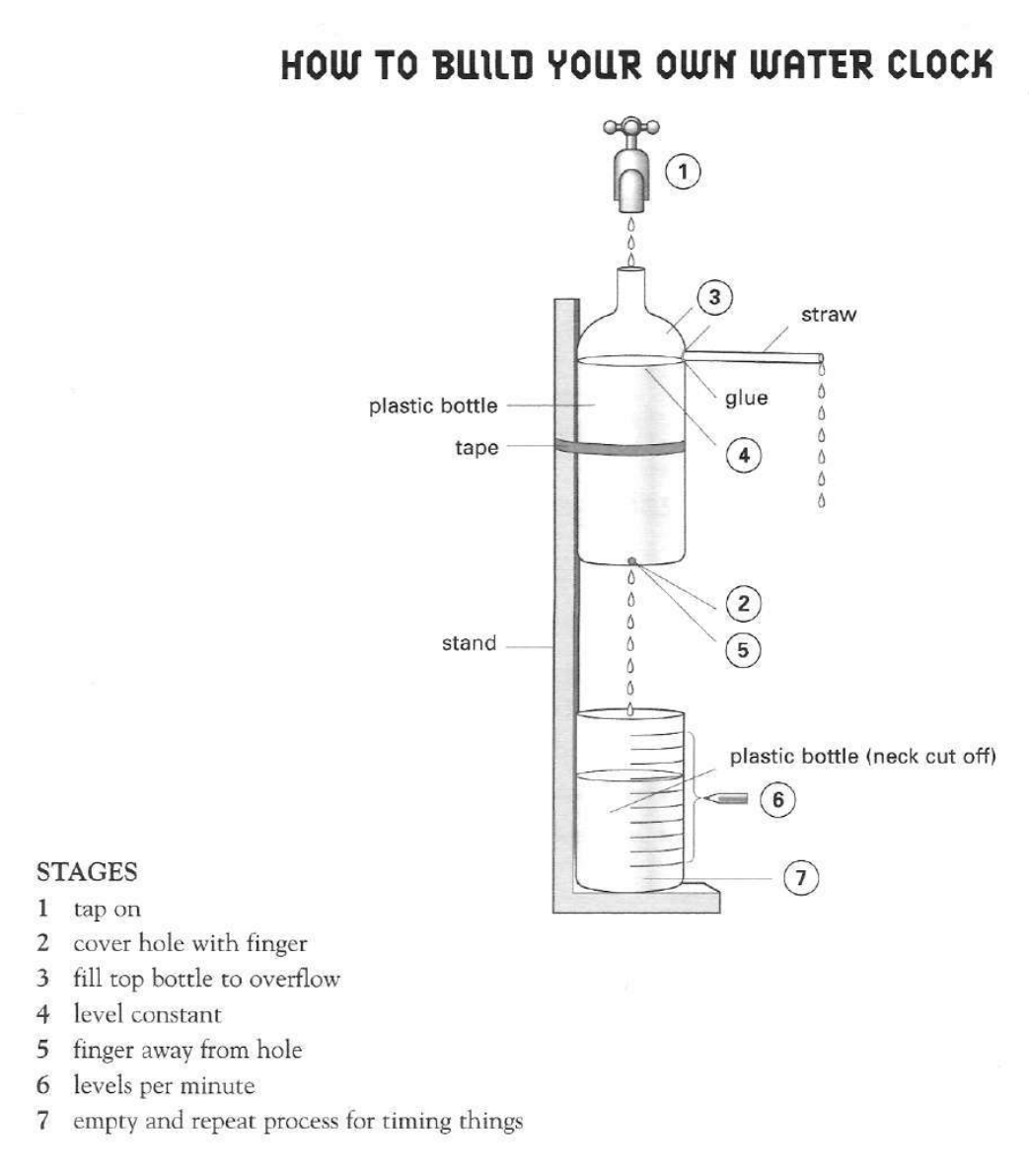
The diagram below shows the process for making a water clock.
Write a report for a university lecturer describing the information below.
HOW TO BUILD YOUR OWN WATER CLOCK
Student answer (Band 5.5)
The diagram illustrate about the procedure of creating water clock by using 7 different kinds of stages.
Initially, there is tap on connect with waterpipe when opne tap on the water flows from that valv into plastic bottle which is tape on the stand. After that, onec it fillout with water the water in bottle goes out from cover hole with finge to another plastic botttle. Then, the water is fill top bottle to overflow there is straw connected on bottle with glue overflow water goes away from that straw and keep the water level is remain flat.
Afterwards, on the bottom plastic bottle there are scale for the mesurement of the level of water per miniute like how much water does it fill it out from the top plastic bottle with the help of finger away from hole. Finally, have to emapy the water from the bottle and repeat the procedure again and again and noteown the different timings.
Overall, it can be observed that this experiement tells how long does it will take to fill out the whole bottle from tiny.
AI examiner evaluation
| Criterion | Band |
|---|---|
| Task Achievement / Task Response | 5.5 |
| Coherence and Cohesion | 6.0 |
| Lexical Resource | 5.0 |
| Grammatical Range and Accuracy | 5.0 |
| Overall | 5.5 |
Task Achievement / Task Response: Band 5.5
You identify the diagram as a sequence for making and using a water clock, and include several relevant details: the tap, upper bottle, straw, lower bottle, water levels and repeating the process. However, some stages are confused or inaccurately described. For example, the water is not poured “from cover hole with finge”; the finger first covers the hole while the upper bottle fills to the overflow, then is removed so water drips into the lower bottle. The final overview, which says the experiment shows how long it takes to fill the whole bottle, also misstates the purpose: the marked levels indicate elapsed time, and the process can be repeated to time activities. A clearer overview and more accurate explanation of the sequence would strengthen the report.
Coherence and Cohesion: Band 6.0
The response has a recognisable structure, moving from the initial setup through later stages and ending with an overall statement. Sequencing expressions such as “Initially,” “After that,” “Afterwards” and “Finally” help the reader follow the process. However, the progression is sometimes difficult to track because several stages are combined in long sentences, and references such as “it,” “that” and “the bottle” do not always make clear which container or action is meant. The overview is placed at the end and does not clearly summarise the process. Use one paragraph for the apparatus and filling, another for measuring and repeating, and make each stage’s subject explicit to improve cohesion.
Lexical Resource: Band 5.0
You use some task-relevant vocabulary, including “tap,” “plastic bottle,” “stand,” “straw,” “overflow” and “scale,” so the reader can identify the main equipment and actions. However, the range is limited and several word choices or forms make the description unclear, such as “cover hole with finge,” “fillout,” “noteown” and “tiny.” There are also spelling errors in “opne,” “botttle,” “mesurement” and “miniute.” Some phrases are imprecise, including “the water level is remain flat” and “different timings.” Build a more accurate process vocabulary and check spelling; for example, use “remove a finger from the hole,” “water level,” and “record elapsed times.”
Grammatical Range and Accuracy: Band 5.0
You attempt both simple and longer sentences, and the sequence is generally expressed through clauses linked with “when,” “once” and “afterwards.” However, complex sentences are often faulty, and errors in verb forms, agreement, articles and sentence construction sometimes make the process hard to understand. For instance, “The diagram illustrate” needs subject–verb agreement, while “the water level is remain flat” combines incompatible verb forms. “Finally, have to emapy the water” also lacks a clear subject. Aim for shorter, complete sentences with a consistent present simple: “The upper bottle is filled until water overflows,” followed by “The finger is then removed.” Check articles and plural forms as you revise.
See this exact question answered at other band scores. The same prompt compared across bands.
Browse more IELTS Writing model answers or get your own writing scored by the same AI examiner.