Band 5.5 IELTS Writing Task 1 Model Answer
Overall Band Score: 5.5 · IELTS Complete Catalyst · 2026-11-20
IELTS Writing Task 1 question
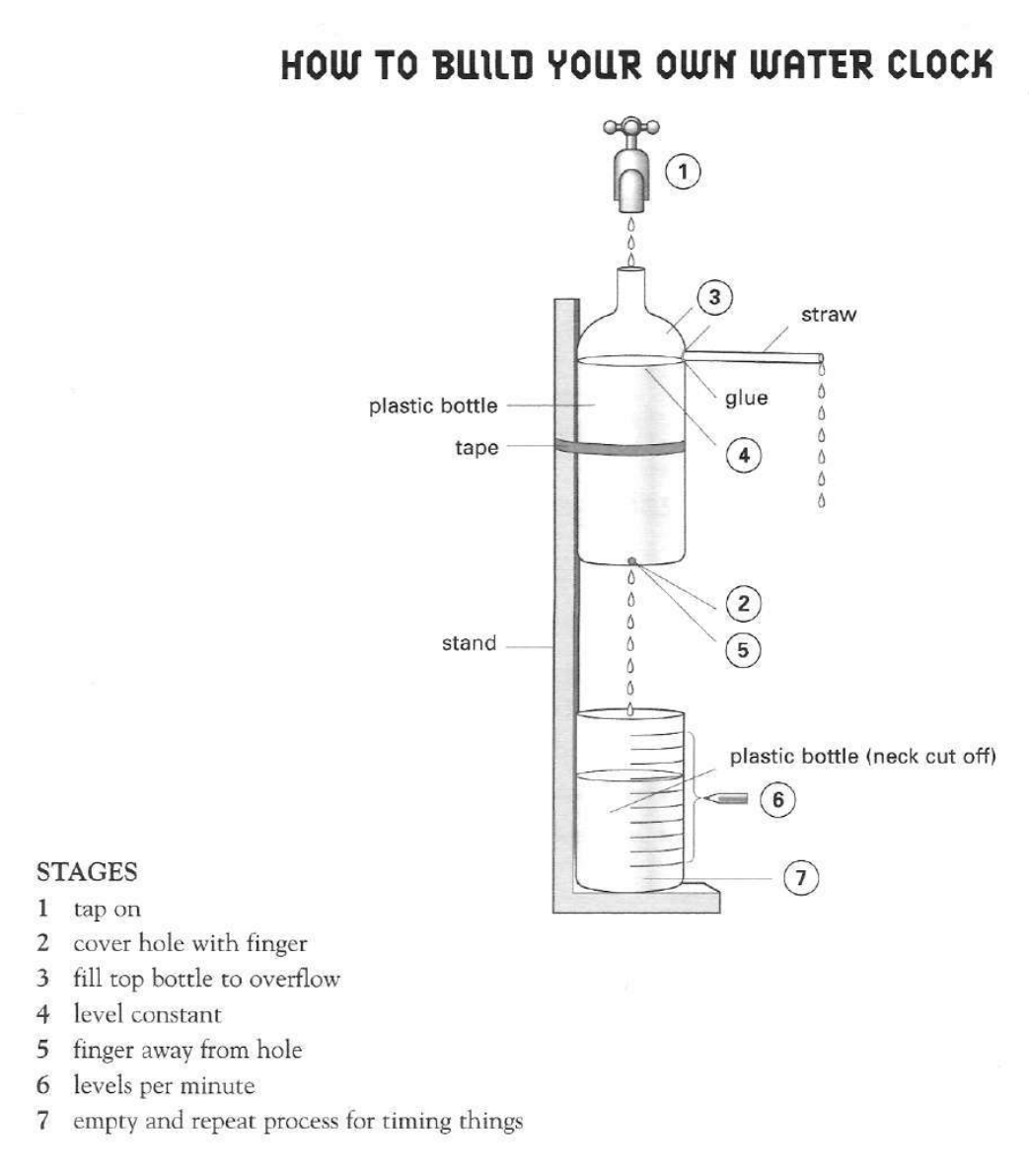
The diagram below shows the process for making a water clock.
Write a report for a university lecturer describing the information below.
HOW TO BUILD YOUR OWN WATER CLOCK
Student answer (Band 5.5)
The diagram illustrates seven steps by which you can build your own water clock.
Overall, making water clock consist of seven stages. Starting with tap on the null and end with empty and repeat it again for timing things. Straw is used to overflow extra water.
The whole process contain seven steps. Null is taped on and water is filled in upper bottle attached with stand with the help of tape. Straw is attached at the top of bottle with glue to flow extra water. This bottle has a hole at the bottom, when fingure is kept away from hole water dropped into the lowest bottle which's neck is cut off.
When water drops count the levels per minute thats are drawn on the lowest bottle. To repeat the process empty the bottle, tap the null, cover hole with fingure, fill the upper bottle and repeat the process for find the timing of different objects.
AI examiner evaluation
| Criterion | Band |
|---|---|
| Task Achievement / Task Response | 6.0 |
| Coherence and Cohesion | 6.0 |
| Lexical Resource | 5.0 |
| Grammatical Range and Accuracy | 5.0 |
| Overall | 5.5 |
Task Achievement / Task Response: Band 6.0
The report identifies the diagram as a seven-stage process and includes the main sequence: turning on the tap, filling the upper bottle, allowing water to pass into the lower bottle, and repeating the procedure to time things. It also notes the straw’s overflow function and the lower bottle’s cut-off neck. However, some stages are compressed or unclear: “level constant” and the purpose of marking levels per minute are not explained precisely, and the calibration lines are mentioned only briefly. The description of the apparatus could also be more systematic, including how the upper bottle is fixed to the stand and how the straw is positioned. Overall, the key process is covered, but some details are less fully developed than others.
Coherence and Cohesion: Band 6.0
The response has a recognisable structure, with an introduction, an overview, and further description of the equipment and sequence. The reader can generally follow the process, and phrases such as “Starting with” and “To repeat the process” help signal order. However, the overview repeats the point that there are seven stages, and the later paragraphs move between construction details and operating instructions without a consistently clear progression. Some references are also difficult to follow, particularly “This bottle” and “the lowest bottle,” while “When water drops count the levels per minute” does not clearly connect the water flow to the calibration marks. Grouping the apparatus description first and then presenting the numbered operating stages would make the progression clearer.
Lexical Resource: Band 5.0
The response uses relevant process vocabulary, including “overflow,” “attached,” “hole,” “levels per minute,” and “repeat the process,” so the main subject is usually understandable. However, the range is limited and several choices are inaccurate or unnatural, such as “tap on the null” and “tap the null,” which obscure the instruction to turn on the tap. “Water dropped” is also an imprecise description of the water’s movement, and “lowest bottle” is less suitable than a clear term such as “lower bottle.” Spelling errors, including “fingure,” further reduce accuracy. Aim for precise process verbs and consistent names for each component; this will make the description more natural and easier to interpret.
Grammatical Range and Accuracy: Band 5.0
There is an attempt to use both simple and more complex sentences, for example, “This bottle has a hole at the bottom, when…” and “To repeat the process…”. However, some sentence structures are incomplete or incorrectly joined. “Overall, making water clock consist of seven stages” lacks a natural grammatical construction, while the comma in “at the bottom, when…” joins clauses that need clearer punctuation or restructuring. There are also errors in articles and agreement, as in “a water clock consist” and “The whole process contain seven steps.” The final sentence has a long sequence of actions without clear grammatical links. Practise accurate subject–verb agreement, articles, and clause boundaries while retaining some complex sentence forms.
See this exact question answered at other band scores. The same prompt compared across bands.
Browse more IELTS Writing model answers or get your own writing scored by the same AI examiner.