Band 6.0 IELTS Writing Task 1 Model Answer
Overall Band Score: 6.0 · IELTS Complete Catalyst · 2026-11-20
IELTS Writing Task 1 question
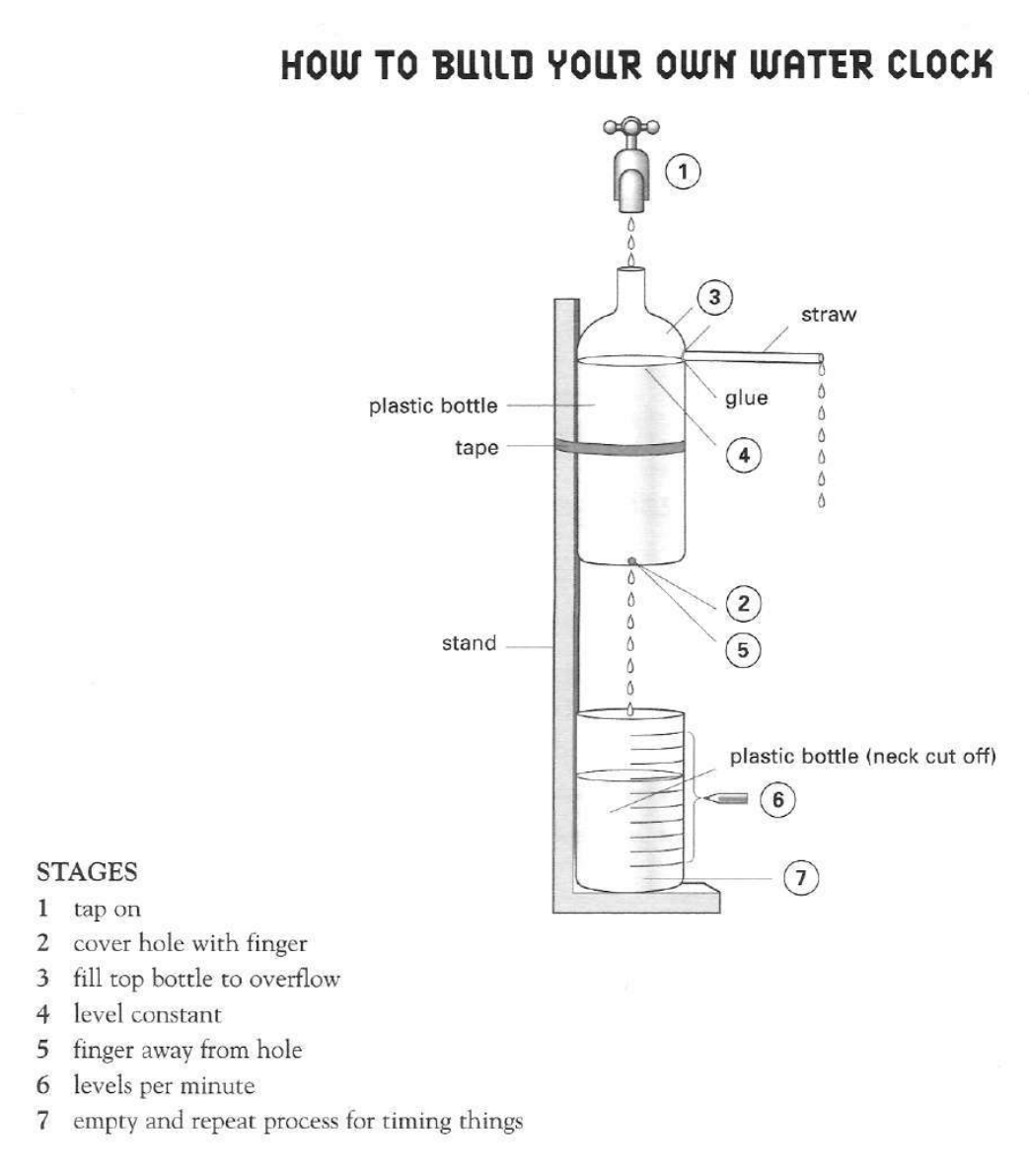
The diagram below shows the process for making a water clock.
Write a report for a university lecturer describing the information below.
HOW TO BUILD YOUR OWN WATER CLOCK
Student answer (Band 6.0)
In order to build a water clock with the help of water and bottles we have to follow the given diagram. According to the seven stages given in points and the numbers labled on the diagram, we have a complete road map to be followed to create a water clock.
First of all we will have 2 water bottles and cut the neck off from one of them. Place them on a stand as demonstrated in image. Turn the water tap on while covering the hole in the bottom of the bottle and wait for it to be filled.
Wait until the water in that bottle starts to overflow, however, you will have to see when the water level becomes contstand after dripping through the straw. Now, move your finger away to uncover the hole in the bottom.
Here, you will see constant drops dripping through that bottom hole that you covered earlier with your finger. This is the time when you will note the readings from the lower bottle with markings every minute. your water clock is ready and now you can empty the bottles and repeat the process to check water levels per minute.
AI examiner evaluation
| Criterion | Band |
|---|---|
| Task Achievement / Task Response | 6.0 |
| Coherence and Cohesion | 6.0 |
| Lexical Resource | 6.0 |
| Grammatical Range and Accuracy | 6.0 |
| Overall | 6.0 |
Task Achievement / Task Response: Band 6.0
The response covers the main sequence, from turning on the tap and filling the upper bottle to uncovering the hole and repeating the process. It also mentions the lower bottle’s markings, so the purpose of the apparatus is partly conveyed. However, some stages are unclear or inaccurately described: the diagram says to cover the hole before filling the upper bottle to overflow, whereas the response combines these actions as “while covering the hole … and wait for it to be filled.” It also does not clearly explain that the straw maintains a constant water level, or that the lower bottle is used to record levels per minute. A more precise overview of how the apparatus works, followed by a clearer account of each stage, would make the description more complete.
Coherence and Cohesion: Band 6.0
The report follows a generally logical order, and sequencing phrases such as “First of all,” “Now,” and “Here” help the reader follow the process. The three paragraphs also separate the setup, operation, and final use to some extent. However, the stages are sometimes compressed together, making the sequence less clear—for example, the filling, overflow, and constant-level steps are all discussed in one paragraph without clearly distinguishing them. “Here” is also a vague transition, and “that bottle” could refer more clearly to the upper bottle. Organising the report into a brief overview and a more carefully staged description, with precise references to the upper and lower bottles, would improve progression and cohesion.
Lexical Resource: Band 6.0
The vocabulary is adequate for describing the process, with relevant terms such as “stand,” “overflow,” “straw,” “hole,” and “markings.” The writer also attempts process language, including “uncover the hole” and “repeat the process.” However, some choices are imprecise or informal for a report: “complete road map” is figurative, “check water levels per minute” does not clearly express the clock’s timing function, and “constant drops” is less accurate than describing a steady flow or rate. There are also spelling errors, including “labled” and “contstand.” Using more exact technical wording and checking spelling would make the description clearer and more appropriate to the task.
Grammatical Range and Accuracy: Band 6.0
The response uses a mix of simple and more complex forms, including the conditional “when the water level becomes…” and the time clause “until the water … starts to overflow.” Most of the process remains understandable, but some grammatical errors and awkward constructions reduce precision. For example, “we have to follow” shifts into “we will have” and “Place them,” creating inconsistent person and instruction style. “Wait until the water … starts to overflow, however, you will have to see…” joins ideas awkwardly, and “your water clock is ready” shifts to a direct address after the earlier first-person narration. Use consistent impersonal instructions or passive forms, and separate linked steps into complete sentences with accurate punctuation.
See this exact question answered at other band scores. The same prompt compared across bands.
Browse more IELTS Writing model answers or get your own writing scored by the same AI examiner.