Band 4.5 IELTS Writing Task 1 Model Answer
Overall Band Score: 4.5 · IELTS Complete Catalyst · 2026-11-20
IELTS Writing Task 1 question
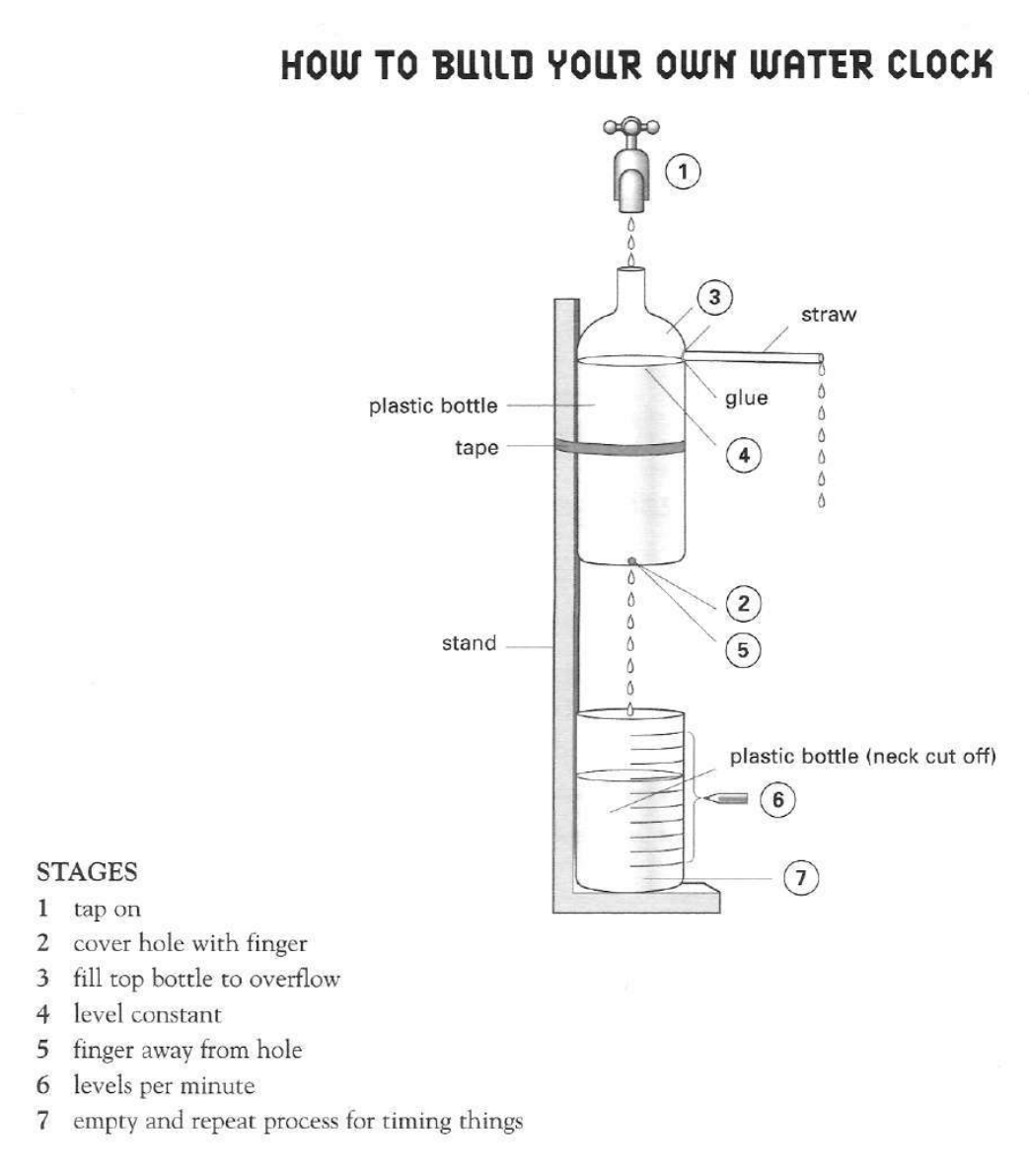
The diagram below shows the process for making a water clock.
Write a report for a university lecturer describing the information below.
HOW TO BUILD YOUR OWN WATER CLOCK
Student answer (Band 4.5)
The diagram illustrate the process for makin a water clock.
In water clock diagram illustrate that, how to build our own water clock. At first we see a stand where water clock. First should do tap on the water clock, then cover the hole with finger on plastic bottle. After that we can fill the top bottle to overflow. There is a straw which lock with glue. In the water bottle middle there is a tape for level constant. After water bottle full of the water then we can undo our finger from hole. Then levels per minute after all of these empty and repeat process for timing things.
Overall
AI examiner evaluation
| Criterion | Band |
|---|---|
| Task Achievement / Task Response | 4.0 |
| Coherence and Cohesion | 5.0 |
| Lexical Resource | 5.0 |
| Grammatical Range and Accuracy | 4.5 |
| Overall | 4.5 |
Task Achievement / Task Response: Band 4.0
You identify the general subject and include several stages, such as covering the hole, filling the upper bottle, releasing the finger, and repeating the process. However, the report responds only minimally to the diagram: it gives little explanation of how the apparatus is assembled or how the clock works, and some details are misread. For example, the straw is described as “lock with glue,” while the tape is incorrectly said to be “for level constant”; the diagram shows tape attaching the upper bottle to the stand, and the water level is kept constant by overflow. The final “Overall” is left blank, so there is no clear summary. The response is also 40 words below the required minimum. Describe the construction and stages accurately, then add a concise overview.
Coherence and Cohesion: Band 5.0
There is a basic sequence, signalled by “At first,” “After that,” and “Then,” and the reader can follow some of the process from filling the bottle to releasing the finger and repeating the timing. However, the response has no effective paragraph structure: the opening repeats the task, the process is compressed into one paragraph, and “Overall” is left unfinished. Connections between ideas are sometimes unclear, particularly in “In the water bottle middle there is a tape for level constant.” The sequence also moves from construction details to operating steps without a clear distinction. Organise the report into an introduction, an overview, and a paragraph describing construction and operation; use linking phrases to show the stages without repeating “then”.
Lexical Resource: Band 5.0
The vocabulary is limited but includes some relevant process terms, such as “stand,” “straw,” “glue,” “overflow,” and “hole.” These help identify parts of the apparatus and actions. However, several inaccurate or awkward choices make details difficult to understand: “lock with glue” does not clearly describe how the straw is attached, and “tape for level constant” confuses the tape with the water-level mechanism. There are also spelling errors, including “makin,” and repeated use of general words such as “water bottle” where the diagram distinguishes upper and lower bottles. Use precise labels and common process collocations, for example “secure the bottle with tape,” “attach the straw with glue,” and “maintain a constant water level.”
Grammatical Range and Accuracy: Band 4.5
The response attempts to connect stages in longer sentences, for example, “After water bottle full of the water then we can undo our finger from hole,” but sentence structures are very limited and errors are frequent. The opening, “The diagram illustrate,” has subject–verb disagreement, while “In water clock diagram illustrate that, how to build our own water clock” is not a complete, well-formed sentence. Articles and prepositions are often missing or misplaced, as in “from hole” and “on plastic bottle,” and the phrase “After water bottle full” lacks a verb. These problems sometimes obscure the intended relationships between steps. Practise accurate simple passive forms such as “The upper bottle is attached to the stand,” then combine them with clear sequencing clauses and check each sentence for a subject and verb.
See this exact question answered at other band scores. The same prompt compared across bands.
Browse more IELTS Writing model answers or get your own writing scored by the same AI examiner.