Band 6.5 IELTS Writing Task 1 Model Answer
Overall Band Score: 6.5 · IELTS Complete Catalyst · 2026-11-20
IELTS Writing Task 1 question
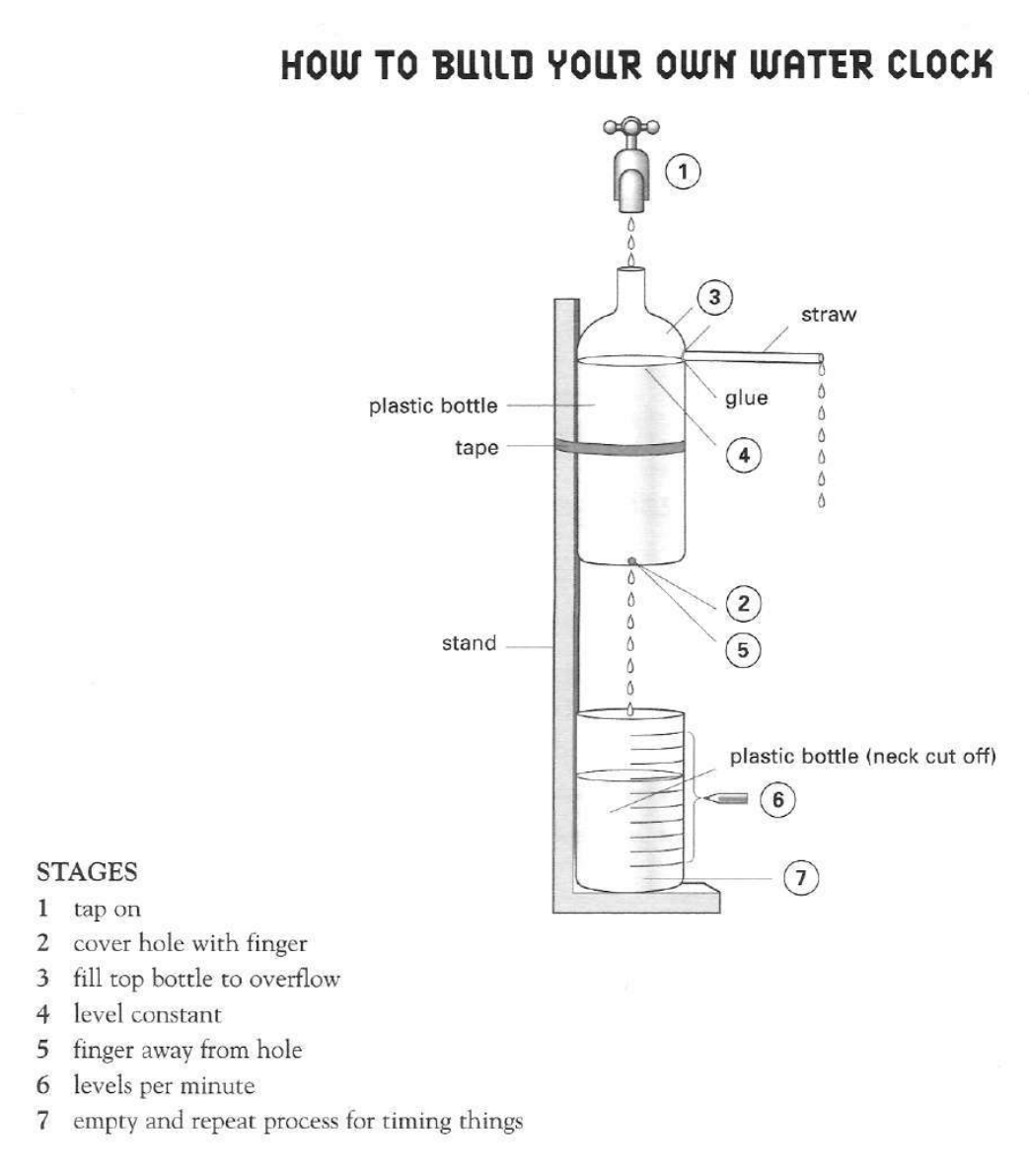
The diagram below shows the process for making a water clock.
Write a report for a university lecturer describing the information below.
HOW TO BUILD YOUR OWN WATER CLOCK
Student answer (Band 6.5)
The diagram below illustrates, how a water clock is made.
Overall, the process of making a water clock is divided into 7 stages.
Firstly, we take a L shape wooden plank, a plastic bottle with a hole at base and a beaker.
The bottle is tied to the upper side of a wooden plank with the tape , and the beaker is put into the bottom of plank.
The tap is then opened and water goes into the bottle. While bottle fills, we cover the hole in the bottle with our finger so water doesn't drops below. A hole on the upper side of the bottle is made and a straw is attached through it with the help of glue, so the extra water overflows through the straw and the water level remains constant.
In 5th step, when the water is filled at certain level and starts overflowing through straw, we remove our finger from the hole below so the water droplets drop into the beaker
We then take a pen and start to make markings on the beaker for levels per minute, so that water continuesly crosses the markings and we will know how many minutes are passing.
Lastly when the beaker is filled completely, we empty it and put it again to repeat the process of measuring time.
AI examiner evaluation
| Criterion | Band |
|---|---|
| Task Achievement / Task Response | 7.0 |
| Coherence and Cohesion | 6.5 |
| Lexical Resource | 6.0 |
| Grammatical Range and Accuracy | 5.5 |
| Overall | 6.5 |
Task Achievement / Task Response: Band 7.0
The report covers the main stages and gives a clear overall summary that the process has seven steps. It accurately describes attaching the upper bottle, controlling the water with a finger, allowing it to flow into the lower container, marking levels, and emptying the container to repeat the timing process. The explanation of the overflow straw and the constant water level also captures an important feature of the apparatus. Some details are less precise: the diagram shows a lower plastic bottle with its neck cut off, rather than a beaker, and the straw is fixed to the side near the top rather than inserted through a newly made upper hole. For greater precision, describe the apparatus and stage sequence exactly as shown, including the tap being turned on and the bottle filling to overflow.
Coherence and Cohesion: Band 6.5
The stages are presented in a generally logical order, and sequencing expressions such as “Firstly,” “In 5th step,” “We then,” and “Lastly” help the reader follow the process. The overview also gives the reader a useful sense of the diagram’s structure. This meets the lower-band expectation of an overall coherent arrangement, while the half-band strength is the clear progression through most of the steps. However, the response is largely one continuous paragraph after the overview, so the stages and the apparatus description are not visually separated. Some links are also mechanical, and the long sentence beginning “While bottle fills” combines several actions. Use separate paragraphs for the overview and process, and group related actions with clearer transitions to make the progression easier to scan.
Lexical Resource: Band 6.0
You use an adequate range of process vocabulary, including “attached,” “overflows,” “water level,” “markings,” and “repeat the process.” These choices make the main procedure understandable, and some terms are relevant to describing how the clock works. However, several expressions are imprecise or informal for an academic process report: “beaker” does not match the labelled lower plastic bottle, “tied” is not the best description of fixing it with tape, and “water droplets drop” is repetitive. There are also spelling and word-form slips, such as “continuesly.” Aim for more exact equipment names and concise technical phrasing, for example “water flows into the lower container” rather than repeating “water” and “drop.”
Grammatical Range and Accuracy: Band 5.5
The response attempts a mix of simple and complex sentences, including a time clause (“While bottle fills”) and a purpose clause (“so that water continuesly crosses the markings”). The sequence is generally understandable, but some grammatical errors remain across the response. Examples include the unnecessary comma in “illustrates, how,” missing articles in “While bottle fills” and “at certain level,” and the agreement error in “water doesn't drops.” The sentence beginning “In 5th step” also lacks an article before the ordinal, while “we will know” shifts tense within a description otherwise written in the present. Review articles, subject–verb agreement, and consistent present-tense forms, and punctuate introductory clauses carefully.
See this exact question answered at other band scores. The same prompt compared across bands.
Browse more IELTS Writing model answers or get your own writing scored by the same AI examiner.