Band 6.0 IELTS Writing Task 1 Model Answer
Overall Band Score: 6.0 · IELTS Complete Catalyst · 2026-11-21
IELTS Writing Task 1 question
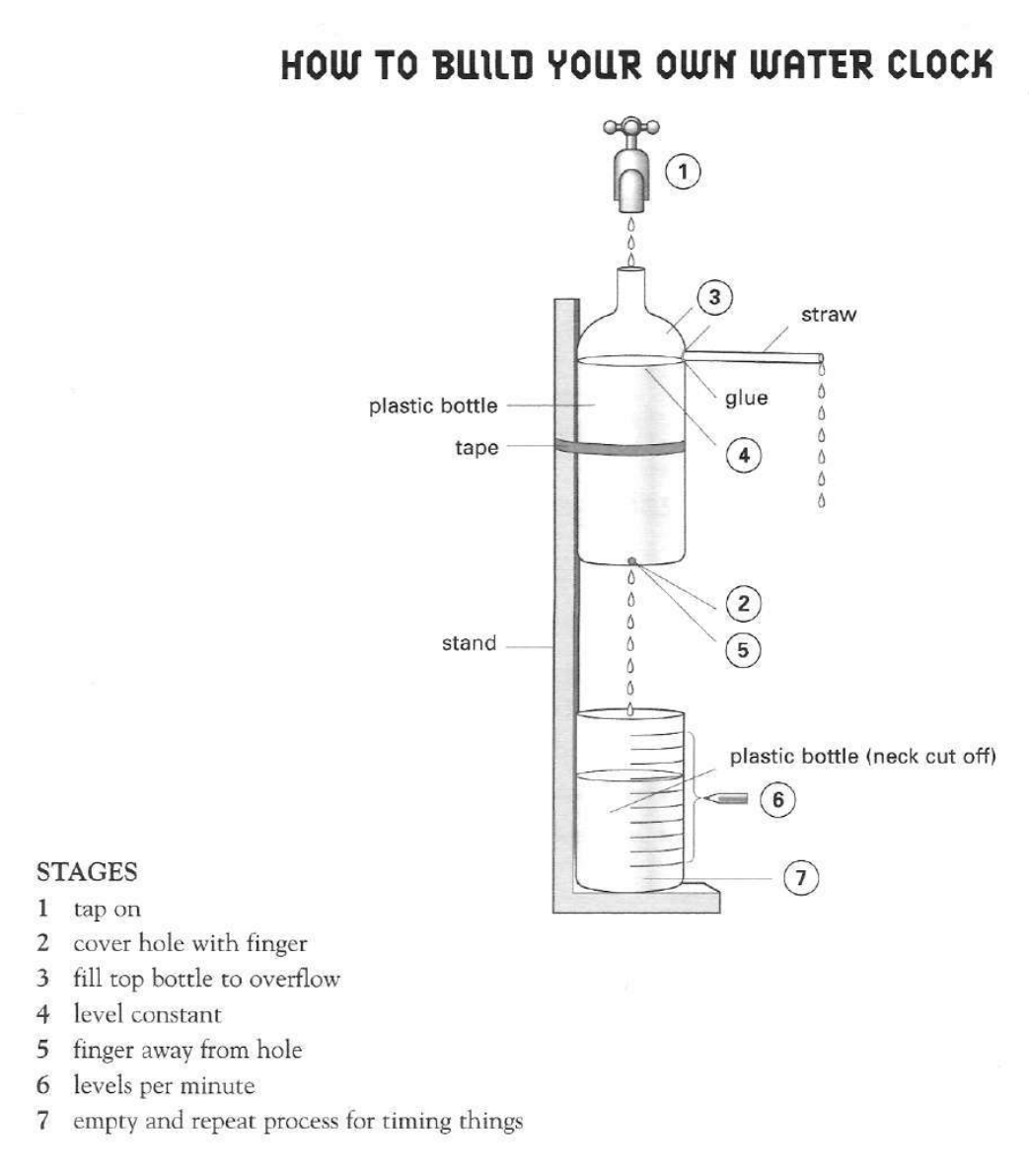
The diagram below shows the process for making a water clock.
Write a report for a university lecturer describing the information below.
HOW TO BUILD YOUR OWN WATER CLOCK
Student answer (Band 6.0)
The given diagram illustrates the procedure of how to build your own water clock.
The process consists of seven different stages with the help of a plastic bottle, straw, glue, tape, stand and a neck piece of a plastic bottle. The process initiates by turning on the water tap and concludes by filling up the cut off neck piece with water by levels per minute. Additionally, this is a man-made phenomenon.
Firstly, the process starts by turning on the water tap, while covering the hole with one finger beneath the plastic bottle. Fill the top bottle to overflow. A straw is placed on the top of the bottle to maintain water levels.
After keeping the water level constant, move the finger away from the hole. The hole will release water drop by drop, filling up the cut off piece of the bottle per minute. This process is forming a water clock. Afterwards, the setup can be reset by emptying both the bottles and the process can be repeated for further timings.
AI examiner evaluation
| Criterion | Band |
|---|---|
| Task Achievement / Task Response | 5.5 |
| Coherence and Cohesion | 6.5 |
| Lexical Resource | 5.5 |
| Grammatical Range and Accuracy | 6.0 |
| Overall | 6.0 |
Task Achievement / Task Response: Band 5.5
You identify the diagram as a seven-stage process and describe its main sequence, including starting the tap, controlling the hole, allowing water to flow, and repeating the timing process. However, some important details are incomplete or inaccurate. The straw is fixed near the top of the upper bottle as an overflow drain, not placed “on the top” to maintain water levels. The lower bottle is used to mark elapsed time, but the claim that it is filled “per minute” is unclear; the diagram says the water levels are marked per minute. The overview also says the process concludes by filling the cut-off piece, whereas the final stage is to empty and repeat. A clearer, accurate overview and fuller explanation of the apparatus would strengthen coverage.
Coherence and Cohesion: Band 6.5
The report has a clear overall arrangement: an introduction and overview are followed by stages in sequence, with “Firstly,” “After,” and “Afterwards” helping the reader follow the process. Paragraphing is appropriate, and the main progression is easy to understand. Some links and references are less precise, however. “After keeping the water level constant” does not clearly explain that the bottle is filled until water overflows, and “This process” could refer either to the dripping or the whole setup. The overview also says the process concludes with filling the lower container, which conflicts with the later statement that it is emptied and repeated. More exact sequencing and clearer references would make the cohesion more consistently effective.
Lexical Resource: Band 5.5
You use a relevant range of process vocabulary, including “procedure,” “stages,” “overflow,” “maintain,” and “reset,” and the reader can generally understand the equipment and actions. However, several choices are imprecise or unnatural for describing this diagram. “Neck piece” and “cut off piece” do not clearly name the lower bottle, while “filling up … per minute” confuses the water collecting with the marked levels. “Man-made phenomenon” is also an unnecessary and awkward description of a constructed device. Aim for precise technical phrases such as “lower bottle with its neck removed,” “water drips into the container,” and “mark the water level at one-minute intervals.” This would improve accuracy and reduce repetition of “process” and “bottle.”
Grammatical Range and Accuracy: Band 6.0
You use a mix of simple and more complex forms, and most sentences communicate the intended sequence. For example, “After keeping the water level constant, move the finger away from the hole” uses a time clause effectively, while “The hole will release water drop by drop” is structurally clear. Some grammatical issues remain. “The process is forming a water clock” uses an awkward progressive construction for a general process; “This process forms a water clock” is more suitable. The overview’s “concludes by filling up the cut off neck piece” is also difficult to interpret, and “while covering the hole with one finger beneath the plastic bottle” leaves the relationship between the finger and bottle unclear. More consistent passive forms and carefully structured descriptions of each action would improve control.
See this exact question answered at other band scores. The same prompt compared across bands.
Browse more IELTS Writing model answers or get your own writing scored by the same AI examiner.