Band 5.0 IELTS Writing Task 1 Model Answer
Overall Band Score: 5.0 · IELTS Complete Catalyst · 2026-11-21
IELTS Writing Task 1 question
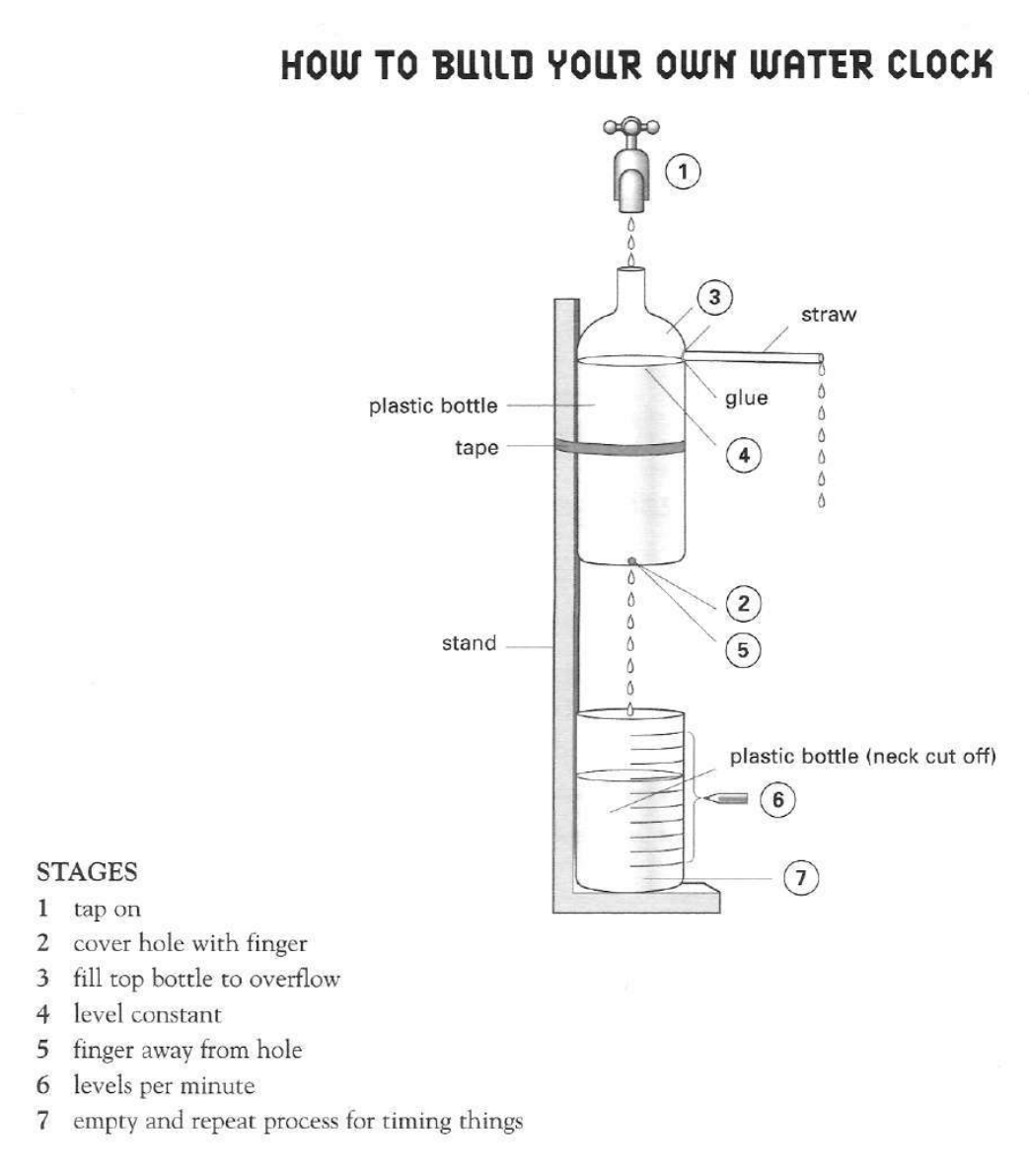
The diagram below shows the process for making a water clock.
Write a report for a university lecturer describing the information below.
HOW TO BUILD YOUR OWN WATER CLOCK
Student answer (Band 5.0)
The diagram illustrate and describe the process you must apply and follow in order to build a functioning water clock.
Overall the building process must start with A really necessary step which is turning on the water tap and do certains must-do steps using water, your finger and important tools to make the clock water working well and giving exact time.
Tthe first thing to do is turn on the water tap so the water is able to stream and start filling the plastic bottle which is already on top mounted on a vertical stand , after you already covered the hole on the bottom of the bottle using your own finger you should wait and watch carefully until it is filled to a constant level marked just before the straw exit
then take your finger away from the hole you cover previously and keep watching the level of the water increasing in the neckless bottle by time to a certain level per minute however to measure the time again you must empty the bottle and repeat the previous steps .
AI examiner evaluation
| Criterion | Band |
|---|---|
| Task Achievement / Task Response | 5.0 |
| Coherence and Cohesion | 5.5 |
| Lexical Resource | 5.0 |
| Grammatical Range and Accuracy | 5.0 |
| Overall | 5.0 |
Task Achievement / Task Response: Band 5.0
You identify the diagram as a process and include its main sequence: turning on the tap, covering the hole, filling the upper bottle, releasing the water, observing the lower bottle, and repeating the process. However, the description only partially covers how the apparatus is built. It omits key construction details, including attaching the upper bottle to the stand, fixing the straw with glue, and using tape; it also does not explain that the lower bottle has its neck cut off or that lines are marked on it. Some details are unclear or inaccurate: the water level is described as “increasing” in the lower bottle, whereas the diagram indicates levels are marked per minute. A fuller account of both construction and operation, with a clear overview, would make the report more complete.
Coherence and Cohesion: Band 5.5
The response follows the general order of the process, and expressions such as “The first thing to do” and “then” help the reader follow the sequence. The opening overview also signals that the diagram describes a series of steps. However, the report is presented as one long paragraph, and the progression from building the apparatus to operating it is not clearly separated. Several ideas are crowded into the final sentence, making the sequence harder to track. References such as “the hole you cover previously” are understandable but awkward, while “however” does not clearly connect the measurement and resetting steps. Use separate paragraphs for the overview and stages, and link each action with precise sequencing and reference.
Lexical Resource: Band 5.0
You use some relevant process vocabulary, including “vertical stand,” “plastic bottle,” “water tap,” and “constant level,” so the reader can identify the main equipment and actions. However, the range is limited and several phrases are inaccurate or unnatural for a diagram report. “Build a functioning water clock” and “make the clock water working well” are awkward, while “neckless bottle” does not accurately name the lower container. “Certain level per minute” is also imprecise for the marked levels. Spelling and word-form slips such as “Tthe,” “certains,” and “previously” in this context reduce control. Choose standard technical terms and concise process verbs, such as “attach,” “mark,” “drip,” and “measure,” to describe the apparatus more precisely.
Grammatical Range and Accuracy: Band 5.0
The response attempts longer sentences with subordinate clauses, for example, “after you already covered the hole … you should wait,” and uses sequencing phrases to connect actions. However, complex sentences are often faulty or difficult to follow, and there are frequent errors in agreement, articles, verb forms, and punctuation. The opening “The diagram illustrate and describe” has subject–verb agreement errors; “A really necessary step” uses an awkward article and capitalisation, and “after you already covered” needs a more suitable tense construction. The final sentence runs several actions together without clear punctuation. Use shorter, controlled sentences and check agreement and tense, for example: “Cover the hole with a finger, then fill the upper bottle until water reaches the straw.”
See this exact question answered at other band scores. The same prompt compared across bands.
Browse more IELTS Writing model answers or get your own writing scored by the same AI examiner.