Band 5.5 IELTS Writing Task 1 Model Answer
Overall Band Score: 5.5 · IELTS Complete Catalyst · 2026-11-21
IELTS Writing Task 1 question
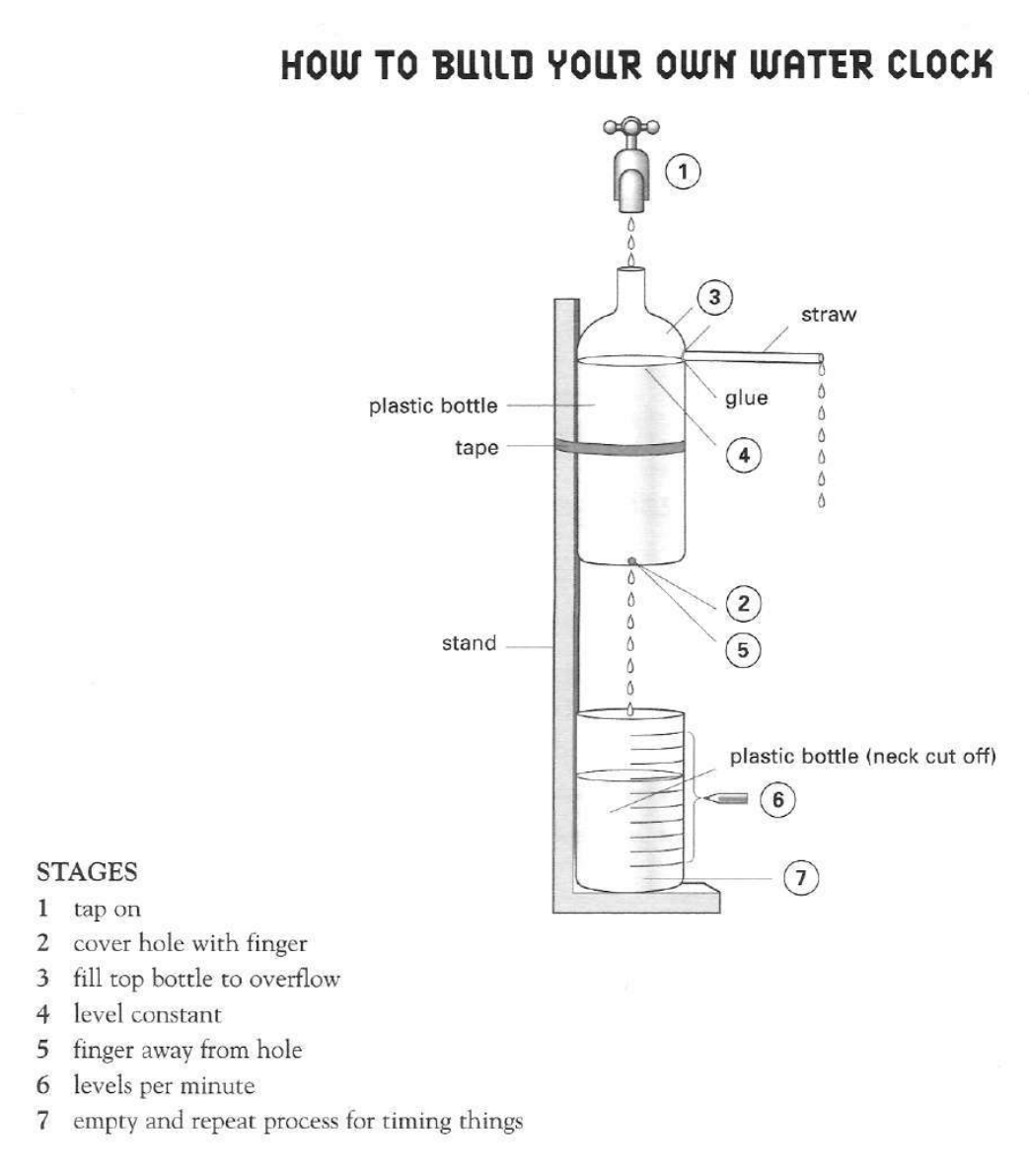
The diagram below shows the process for making a water clock.
Write a report for a university lecturer describing the information below.
HOW TO BUILD YOUR OWN WATER CLOCK
Student answer (Band 5.5)
The diagram illustrates the different steps and stages involved in the mechanism of formation and measurement of time by building a water clock.
The overall procedure includes a water tap that acts as the provider for initial source, water. Furthermore, two plastic water bottles are used in the experiment. One is attached on a stand with two holes and other has it's neck cut off with measurements marked. The second bottle is used for measurement of time.
Water drips down into the opening of the bottle, next to which a straw is glued on the first hole. The plastic bottle is attached through a tape on stand. The second hole of bottle is covered by the finger until the bottle is completely filled with water to start dripping from the straw.
After the water level reaches its constant level, the finger is then moved away causing the water droplets to enter the second plastic bottle placed just beneath the first one. The readings marked on the second bottle tell the timings. This whole process is repeated again after emptying the second bottle.
AI examiner evaluation
| Criterion | Band |
|---|---|
| Task Achievement / Task Response | 5.5 |
| Coherence and Cohesion | 6.0 |
| Lexical Resource | 5.5 |
| Grammatical Range and Accuracy | 5.5 |
| Overall | 5.5 |
Task Achievement / Task Response: Band 5.5
You describe the main sequence from filling the upper bottle to allowing water to drip into the lower one, and you mention that the marked readings indicate time and that the process is repeated. However, some important details are inaccurate or unclear: the straw is an overflow outlet, not a hole through which water drips into the lower bottle, and the finger covers the hole at the base rather than a “second hole.” The overview also focuses on the tap and bottles without clearly summarising how the apparatus measures time. To strengthen the report, explain that the upper bottle is filled until water reaches the straw’s level, then the flow through the base hole is timed against the calibration marks on the lower bottle.
Coherence and Cohesion: Band 6.0
The response is arranged in a generally logical order: an introduction, a description of the equipment, and then the operating sequence. Connectors such as “Furthermore,” “After,” and “then” help the reader follow the process. However, some links are mechanical, and references are occasionally unclear. For example, “the second hole of bottle” is difficult to identify, while “the first hole” and “the straw” are used in a way that blurs their different functions. The paragraph about the apparatus also mixes construction details with the measurement purpose. Grouping the equipment and setup together, then describing the numbered stages in order, would make progression clearer and improve cohesion.
Lexical Resource: Band 5.5
You use relevant process vocabulary, including “attached,” “glued,” “drips,” “constant level,” and “repeated,” so the reader can understand the general procedure. There is also some attempt at more formal phrasing, such as “mechanism of formation and measurement of time,” but this is awkward and less precise than the task requires. Several choices are inaccurate or unnatural: “provider for initial source” is redundant, “readings” is vague for the calibration marks, and “timings” is not the natural term for the measured intervals. Use concise, conventional process language and distinguish the straw’s overflow function from the base hole’s dripping function. More precise vocabulary would make the description clearer without requiring unnecessarily elaborate wording.
Grammatical Range and Accuracy: Band 5.5
You use a mixture of simple and complex sentences, including time clauses such as “until the bottle is completely filled” and a participial construction in “causing the water droplets to enter.” Most of the sequence remains understandable, but some grammatical errors and awkward constructions reduce accuracy. For example, “One is attached on a stand … and other has it's neck cut off” needs clearer article use and parallel structure; “it's” should be the possessive “its.” In “The plastic bottle is attached through a tape on stand,” the article and preposition pattern are faulty. Review articles, possessives, and prepositions, and keep sentence structures controlled when describing each stage. This would make your range more consistently accurate.
See this exact question answered at other band scores. The same prompt compared across bands.
Browse more IELTS Writing model answers or get your own writing scored by the same AI examiner.