Band 5.5 IELTS Writing Task 1 Model Answer
Overall Band Score: 5.5 · IELTS Complete Catalyst · 2026-11-21
IELTS Writing Task 1 question
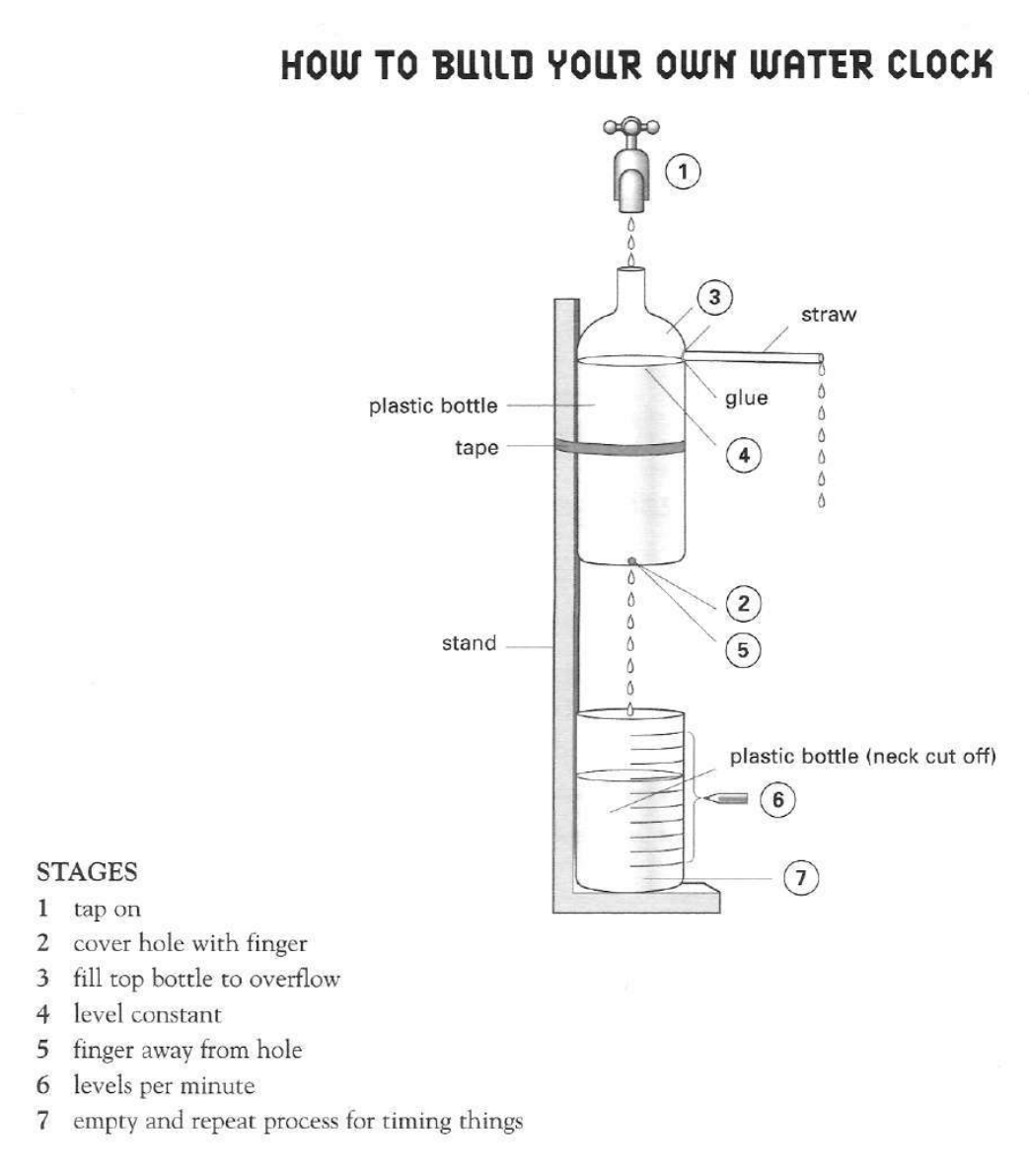
The diagram below shows the process for making a water clock.
Write a report for a university lecturer describing the information below.
HOW TO BUILD YOUR OWN WATER CLOCK
Student answer (Band 5.5)
The diagram illustrates how the water clock is manufacture through various steps. The development step is summarised in 7 steps.
The process starts with the opening up the tap so as the water goes into the plastic bottle. The bottle consists of a small hole at the bottom through where the water leaks and goes to another plastic bottle whose neck is cut off. Intially the plastic bottle with hole is completely let filled with the hole covered with finger. A straw is attached to the top of the bottle to level the water.
After the bottle is filled, the finger is taken away from the hole which causes the constant leaking of the water drops into another plastic bottle. This plastic bottle is leveled for each minutes to calculate the time. The bottle is emptied and the process is repeated after the water reaches the defined level. In this way the water clock works.
AI examiner evaluation
| Criterion | Band |
|---|---|
| Task Achievement / Task Response | 5.5 |
| Coherence and Cohesion | 6.0 |
| Lexical Resource | 5.5 |
| Grammatical Range and Accuracy | 5.5 |
| Overall | 5.5 |
Task Achievement / Task Response: Band 5.5
You describe the main sequence, from turning on the tap and filling the upper bottle to releasing the water, marking the lower bottle and repeating the process. This gives the reader a relevant account of how the clock operates. However, some important details are unclear or inaccurate: the straw is described as being “to level the water,” whereas it acts as an overflow drain, and the response does not explain that the upper bottle is fixed to a stand or that the lower bottle is calibrated as water collects. The overview is also limited; a clearer summary of the apparatus and its purpose would help. Develop these features more precisely and distinguish the filling stage from the steady dripping and timing stages.
Coherence and Cohesion: Band 6.0
The response has a coherent overall arrangement: it introduces the diagram, then describes the initial setup and filling before moving to the dripping and repeated timing process. Phrases such as “The process starts” and “After the bottle is filled” help signal sequence, and the paragraph break broadly separates stages. Some links and references are less clear, however. For example, “This plastic bottle” could refer to either container, and “the bottle” in the filling description is not consistently identified as the upper one. The sequence would be easier to follow if each stage were linked explicitly and the two bottles were named consistently. A brief overview before the detailed stages would also strengthen the progression.
Lexical Resource: Band 5.5
You use relevant process vocabulary, including “tap,” “plastic bottle,” “straw,” “hole,” “finger,” and “water drops,” so the basic procedure is understandable. There are also attempts at more formal wording, such as “illustrates” and “calculate the time.” However, several choices are inaccurate or awkward: “manufacture” does not fit the construction process here, “development step” is unnatural, and “the straw … to level the water” misrepresents its function. Spelling errors such as “Intially” and imprecise phrases such as “constant leaking” also reduce control. Aim for precise process terms and natural collocations, for example, “overflow pipe,” “water flows,” and “marking intervals.”
Grammatical Range and Accuracy: Band 5.5
You attempt both simple and more complex sentence forms, including a relative clause in “another plastic bottle whose neck is cut off” and a cause-and-effect clause beginning “which causes.” The overall meaning is generally recoverable, but some errors affect accuracy and fluency. Examples include “is manufacture,” “The development step is summarised in 7 steps,” and “the plastic bottle … is completely let filled,” where verb forms and sentence construction are faulty. The phrase “After the bottle is filled, the finger is taken away” is clearer, though the passive construction is not consistently controlled elsewhere. Practise accurate passive forms for describing processes and check articles, verb forms and sentence boundaries when revising.
See this exact question answered at other band scores. The same prompt compared across bands.
Browse more IELTS Writing model answers or get your own writing scored by the same AI examiner.