Band 5.5 IELTS Writing Task 1 Model Answer
Overall Band Score: 5.5 · IELTS Complete Catalyst · 2026-11-22
IELTS Writing Task 1 question
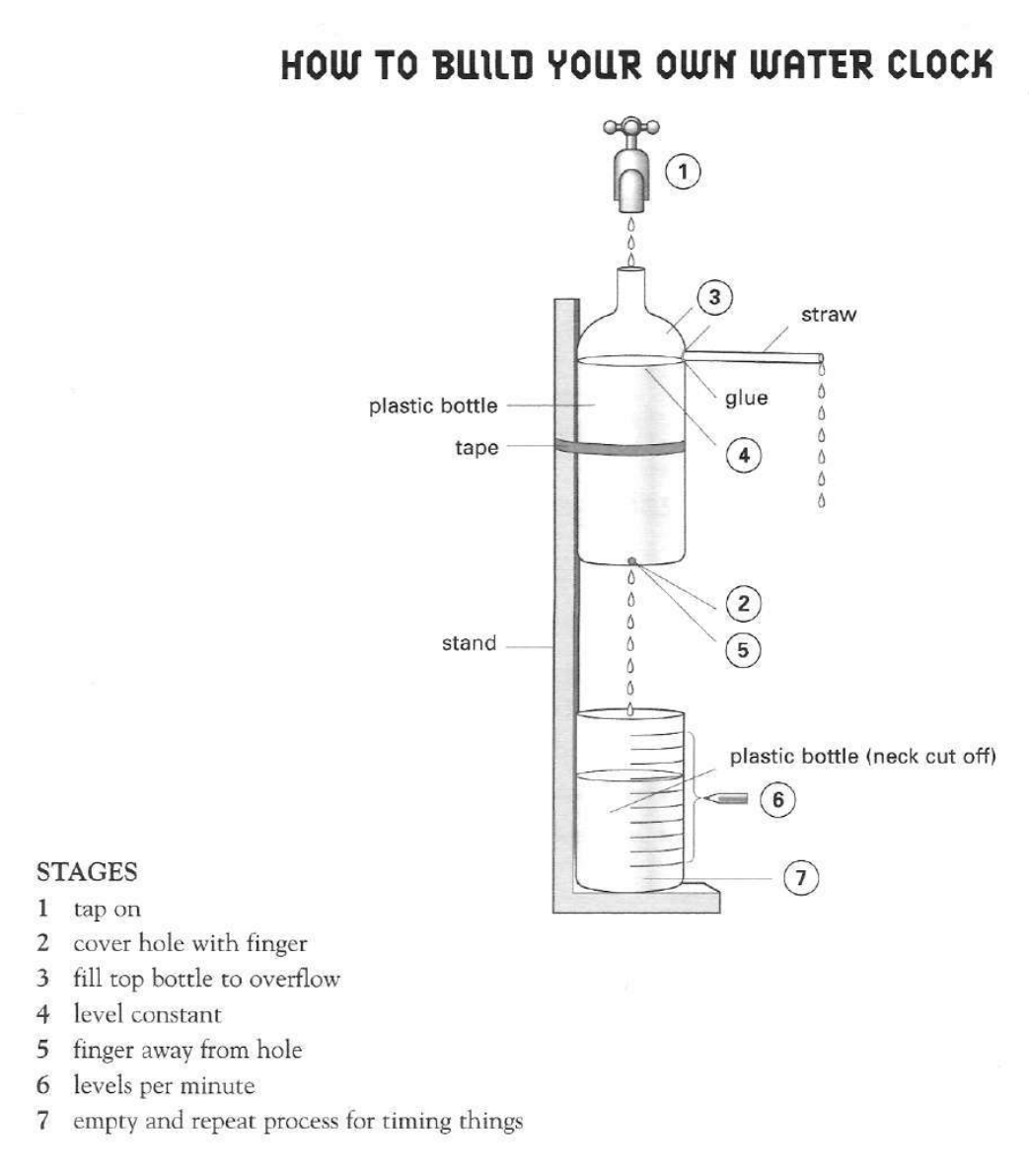
The diagram below shows the process for making a water clock.
Write a report for a university lecturer describing the information below.
HOW TO BUILD YOUR OWN WATER CLOCK
Student answer (Band 5.5)
The Digram illustrate the methods involved in developing a water clock. There are total seven stages involved in process of making a water clock.
First of all, the tap opened to start pouring water into plastic bottle, which was attached to stand with tape. Next cover hole below plastic bottle with finger till it completly filled up. An straw is also attached to the top of bottle with glue. After filling bottle with water it will start overflowing and came to the level of the straw. When water reached at the level of the straw, then get off finger from the hole and allow water to start dripping off into plastic bottle (neck cut-off) placed to the stand below. Plastict bottle below had marked levels when water filled in bottle and single level marked will indicates the .levels per minute. In last, empty the neck cutted bottle and repeat the overall process for knowing the time.
AI examiner evaluation
| Criterion | Band |
|---|---|
| Task Achievement / Task Response | 5.5 |
| Coherence and Cohesion | 6.0 |
| Lexical Resource | 5.5 |
| Grammatical Range and Accuracy | 5.0 |
| Overall | 5.5 |
Task Achievement / Task Response: Band 5.5
You identify the process as having seven stages and describe its main sequence: starting the tap, filling the upper bottle, releasing the water, and repeating the process to measure time. You also include relevant construction details, such as the straw, stand and lower bottle. However, some important information is unclear or incomplete. For example, the diagram says to cover the hole while the upper bottle is filled to overflow; your wording makes it sound as though the bottle is filled only after covering the hole, and the purpose of the straw as an overflow outlet is not clearly explained. The calibration marks and the “levels per minute” stage are also described imprecisely. A clearer overview and more exact explanation of how the stages work would strengthen the report.
Coherence and Cohesion: Band 6.0
The response follows the general order of the diagram, and sequencing phrases such as “First of all,” “Next,” “After filling,” and “In last” help the reader follow the process. The information is broadly arranged from construction and filling to timing and repetition. However, the account is presented as one paragraph, and some links between actions are unclear. For instance, the sentence beginning “After filling bottle with water” does not clearly distinguish the overflow stage from removing the finger and allowing water to drip. The transition from describing the lower bottle to explaining its markings is also abrupt. Grouping the setup and operating stages separately, and using more precise references to the bottles and water, would make the progression easier to follow.
Lexical Resource: Band 5.5
You use a relevant range of process vocabulary, including “attached,” “overflowing,” “dripping,” and “marked levels,” which helps communicate the main actions. Some terms are also specific to the diagram, such as “stand” and “straw.” However, several word choices and collocations are inaccurate or awkward, including “developing a water clock,” “get off finger,” and “knowing the time.” Spelling and word-form errors such as “Digram,” “completly,” and “cutted” are noticeable, and “plastic bottle” is repeated frequently without always making clear which bottle is meant. Choose standard process-report expressions and use “upper bottle” and “lower bottle” consistently to improve precision and readability.
Grammatical Range and Accuracy: Band 5.0
You attempt to connect stages using longer sentences, for example, “When water reached at the level of the straw, then get off finger from the hole,” and you use some passive constructions such as “was attached to stand.” However, the range of sentence structures is limited, and errors occur frequently enough to make parts of the process difficult to interpret. Examples include missing articles in “the tap opened” and “attached to stand,” inconsistent verb forms in “it will start overflowing and came,” and the incomplete ending “will indicates the .levels per minute.” Several sentences also lack clear subjects or use tense inconsistently. Practise forming accurate passive instructions and sequencing clauses, such as “Once the bottle is full, remove your finger from the hole.”
See this exact question answered at other band scores. The same prompt compared across bands.
Browse more IELTS Writing model answers or get your own writing scored by the same AI examiner.