Band 5.5 IELTS Writing Task 1 Model Answer
Overall Band Score: 5.5 · IELTS Complete Catalyst · 2026-11-22
IELTS Writing Task 1 question
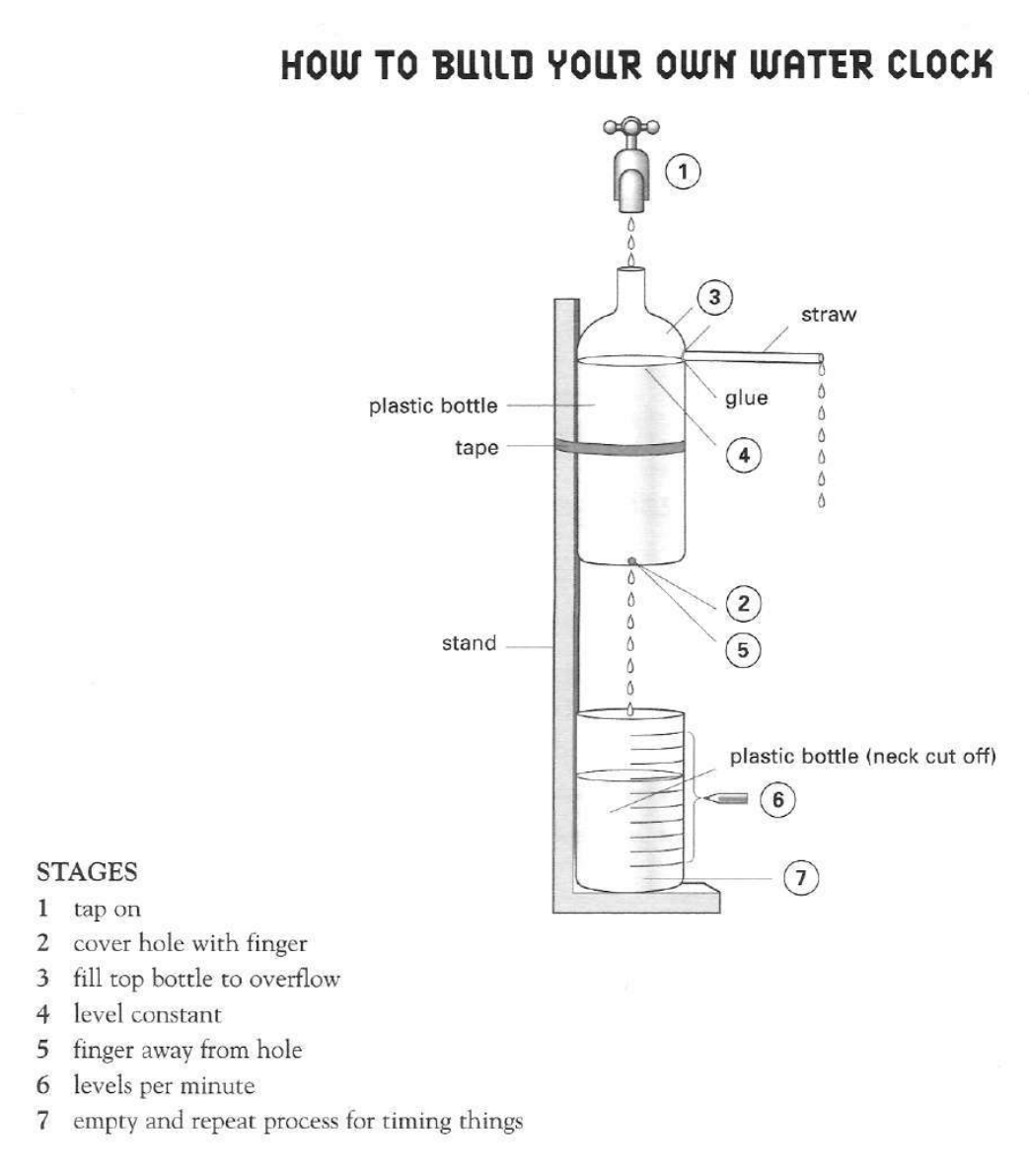
The diagram below shows the process for making a water clock.
Write a report for a university lecturer describing the information below.
HOW TO BUILD YOUR OWN WATER CLOCK
Student answer (Band 5.5)
The picture demonstrate the process for making a water clock, the whole process includes a plastic bottle taped with a stand, a straw attached to the bottles neck, and another bottle with its neck being cut off placed under the taped bottle
firstly we need to turn on the tap for the water flow to fill up the bottle, then we have to cover the small hole placed at the very bottom of the plastic bottle, after that we will remove our finger so water starts leaking drop by drop, wait till it reaches the constant level till the tape, then all we have to do it recorT the level per minute drop by drop. then again empty the bottle repeat the whole process all over again to record the timings
AI examiner evaluation
| Criterion | Band |
|---|---|
| Task Achievement / Task Response | 5.0 |
| Coherence and Cohesion | 5.5 |
| Lexical Resource | 5.5 |
| Grammatical Range and Accuracy | 5.0 |
| Overall | 5.5 |
Task Achievement / Task Response: Band 5.0
You identify the main apparatus and give a broadly relevant account of the sequence, including turning on the tap, covering the hole, releasing the water and repeating the process. However, the report only partially covers the diagram: it does not explain that the upper bottle is filled until water overflows through the straw, or that this establishes a constant water level before timing begins. The description of recording “the level per minute drop by drop” is unclear and does not accurately explain the marked levels on the lower bottle. The response is also 19 words below the required minimum, which limits the detail provided. To improve, include a clear overview and describe the stages and equipment more precisely.
Coherence and Cohesion: Band 5.5
The stages are presented in a generally sensible order, and sequencing expressions such as “firstly,” “then” and “after that” help the reader follow the process. The response also moves from describing the equipment to explaining how it is used. However, nearly all the information is compressed into one long paragraph, with limited punctuation and no clear separation between the construction and operating stages. The repeated use of “then” and “after that” makes the linking somewhat mechanical, while the relationship between waiting for a constant level and recording measurements is difficult to follow. Use separate paragraphs for the apparatus and the procedure, and make each stage a clear sentence linked by varied, accurate transitions.
Lexical Resource: Band 5.5
You use relevant vocabulary for the diagram, including “plastic bottle,” “straw,” “tap,” “hole” and “constant level,” so the basic subject is clear. There is some attempt to describe the process with phrases such as “water starts leaking drop by drop.” However, the range is limited, and several choices are imprecise or awkward: “bottles neck” does not clearly identify which bottle, “taped bottle” is vague, and “record the timings” does not specify what is being measured. The spelling error “recorT” also detracts from accuracy. Choose more precise process vocabulary, such as “upper bottle,” “overflow straw,” “water drips,” and “mark the water level,” and check spelling before submitting.
Grammatical Range and Accuracy: Band 5.0
The response attempts to connect stages using longer sentences, for example, “firstly we need to turn on the tap … then we have to cover the small hole,” but control of these structures is inconsistent. The opening sentence has subject–verb disagreement (“picture demonstrate”), and several sentences run together without appropriate full stops or capital letters. There are also errors in verb forms and sentence construction, as in “all we have to do it recorT” and “wait till it reaches the constant level till the tape.” These problems sometimes make the sequence hard to interpret. Practise writing one complete sentence for each stage, checking agreement and verb forms, and use full stops to separate instructions.
See this exact question answered at other band scores. The same prompt compared across bands.
Browse more IELTS Writing model answers or get your own writing scored by the same AI examiner.