Band 6.0 IELTS Writing Task 1 Model Answer
Overall Band Score: 6.0 · IELTS Complete Catalyst · 2026-11-22
IELTS Writing Task 1 question
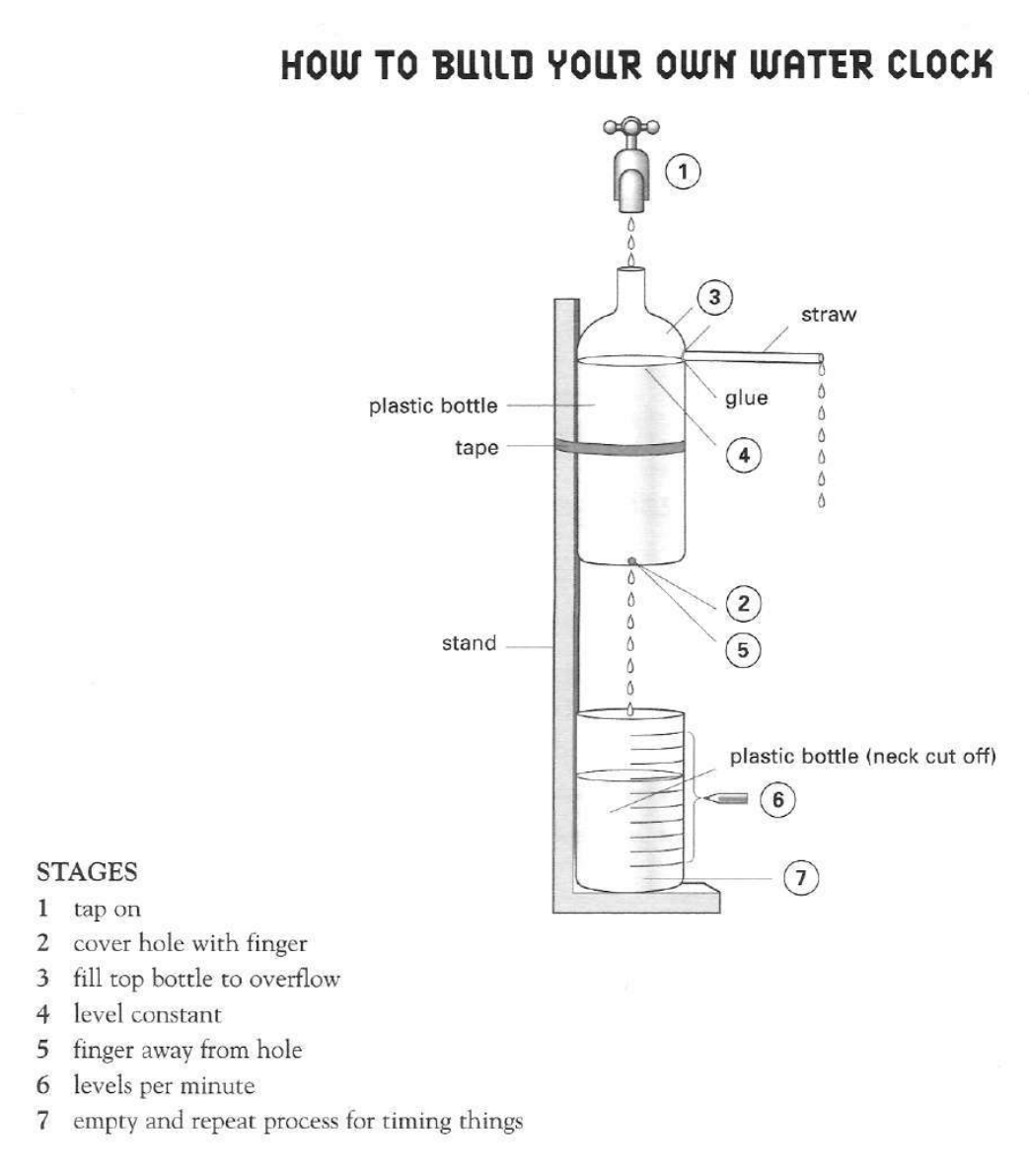
The diagram below shows the process for making a water clock.
Write a report for a university lecturer describing the information below.
HOW TO BUILD YOUR OWN WATER CLOCK
Student answer (Band 6.0)
The diagram above displays the complete process for building a water clock.
Overall, the entire process for creating water clock goes through 7 stages. Plastic bottles, tape and stand seems to play a vital role in the process.
To begin with creating this model, L shape stand is required along with two plastic bottles. One bottle is kept at the bottom of the stand with the neck cut off and the other bottle is taped on the top of the stand, making a hole at the base, through which water can flow. A straw is attached at the side of the bottle so that water can overflow through it. Firstly, switch on the tap and let the top bottle fill until it overflows. Make sure to cover the hole beneath the bottle with the finger. The level of water should stay constant to the straw level. Once the bottle is filled, remove the finger and let the water flow downwards to the second bottle. Water levels per minute and thats how time is measured. Empty the bottle and repeat the process for measuring time.
AI examiner evaluation
| Criterion | Band |
|---|---|
| Task Achievement / Task Response | 6.0 |
| Coherence and Cohesion | 6.5 |
| Lexical Resource | 6.0 |
| Grammatical Range and Accuracy | 5.5 |
| Overall | 6.0 |
Task Achievement / Task Response: Band 6.0
The report covers the main sequence and gives a useful overall summary that the clock is made in seven stages. It also describes the key apparatus, including the two bottles, stand, straw and the hole through which water flows. The account of filling the upper bottle, releasing the water and repeating the process is relevant and generally matches the diagram. However, some details are incomplete or unclear: the straw is specifically an overflow drain, and the diagram shows the upper bottle being filled to overflow while the hole is covered, then the water level remaining constant before the finger is removed. The explanation that “Water levels per minute” is how time is measured is also imprecise; clarify that the lower bottle is marked to show elapsed time. Developing these points would make the description more complete.
Coherence and Cohesion: Band 6.5
The response is organised into an introduction, an overview and a chronological description, so the reader can follow the process from construction to use. Sequencing expressions such as “To begin with,” “Firstly,” “Once” and “Empty the bottle” help signal the order of events. This clear overall progression meets the lower-band expectations and shows some flexibility in linking stages. However, the construction details and operating instructions are crowded into one paragraph, and the transition from making the apparatus to using it could be clearer. “Firstly” also introduces the tap before the instruction to cover the hole, which makes the sequence slightly confusing. Separate the setup from the operating stages and use precise references to the upper and lower bottles to strengthen cohesion.
Lexical Resource: Band 6.0
The vocabulary is adequate for describing a process, with relevant terms such as “overflow,” “attached,” “base,” “level” and “repeat.” The writer also uses some useful process language, including “let the water flow downwards” and “measuring time,” and the meaning is generally clear. There are, however, several imprecise or awkward choices that limit precision: “creating water clock” needs an article, “L shape stand” is not a natural description, and “Water levels per minute” does not clearly express the calibration function. “Vital role” is also stronger than necessary for describing the materials. Use more exact terms such as “L-shaped stand,” “graduation marks” and “measure elapsed time,” and avoid vague phrasing where the diagram provides a specific function.
Grammatical Range and Accuracy: Band 5.5
The response uses a mix of simple and complex forms, including purpose clauses (“so that water can overflow through it”) and time clauses (“Once the bottle is filled”). Most sentences communicate the process successfully, but some grammatical errors remain. Articles are missing in “creating water clock” and “L shape stand,” and subject–verb agreement is incorrect in “Plastic bottles, tape and stand seems.” The sentence “Water levels per minute and thats how time is measured” is not grammatically complete, and “thats” also needs an apostrophe. There is some control of passive forms, as in “is attached” and “is filled,” but more consistent accuracy with articles, agreement and complete sentence structure would improve the report.
See this exact question answered at other band scores. The same prompt compared across bands.
Browse more IELTS Writing model answers or get your own writing scored by the same AI examiner.