Band 5.5 IELTS Writing Task 1 Model Answer
Overall Band Score: 5.5 · IELTS Complete Catalyst · 2026-11-23
IELTS Writing Task 1 question
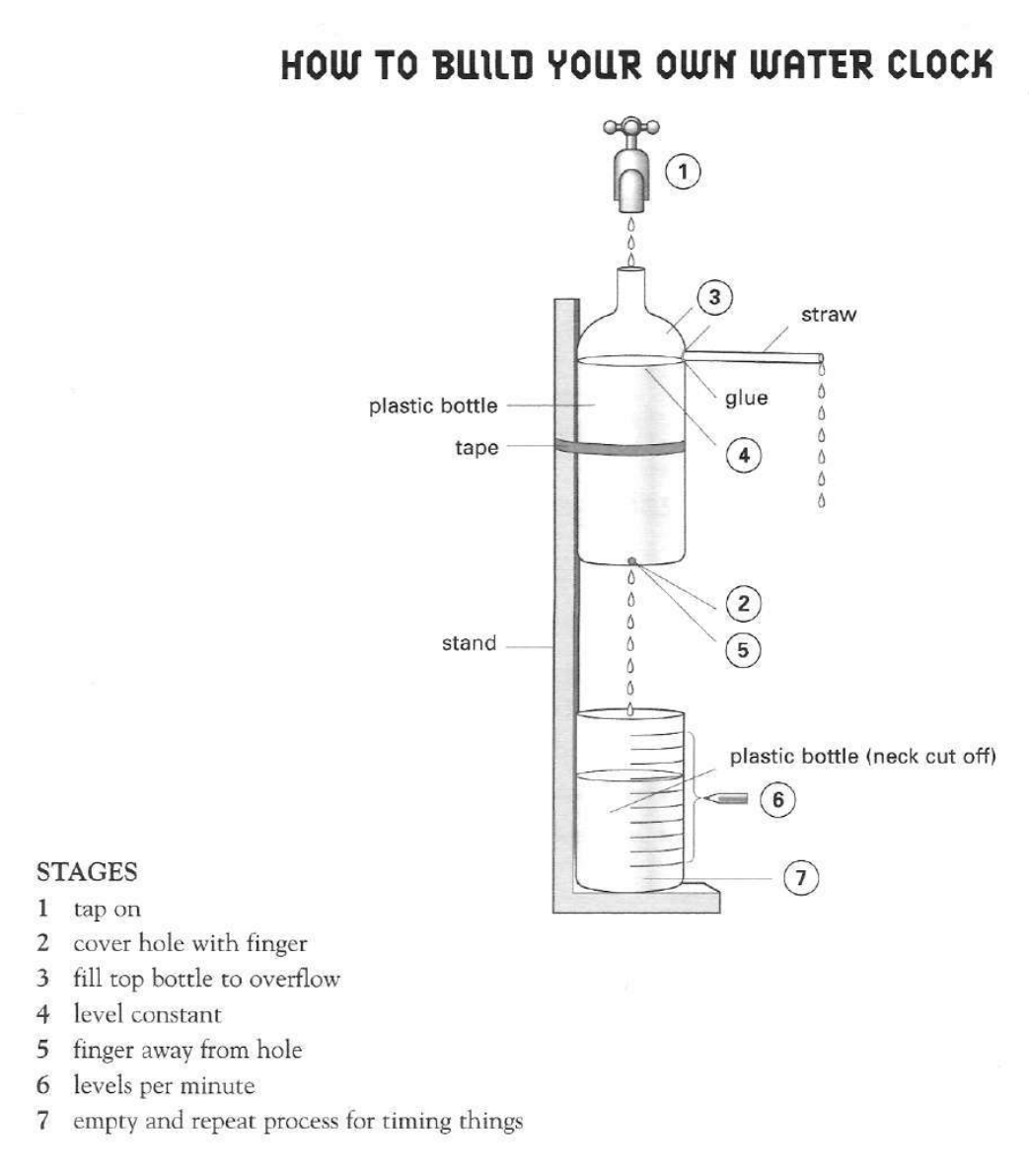
The diagram below shows the process for making a water clock.
Write a report for a university lecturer describing the information below.
HOW TO BUILD YOUR OWN WATER CLOCK
Student answer (Band 5.5)
The diagram illustrates the process how to build your own water clock.
Overall, it can be seen that total process consists of seven stages. To start with, collecting water from water tap and ending with empty and repeat process for timing things.
To start with, plastic bottle are attached with stand and tape. After that, collecting water from special tap and top of the bottle had a straw for extra water outfut. Then cover hole with finger for better result. Next, level constand to fill top bolttle to overflow.
However, plastic bottle lower neck cut off and finger away from hole. Moreover, counted time levels per minute that was very hard process. Followling this, when the result became sucessfull then finally own water clock are ready for using. Finally, the stage are empty the water bottle and again fill up for repeat process for timing things that is the process for water clock.
AI examiner evaluation
| Criterion | Band |
|---|---|
| Task Achievement / Task Response | 6.0 |
| Coherence and Cohesion | 5.5 |
| Lexical Resource | 5.0 |
| Grammatical Range and Accuracy | 5.0 |
| Overall | 5.5 |
Task Achievement / Task Response: Band 6.0
You identify the diagram as a seven-stage process and include several relevant features, including the stand, tape, overflow straw, finger covering the hole, and the final repeat step. This gives the report a generally relevant account of the task. However, some stages are unclear or reported in the wrong order: the bottle is filled to overflow before the finger is removed, and the water level is then observed to measure levels per minute. Your account reverses or blurs these steps in “Next, level constand to fill top bolttle to overflow.” The apparatus description also omits key details such as water dripping into the lower bottle and calibration marks being made on it. A clearer overview and more accurate explanation of how the clock measures time would make the main features more complete.
Coherence and Cohesion: Band 5.5
The response has an opening, an overview, and two body paragraphs, and it uses sequencing expressions such as “After that,” “Next,” and “Finally.” These help the reader recognise that the diagram describes a process. However, progression is not consistently logical: “level constant” is placed before filling the bottle to overflow, while the lower bottle and removal of the finger appear later without a clear connection. “To start with” is also repeated, and “However” does not express a contrast between the ideas that follow. Some sentences combine several stages, making the sequence difficult to follow. Organise the body strictly in numbered order and use a small range of accurate transitions and clear references to each bottle.
Lexical Resource: Band 5.0
You use some task-related vocabulary, including “stand,” “straw,” “overflow,” and “levels per minute,” so the reader can identify the general subject. However, the range is limited and several word choices or forms make the description unclear, such as “special tap,” “extra water outfut,” and “counted time levels per minute.” Spelling errors including “constand,” “bolttle,” “Followling,” and “sucessfull” also reduce precision. Aim for standard process vocabulary and accurate collocations: for example, describe water as flowing through an overflow straw and the lower bottle as collecting the drips. Replacing vague phrases with specific terms will help convey the diagram’s details more reliably.
Grammatical Range and Accuracy: Band 5.0
You attempt both simple sentences and longer clauses, and the overall meaning is usually recoverable. However, control of sentence structure and basic forms is inconsistent. For example, “The diagram illustrates the process how to build” needs a construction such as “the process of building,” while “plastic bottle are attached” has a subject–verb agreement error. The fragment “To start with, collecting water from water tap” lacks a complete clause, and “the stage are empty” also has faulty agreement and sentence structure. Articles and verb forms are often missing or inaccurate, as in “finger away from hole.” Practise writing complete sentences with a clear subject and verb, then check agreement, articles, and tense before adding more complex clauses.
See this exact question answered at other band scores. The same prompt compared across bands.
Browse more IELTS Writing model answers or get your own writing scored by the same AI examiner.