Band 5.5 IELTS Writing Task 1 Model Answer
Overall Band Score: 5.5 · IELTS Complete Catalyst · 2026-11-23
IELTS Writing Task 1 question
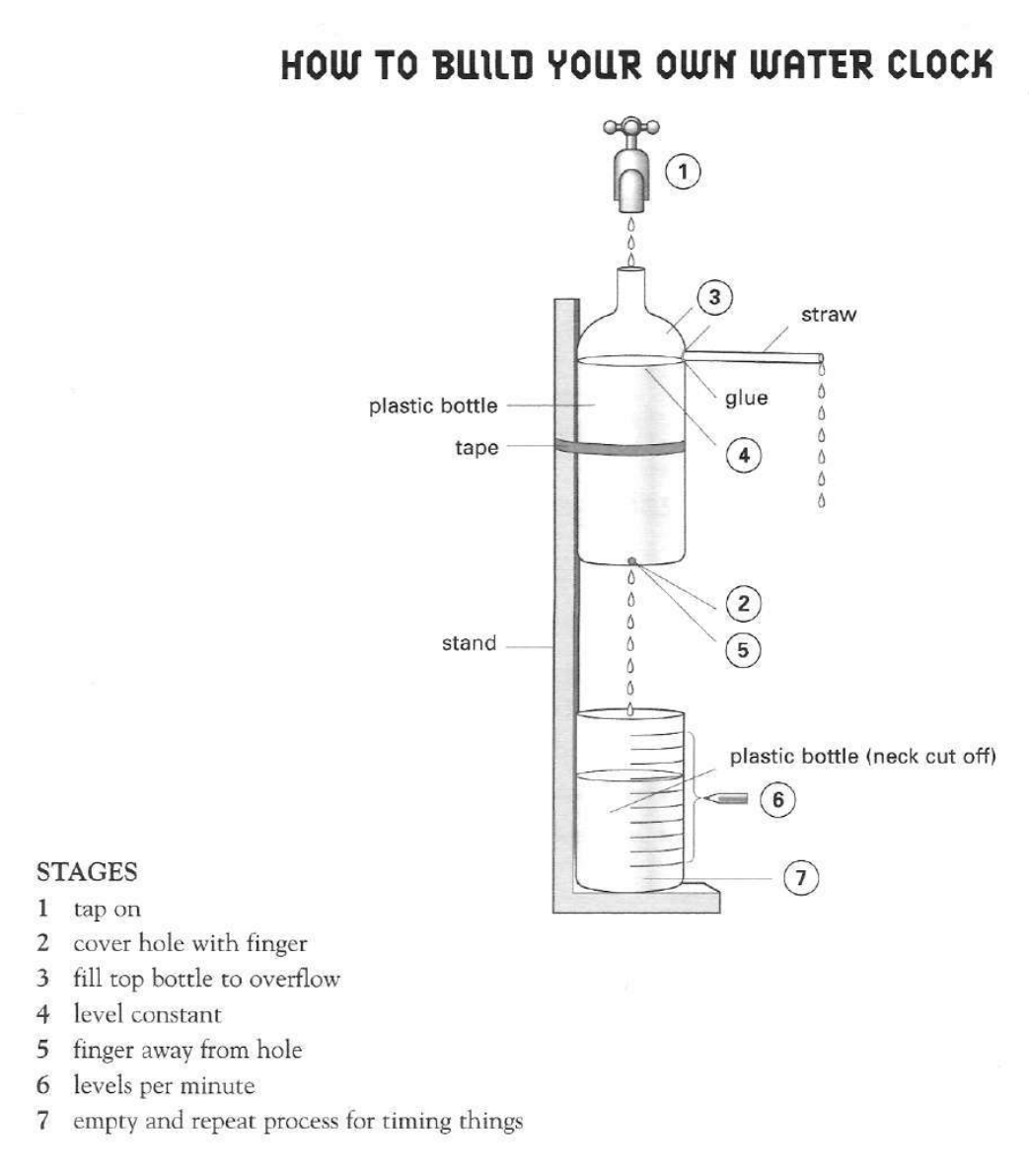
The diagram below shows the process for making a water clock.
Write a report for a university lecturer describing the information below.
HOW TO BUILD YOUR OWN WATER CLOCK
Student answer (Band 5.5)
The diagram shows the information about the process for making a water clock.
There are following stages that takes place during build our own water clock, tap on,cover hole,fill bottle,check level,finger away from top,check levels per minute and repeat the process for timing.
First of all, start the process with tap on, take a stand and two plastic bottles, both bottles adjust on the stand.A straw is attached to the upper bottle with glue for overflow.The upper bottle is wrapped with tape to adjust on stand and the second bottle nect is cutt off and measuring numbers are on it.
We start the process of measuring with tap on, then covers the hole with finger. Fill the top bottle to overflow and makes the level constant.Now, the finger is away from the hole and count the levels per minute.Empty the bottle and repeat the process again and again.Note all the reading and make the results save during all process.
AI examiner evaluation
| Criterion | Band |
|---|---|
| Task Achievement / Task Response | 5.5 |
| Coherence and Cohesion | 6.0 |
| Lexical Resource | 5.0 |
| Grammatical Range and Accuracy | 5.0 |
| Overall | 5.5 |
Task Achievement / Task Response: Band 5.5
You identify the subject and include several relevant stages, such as covering the hole, filling the upper bottle until it overflows, allowing the finger away, and repeating the process. You also describe key equipment, including the stand, straw, tape and two bottles. However, the report does not clearly explain the diagram’s full sequence: the constant water level and the lower bottle’s role in collecting drips and being marked for measurement are not accurately developed. The phrase “count the levels per minute” is unclear, and the added instruction to “note all the reading” is not shown in the diagram. A clearer overview of how the apparatus works, followed by a precise account of each stage, would make the description more complete and better grounded in the visual.
Coherence and Cohesion: Band 6.0
The response has a recognisable overall order: an introduction, a list of stages, a description of the equipment, and then an account of operating the clock. This gives the reader a basic progression from construction to use. However, the sequence is repeated in the second and third paragraphs, and the opening list is difficult to follow because the stages run together (“tap on,cover hole,fill bottle”). Connections between construction details and the numbered operating steps are also not always clear. Use separate paragraphs for the apparatus and its operation, and link each step with precise sequencing language such as “Next” and “Once the bottle is full.” This would make the organisation more coherent and reduce repetition.
Lexical Resource: Band 5.0
You use some relevant task vocabulary, including “overflow,” “stand,” “straw,” “glue,” and “levels per minute,” so the reader can identify the main equipment and actions. However, the range is limited and several choices are imprecise or unnatural, which sometimes makes the process unclear. For example, “the second bottle nect is cutt off” appears to mean that the lower bottle’s neck is cut off, while “measuring numbers” does not clearly describe the calibration marks. There are also spelling errors such as “cutt” and “nect,” and phrases such as “make the results save” are not idiomatic. Aim for accurate process terms and natural collocations, such as “mark measurement lines” and “record the readings.”
Grammatical Range and Accuracy: Band 5.0
The response attempts both simple and longer sentences, and the reader can generally follow the main actions. However, control is inconsistent, particularly in verb forms, agreement, articles and sentence construction. For example, “There are following stages that takes place” has problems with both the article and subject–verb agreement; “both bottles adjust on the stand” does not use a suitable passive form; and “then covers the hole” shifts to an incorrect verb form. Some sentences also join several instructions without clear punctuation, as in “Fill the top bottle to overflow and makes the level constant.” Practise describing processes with consistent present simple or passive forms, for example, “Both bottles are attached to the stand,” and check agreement and punctuation when combining steps.
See this exact question answered at other band scores. The same prompt compared across bands.
Browse more IELTS Writing model answers or get your own writing scored by the same AI examiner.