Band 5.0 IELTS Writing Task 1 Model Answer
Overall Band Score: 5.0 · IELTS Complete Catalyst · 2026-11-23
IELTS Writing Task 1 question
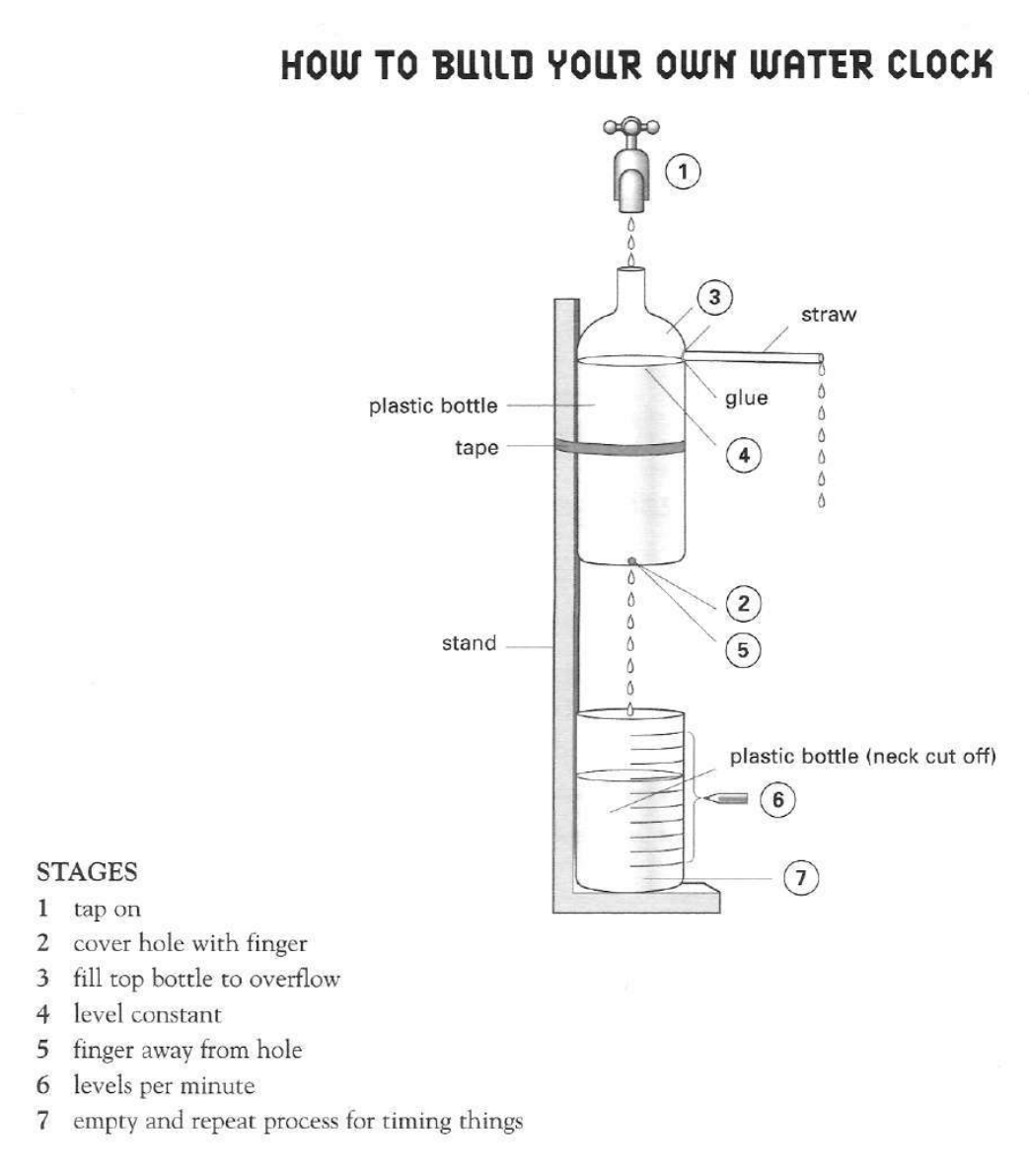
The diagram below shows the process for making a water clock.
Write a report for a university lecturer describing the information below.
HOW TO BUILD YOUR OWN WATER CLOCK
Student answer (Band 5.0)
This report is used to present the university lecturer that how someone build a water clock by his own. The water clock consist of scientific apparatus in which the tap is on the top who filtered water in a plastic bottle which is taped with a stand and a straw into it used for lessen the overconcentration of water and maintain the level constant. Inside the lower bottom of bottle, there is a hole and finger is used to cover and remove the hole space to hold and fall the water in another plastic bottle. When finger get away from the hole, water fall in another bottle which is putting beneath the upward one on some distance by levels per minute. This whole process repeat again and again for timing things by empty the lower plastic bottle and removing the finger from the hole by filling the upward plastic bottle.
AI examiner evaluation
| Criterion | Band |
|---|---|
| Task Achievement / Task Response | 5.5 |
| Coherence and Cohesion | 5.0 |
| Lexical Resource | 5.0 |
| Grammatical Range and Accuracy | 5.0 |
| Overall | 5.0 |
Task Achievement / Task Response: Band 5.5
You identify the subject and describe several relevant features, including the tap, upper bottle, straw, stand, water flow and repeated use for timing. However, some key stages are unclear or inaccurately described. The hole is at the base of the upper bottle, not inside the lower bottle, and the lower bottle is where water collects and is marked with calibration lines. The straw is an overflow drain; saying it is used to “lessen the overconcentration of water” does not explain its function accurately. The numbered sequence—cover the hole, fill the upper bottle to overflow, allow the level to remain constant, then release the water—is not clearly set out. A clearer overview and more precise stage-by-stage account would make the report more complete.
Coherence and Cohesion: Band 5.0
The response follows a broadly understandable order, moving from the apparatus to the water flow and then to repeating the process. This gives the reader a basic sense of how the clock works. However, the report is presented as one long paragraph, and the sequence of actions is difficult to follow because several stages are combined in lengthy sentences. For example, the final sentence brings together emptying the lower bottle, removing the finger and filling the upper bottle without clearly distinguishing when each action occurs. Some linking phrases, such as “When finger get away,” help signal sequence, but connections between ideas are often unclear. Organise the description into an introduction/overview and a clearly ordered account of the stages, using concise sequencing language.
Lexical Resource: Band 5.0
You use some task-related vocabulary, including “tap,” “plastic bottle,” “stand,” “straw” and “levels per minute,” so the reader can recognise the general subject. However, the range is limited and several word choices or collocations make the process difficult to understand. “Filtered water” does not accurately describe water flowing from a tap, while “lessen the overconcentration of water” is not a natural way to explain the straw’s overflow function. Phrases such as “hole space” and “upward one” are also imprecise. Aim for specific process vocabulary and natural combinations, such as “water flows,” “overflow outlet,” “calibration marks” and “lower container.” This would improve precision without requiring unnecessarily complex wording.
Grammatical Range and Accuracy: Band 5.0
You attempt to connect ideas in longer sentences, including a conditional time clause beginning “When finger get away from the hole,” but these structures are often faulty. Errors in agreement and verb forms occur in phrases such as “The water clock consist,” “water fall,” and “This whole process repeat.” Articles and sentence construction are also inconsistent, as in “present the university lecturer that how someone build.” These problems sometimes make the relationships between actions hard to follow. Most of the response relies on extended sentences joined by “and” or “which,” with limited control of varied structures. Practise accurate simple sentences first, then combine stages using controlled clauses and consistent present-simple verbs.
See this exact question answered at other band scores. The same prompt compared across bands.
Browse more IELTS Writing model answers or get your own writing scored by the same AI examiner.