Band 5.0 IELTS Writing Task 1 Model Answer
Overall Band Score: 5.0 · IELTS Complete Catalyst · 2026-11-23
IELTS Writing Task 1 question
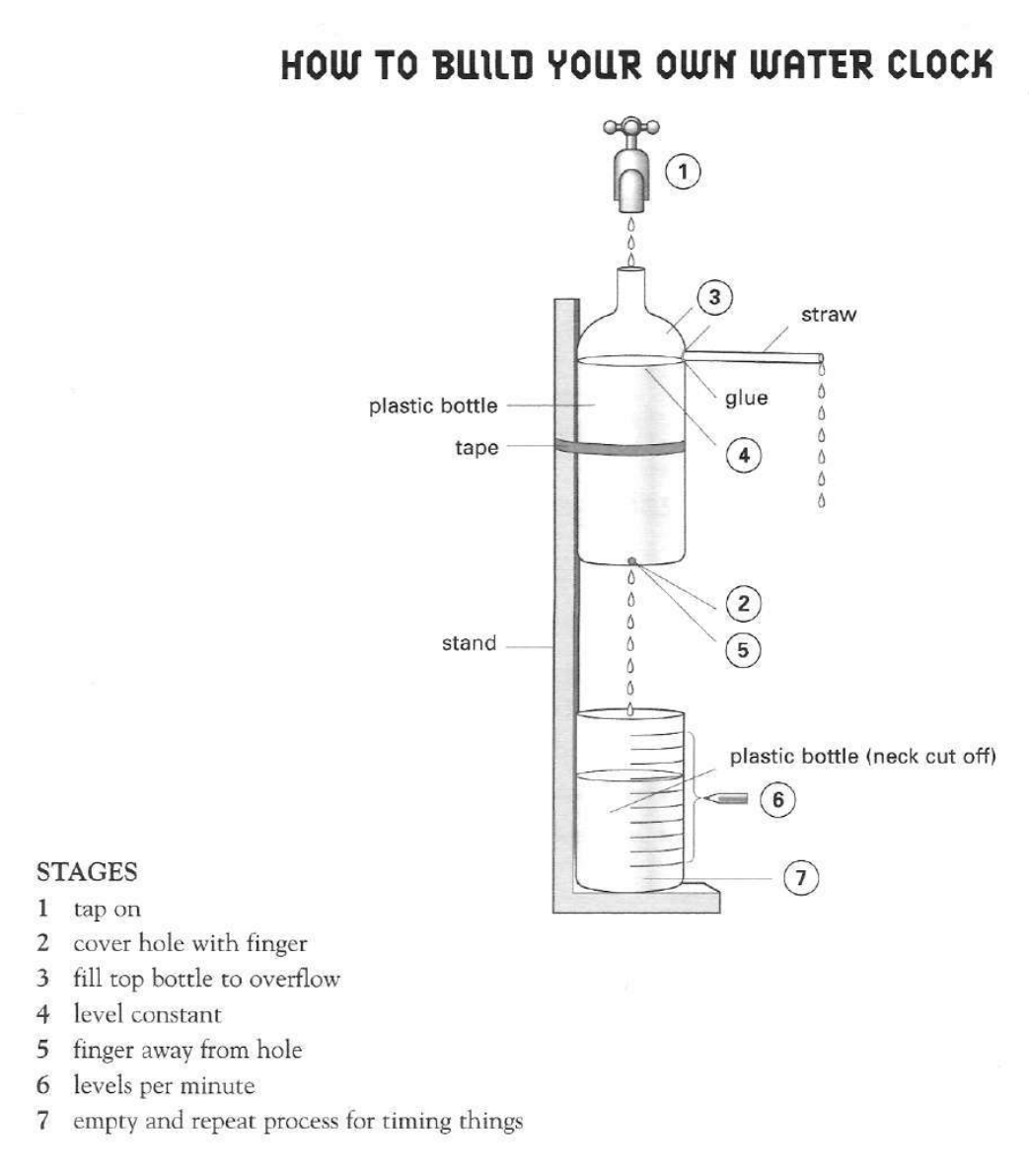
The diagram below shows the process for making a water clock.
Write a report for a university lecturer describing the information below.
HOW TO BUILD YOUR OWN WATER CLOCK
Student answer (Band 5.0)
The process diagram presents the seven stages of making a water clock.
Overall, from tap water to empty plastic bottle and repeat the process things this is called own water clock . For making this water clock it needed seven essential equipment's ( Tap water, plastic bottle and jar , one stand ,tape , glue and one straw).
Initially have to make a hole in plastic bottle on the lower surface then make a another hole on upper right side subsequently, add one straw in that upper hole with glue, Conversely, have to attach the plastic bottle on the stand with tape .
Secondly , have to cut off the neck of another plastic bottle and make a plastic jar. after that plastic jar have to put on the lower portion of stand, then water tap on have to cover hole with finger, have to wait for overflow the water after level became constant then remove the finger from the hole , therefore, levels per minute then empty and repeat the process.
AI examiner evaluation
| Criterion | Band |
|---|---|
| Task Achievement / Task Response | 5.0 |
| Coherence and Cohesion | 5.0 |
| Lexical Resource | 5.0 |
| Grammatical Range and Accuracy | 5.0 |
| Overall | 5.0 |
Task Achievement / Task Response: Band 5.0
You identify the diagram as a seven-stage process and include several relevant construction details, such as attaching the upper bottle to a stand, using glue for the straw, and placing a cut-neck bottle below. You also report the sequence of filling, removing the finger, and repeating the process. However, the account is only partial: it does not clearly explain that the straw provides an overflow outlet or that the lower bottle is marked with calibration lines to show levels per minute. The overview, “from tap water to empty plastic bottle,” is unclear, and “jar” is not the label used in the diagram. To strengthen the report, give a concise overview of how the apparatus works, then describe its construction and operating stages accurately.
Coherence and Cohesion: Band 5.0
There is a basic attempt to organise the report: an introduction and overview are followed by construction details and then operating instructions. The sequence is partly traceable through “Initially” and “Secondly,” and the final actions broadly follow the diagram. However, the second paragraph combines many steps in one long chain, making the order and relationships difficult to follow. Connectors such as “subsequently,” “Conversely,” and “therefore” are either awkward or do not express the intended relationship. Paragraphing also does not clearly separate building the apparatus from using it. Group the construction steps together, then present the operating sequence in a separate paragraph with simple, accurate links such as “Next,” “Once the water level is constant,” and “Finally.”
Lexical Resource: Band 5.0
The response uses some task-related vocabulary, including “straw,” “stand,” “overflow,” “glue,” and “tape,” so the reader can identify the main objects and actions. However, the range is limited and several choices are inaccurate or unnatural, which sometimes makes the process unclear. For example, “plastic bottle and jar” does not clearly identify the two bottles, “levels per minute” is copied without explaining the markings, and “repeat the process things” is not a natural phrase. “Equipment’s” is also an incorrect form in this context. Use precise process vocabulary and standard collocations, such as “lower container,” “calibration marks,” “water flows through the hole,” and “repeat the procedure to time events.”
Grammatical Range and Accuracy: Band 5.0
The response attempts to describe a sequence using longer clauses, but these structures are often faulty, and errors occur frequently enough to make some instructions hard to interpret. Examples include “Initially have to make a hole,” which lacks a clear subject, and “after level became constant,” which needs an article and a more complete clause. The sentence beginning “then water tap on have to cover hole” has unclear word order and missing grammatical elements. There are also inconsistent sentence boundaries and punctuation, particularly in the long final sequence. Practise writing complete passive or imperative instructions—for example, “A hole is made in the base of the bottle” or “Cover the hole with a finger”—and use full stops to separate each stage.
See this exact question answered at other band scores. The same prompt compared across bands.
Browse more IELTS Writing model answers or get your own writing scored by the same AI examiner.