Band 5.0 IELTS Writing Task 1 Model Answer
Overall Band Score: 5.0 · IELTS Complete Catalyst · 2026-11-24
IELTS Writing Task 1 question
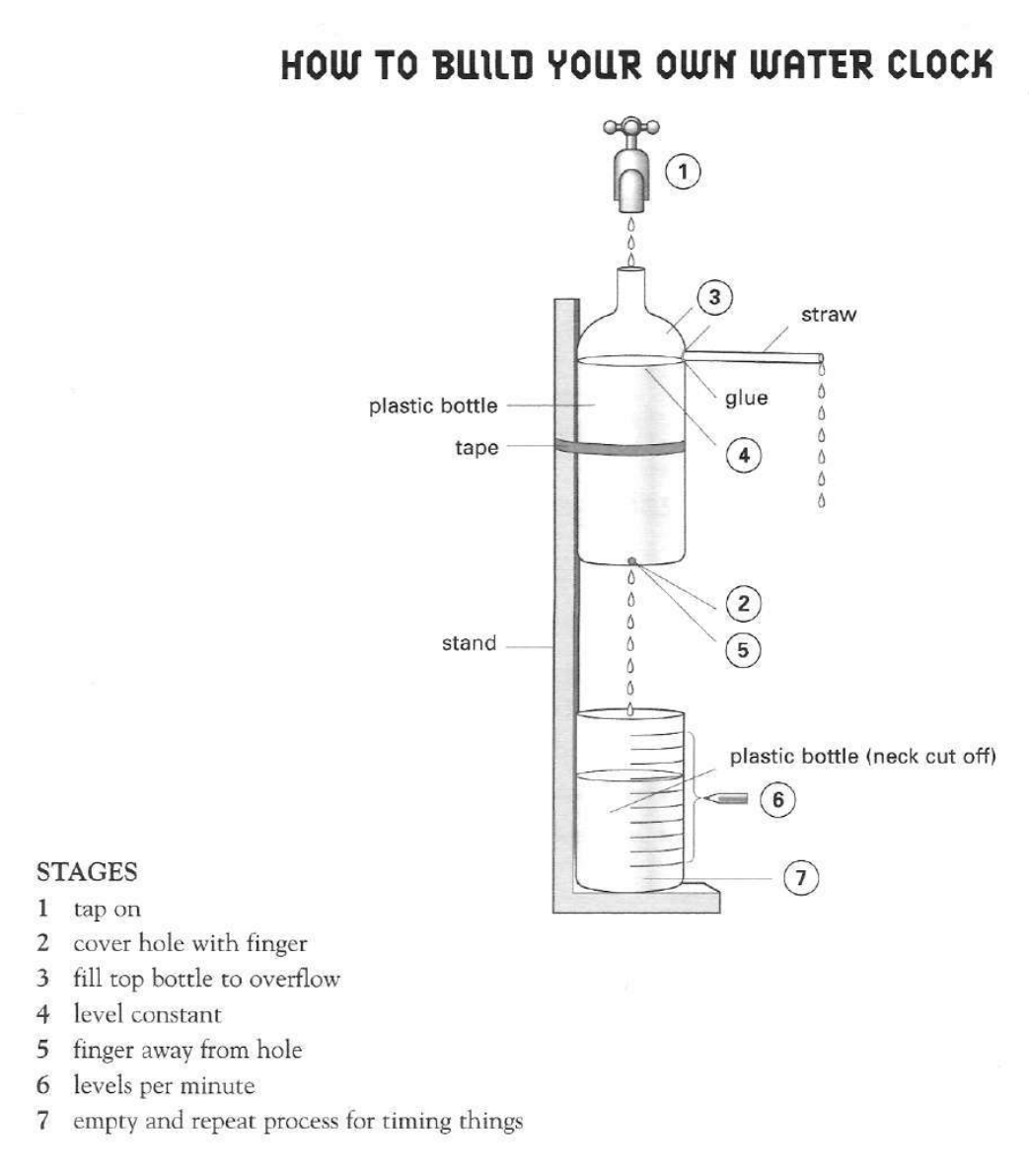
The diagram below shows the process for making a water clock.
Write a report for a university lecturer describing the information below.
HOW TO BUILD YOUR OWN WATER CLOCK
Student answer (Band 5.0)
Today, we will build our own water clock by describing detailed explanation from start to end. The chart explain everything about the process of water clock. it have different components and the main thing used in it is water first of all we need to start the tap so the dropping of water begin after that cover the hole of bottle with finger so the bottle filled up additionally take a closer look on the bottle when the bottle is filled on a certain level after that the finger you have placed on the straw to stop the dropping of water took your finger away from the hole so the dropping of water begins. therefore analyze the level of plastic bottle per minute. The bottle has been cut off from the top furthermore mark the top,middle and bottom of the bottle with pencil. After this whole process you will be able to know the time furthermore emptly the bottle and start the process again.
AI examiner evaluation
| Criterion | Band |
|---|---|
| Task Achievement / Task Response | 5.0 |
| Coherence and Cohesion | 4.5 |
| Lexical Resource | 5.0 |
| Grammatical Range and Accuracy | 4.5 |
| Overall | 5.0 |
Task Achievement / Task Response: Band 5.0
The response identifies the general purpose of the diagram and follows several stages, including turning on the tap, covering the hole, allowing water to flow, observing the level, and repeating the process. However, the account only partially describes how the clock is built and used. Important features are missing or unclear, such as attaching the upper bottle to a stand, using the straw as an overflow, and collecting the water in the lower bottle. Some details are inaccurate: the finger covers the hole, not the straw, and the lower bottle’s neck is cut off rather than the bottle being “cut off from the top” as stated. A clearer overview and more accurate explanation of the apparatus and sequence would make the report more complete.
Coherence and Cohesion: Band 4.5
The stages are presented broadly in chronological order, and linking expressions such as “after that,” “furthermore,” and “after this” show an attempt to connect the steps. However, the response is written as one long, loosely connected sequence, so the progression is difficult to follow. Several transitions are repetitive, and the relationship between actions is sometimes unclear—for example, the explanation moves from filling the bottle to checking its level and then to removing the finger without clearly separating these stages. The opening also repeats the idea that the text explains the process. Organise the report into a brief introduction, an overview, and clearly sequenced stages, using paragraph breaks and more precise links.
Lexical Resource: Band 5.0
The response uses some relevant vocabulary, including “tap,” “hole,” “plastic bottle,” “pencil,” and “level,” which helps communicate the basic process. However, the range is limited and several choices are inaccurate or unnatural for describing a diagram. “The chart” is not the best term for a process illustration, “dropping of water” is less precise than a description of water flowing or dripping, and “emptly” is an incorrect spelling and word form. The phrase “the bottle filled up” also does not specify which bottle or how it is filled. Use more precise process vocabulary and check spelling and collocations; this would make the description clearer without requiring unnecessarily advanced words.
Grammatical Range and Accuracy: Band 4.5
The response attempts to combine stages using subordinate clauses and sequencing phrases, but sentence control is weak. Many ideas run together without full stops, and capitalisation is inconsistent, as in “it have” after the opening sentence. There are frequent problems with subject–verb agreement and verb forms, including “The chart explain” and “the finger … took your finger away.” Articles and sentence construction are also unreliable, making some relationships difficult to understand. For example, the long sentence beginning “after that cover the hole” contains several actions without clear grammatical boundaries. Practise writing one complete sentence for each stage, checking agreement and tense, and use punctuation to separate steps.
See this exact question answered at other band scores. The same prompt compared across bands.
Browse more IELTS Writing model answers or get your own writing scored by the same AI examiner.