Band 4.0 IELTS Writing Task 1 Model Answer
Overall Band Score: 4.0 · IELTS Complete Catalyst · 2026-11-24
IELTS Writing Task 1 question
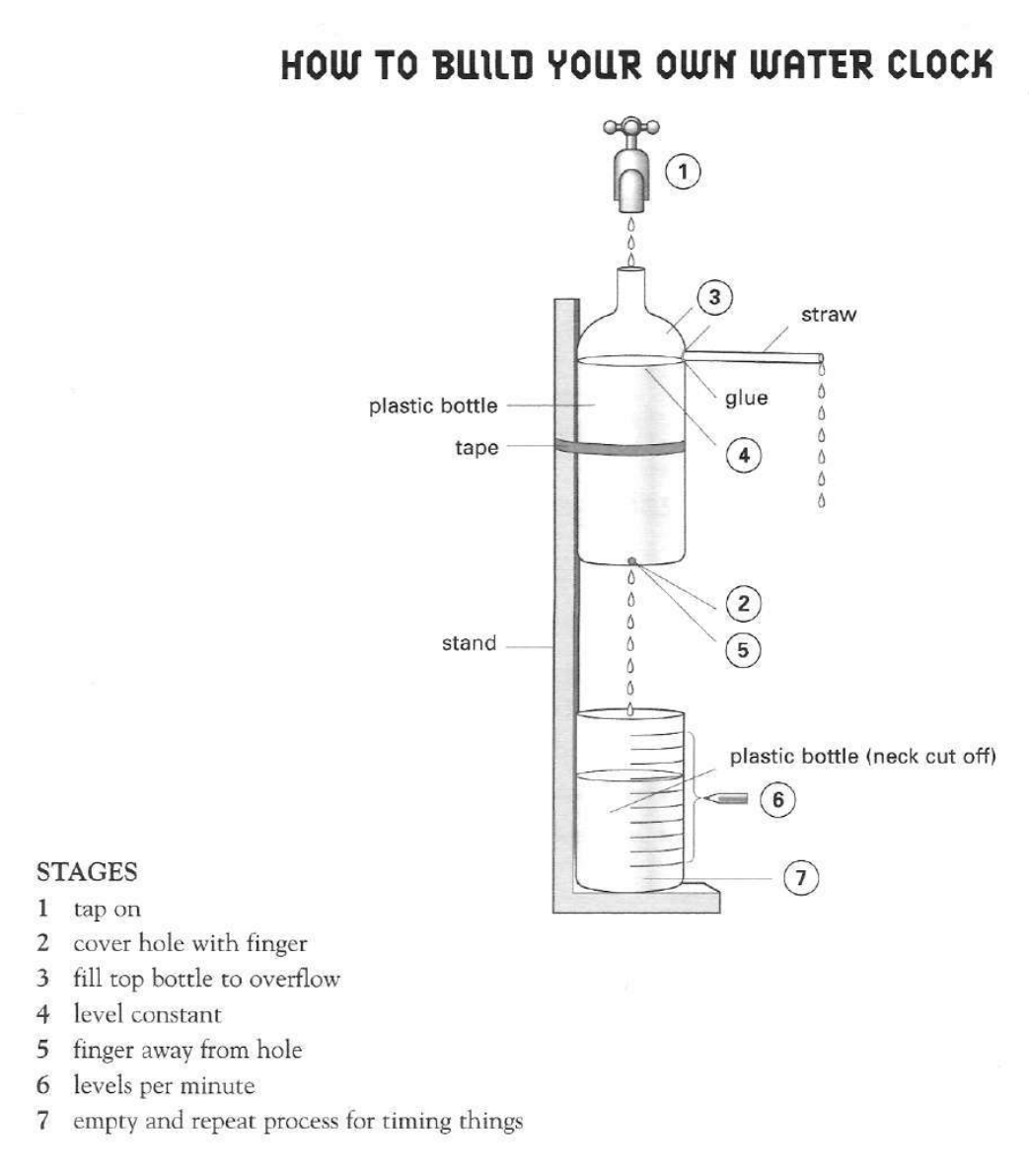
The diagram below shows the process for making a water clock.
Write a report for a university lecturer describing the information below.
HOW TO BUILD YOUR OWN WATER CLOCK
Student answer (Band 4.0)
I would like to write a report for university my lecturer and describing the information of given below. The diagram below illustrates the process for marking a water clock.
Firstly, I talk to how to build your own water clock. To explain it, In our village suffering drinking water. A lot of individuals asked for everyday how to build our water clock . More specially, people had drinking unhealthy water. For instance, many people migrated nowadays so decreased water resources. Therefore individuals drinking unhealthy water because of this high migrated person. As a result, Few a day people become unhealthy unable to works.
Secondly, first of all the process of making water clock. Fethuremore , first tages tap on cover more tightly on the finger. for example, if coverage tightly then ti will be better. thirdly, fill top bottle to overflow, level constant, finger away from hole, levels per minutes, empty and repeat process for timing things. The figure shows plastic bottle tape tand plastic bottle ( neck cut off) glued straw.
AI examiner evaluation
| Criterion | Band |
|---|---|
| Task Achievement / Task Response | 3.5 |
| Coherence and Cohesion | 4.0 |
| Lexical Resource | 4.5 |
| Grammatical Range and Accuracy | 4.5 |
| Overall | 4.0 |
Task Achievement / Task Response: Band 3.5
The response identifies the subject as a water-clock process and includes several genuine stage labels, such as filling the upper bottle to overflow, moving a finger away from the hole, and repeating the process. However, much of the report is unrelated to the diagram: the discussion of village drinking-water shortages, migration and illness does not describe the visual. The construction details are also only briefly listed, and the sequence is not explained clearly; for example, “cover more tightly on the finger” does not accurately convey covering the hole, while the tap and the water’s movement into the lower bottle are not described. A clearer overview and a factual, step-by-step account of the apparatus and stages are needed.
Coherence and Cohesion: Band 4.0
There is a basic attempt to organise the response using “Firstly” and “Secondly,” and the final section includes several stages in roughly the correct order. However, the progression is difficult to follow because the first large section shifts to unrelated ideas about water quality and migration, then the second section moves abruptly to the diagram. Connectors such as “For instance,” “As a result,” and “Furthermore” do not establish useful relationships between the information presented. The stages are compressed into a list rather than developed as connected steps, and references such as “it” in “then ti will be better” are unclear. Group the construction and operation into logical paragraphs and use simple, accurate links between stages.
Lexical Resource: Band 4.5
The response uses some relevant task vocabulary, including “overflow,” “finger,” “hole,” “plastic bottle,” and “straw,” so the reader can recognise parts of the process. However, vocabulary is often inaccurate or awkward, and several phrases make the intended meaning hard to understand. Examples include “marking a water clock” instead of making one, “Fethuremore,” “first tages,” and “high migrated person.” Some labels are copied from the diagram but not expressed as clear descriptions, such as “levels per minutes.” Aim for precise process vocabulary and natural collocations, for example “attach the bottle to a stand,” “water drips through the hole,” and “mark the water level at one-minute intervals.”
Grammatical Range and Accuracy: Band 4.5
The response attempts both simple statements and longer sentences, including “As a result, Few a day people become unhealthy unable to works,” but control is inconsistent and the longer constructions are often difficult to interpret. Errors include missing or incorrect articles and prepositions in “for university my lecturer,” faulty sentence structure in “I talk to how to build,” and agreement or verb-form problems in “people become unhealthy unable to works.” Capitalisation and punctuation are also uneven, as in “In our village” after a comma and the extra space before the full stop in “clock .” Use complete, direct sentences with a clear subject and verb, and check articles, verb forms, and sentence boundaries.
See this exact question answered at other band scores. The same prompt compared across bands.
Browse more IELTS Writing model answers or get your own writing scored by the same AI examiner.