Band 5.5 IELTS Writing Task 1 Model Answer
Overall Band Score: 5.5 · IELTS Complete Catalyst · 2026-11-24
IELTS Writing Task 1 question
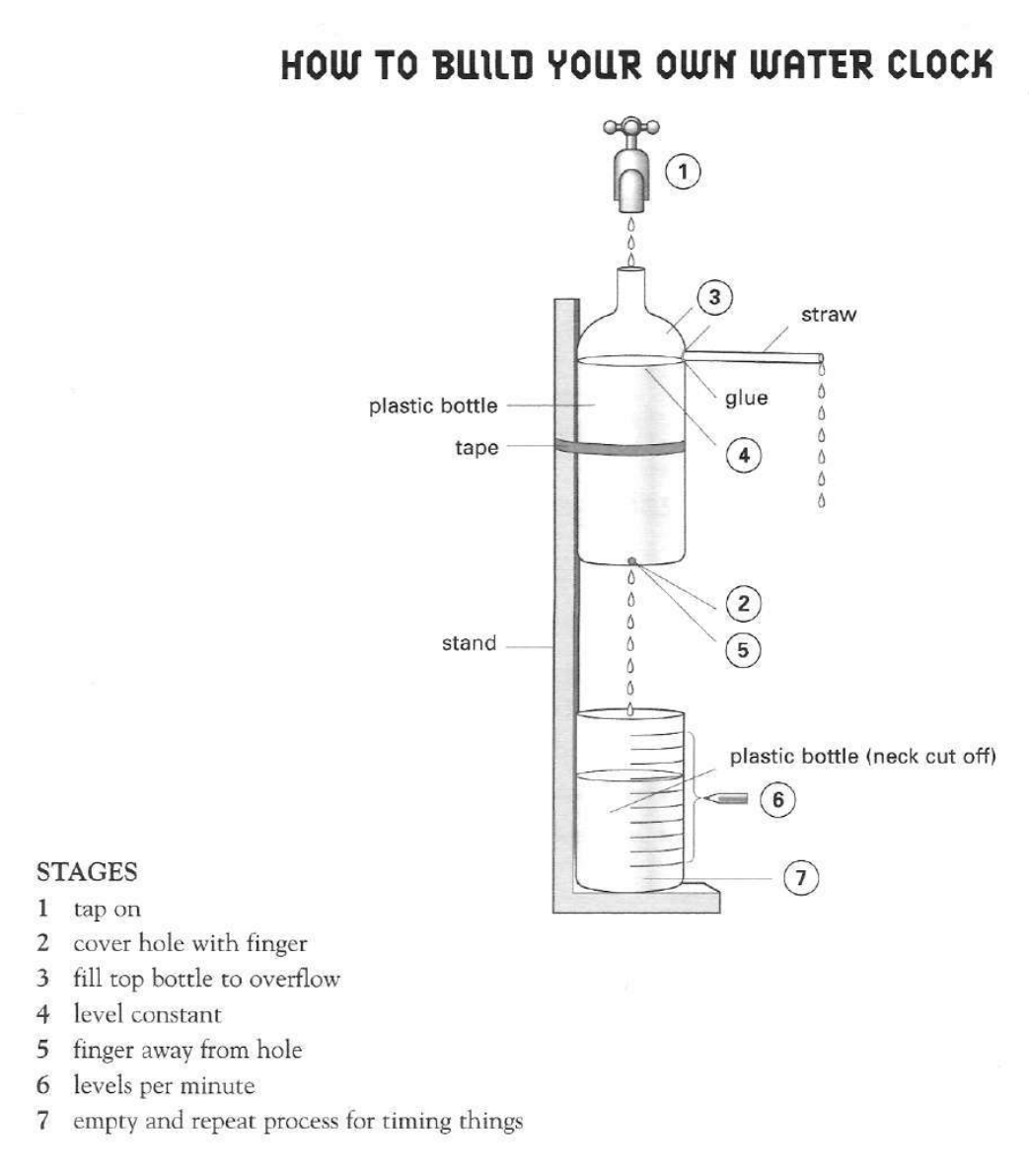
The diagram below shows the process for making a water clock.
Write a report for a university lecturer describing the information below.
HOW TO BUILD YOUR OWN WATER CLOCK
Student answer (Band 5.5)
The flow chart illustrate the process for building a water clock.
Overall, this progress involves seven main phases, beginning with water flowing into a bottle and ending with emptying the container before process starts again.
Initially, tap water is poured into the plastic bottle that attached to the top of stand by a tape. In the following step, cover hole that is placed bottom of the bottle before water starts pouring from a straw that is placed top of the plastic bottle. When water level becomes constant, finger is taken away from the hole.
Subsequently, water starts to drop by a hole and starts filling the below container which is simply a plastic bottle that is cut off. After that, water level is checked per minute before it gets empty again and repeat the process.
AI examiner evaluation
| Criterion | Band |
|---|---|
| Task Achievement / Task Response | 5.0 |
| Coherence and Cohesion | 6.0 |
| Lexical Resource | 5.0 |
| Grammatical Range and Accuracy | 5.0 |
| Overall | 5.5 |
Task Achievement / Task Response: Band 5.0
You identify the process as having seven phases and give a relevant beginning-to-end overview, including the repeated use of the clock. However, the account only partially describes the diagram: it does not explain that the straw drains excess water to keep the upper bottle’s level constant, or that the lower bottle is marked with calibration lines to measure the water level over time. The sequence is also unclear in places: the finger is removed before you explain that water begins dripping into the lower container. The phrase “water level is checked per minute” does not accurately convey that the levels correspond to minutes. The response is also 15 words below the required minimum. Add the missing functional details and explain the stages more fully.
Coherence and Cohesion: Band 6.0
The response has a clear overall arrangement: an introduction, an overview, and two paragraphs describing the stages. Sequencing expressions such as “Initially,” “In the following step,” and “Subsequently” help the reader follow the process. However, some links between stages are unclear or mechanically expressed. For example, “When water level becomes constant, finger is taken away” does not clearly connect the overflow stage to the release of water, and “After that” introduces a measurement step without explaining how the marked levels are used. The final sentence also combines emptying and repeating without a clear grammatical link. Improve cohesion by describing each action in its actual order and using clear references to the upper and lower bottles.
Lexical Resource: Band 5.0
You use relevant process vocabulary, including “flow chart,” “plastic bottle,” “stand,” “straw,” and “container,” so the topic is generally understandable. However, the range is limited and several word choices or collocations are inaccurate, which makes some details difficult to interpret. “This progress” is not the right expression for a sequence of steps, while “water starts to drop by a hole” is an unclear description of water dripping through the opening. “Water level is checked per minute” also misrepresents the calibration marks, which indicate elapsed minutes rather than a checking action. Aim for precise process verbs and terms such as “overflow,” “drip,” and “calibration marks,” and avoid repeating “starts” where a more exact verb is available.
Grammatical Range and Accuracy: Band 5.0
The response attempts a few longer sentences, including “When water level becomes constant, finger is taken away from the hole,” but most structures are simple and several sentences contain recurring grammatical errors. In “The flow chart illustrate,” the subject and verb do not agree; “that attached to the top” is missing a verb; and instructions such as “cover hole” shift into an imperative form rather than maintaining a consistent report style. Articles are also often missing, as in “bottom of the bottle” and “a hole,” and the final phrase “before it gets empty again and repeat the process” has an unclear subject and verb structure. Use complete passive constructions consistently, check articles and agreement, and vary sentence patterns while keeping each stage clear.
See this exact question answered at other band scores. The same prompt compared across bands.
Browse more IELTS Writing model answers or get your own writing scored by the same AI examiner.