Band 6.0 IELTS Writing Task 1 Model Answer
Overall Band Score: 6.0 · IELTS Complete Catalyst · 2026-11-24
IELTS Writing Task 1 question
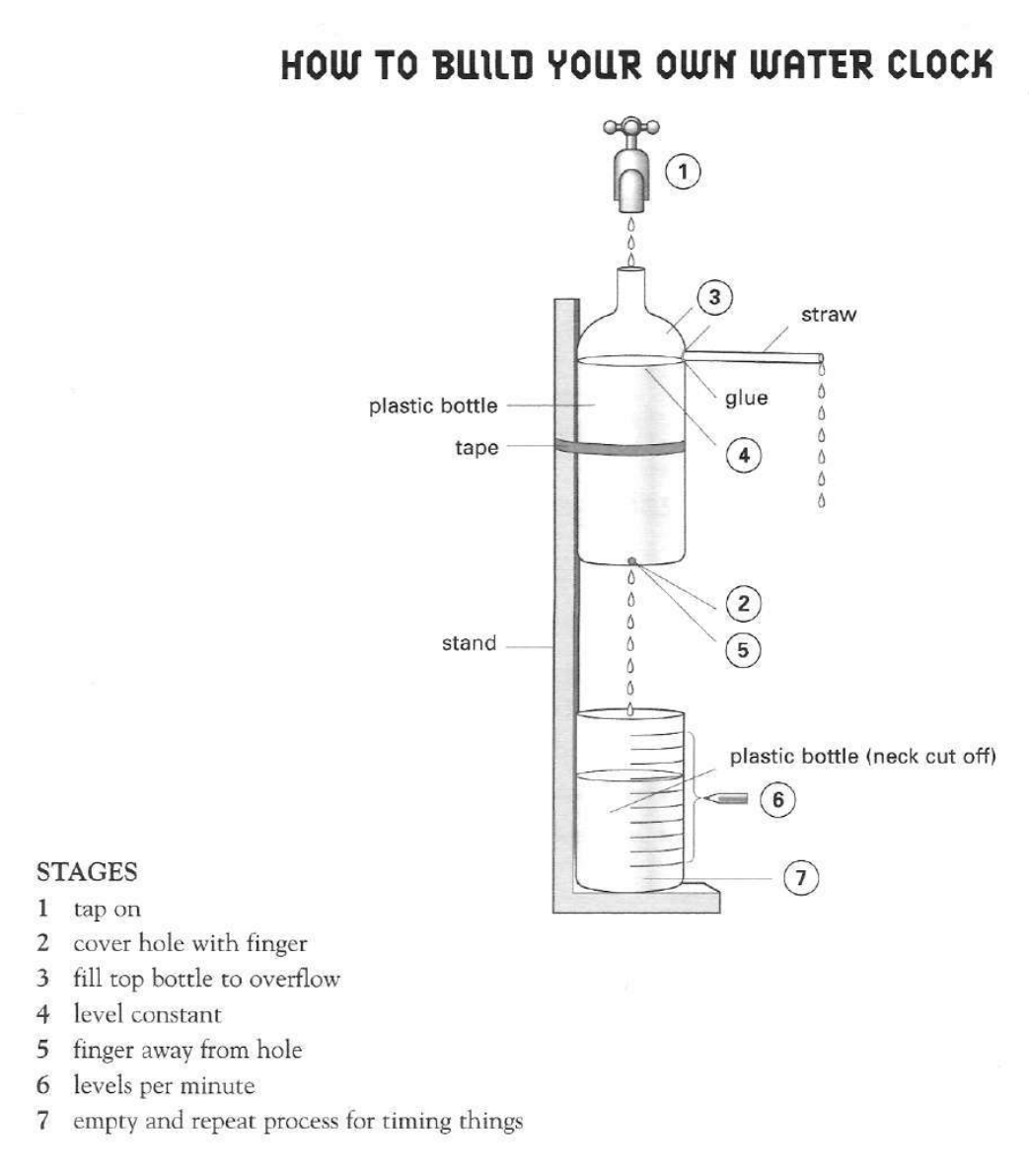
The diagram below shows the process for making a water clock.
Write a report for a university lecturer describing the information below.
HOW TO BUILD YOUR OWN WATER CLOCK
Student answer (Band 6.0)
The diagram illustrates the making of our own water clock. Below is the report for the university lecturer that describes the formation of our own water clock.
Overall, the building process consists of seven stages including turning the tap on, cover hole with finger, fill top bottle to overflow, level constant, finger away from hole and reading the levels per minute.
Additionally, the arrangement of the experiment consists of other materials such as the plastic bottle, tape, stand, straw, glue and the plastic bottle with neck cut off. First, the tap is turned on so that water flows from tap to plastic bottle. At the same time, we have to cover the hole with a finger which is at the bottom of bottle. Then, we will wait untill the bottle overflows.
Furthermore, we will note the constant level of water. After that, extra water will flow through the straw. When the water comes to constant level we will remove our finger and the water flows from other bottle to bottle (neck cut off) . We will record the water level measurments with respect to minutes. At last, we will empty the flask or apparatus and repeat process to measure time intervals.
AI examiner evaluation
| Criterion | Band |
|---|---|
| Task Achievement / Task Response | 6.5 |
| Coherence and Cohesion | 6.0 |
| Lexical Resource | 5.5 |
| Grammatical Range and Accuracy | 6.0 |
| Overall | 6.0 |
Task Achievement / Task Response: Band 6.5
The report covers the main stages and gives a useful overview of the seven-step sequence, including filling the upper bottle to overflow, removing a finger from the hole, recording levels per minute, and repeating the process. It also identifies the main materials and describes water passing into the lower bottle. These details show good coverage of the task. However, some stages are unclear or inaccurately expressed: “level constant” is not explained as maintaining a constant water supply, and “water flows from other bottle to bottle” obscures the direction of flow from the upper bottle into the lower one. The apparatus description could also be more precise about the straw acting as an overflow and the lower bottle being marked for measurement. Clearer explanation of these features would make the account more complete.
Coherence and Cohesion: Band 6.0
The response has a recognisable structure, moving from an introduction and overview to materials and then a chronological account. Sequencing phrases such as “First,” “Then,” “After that,” and “At last” help the reader follow the process. However, cohesion is sometimes mechanical, with several transitions doing little to clarify how stages relate. The overview lists actions in a compressed form, while the body repeats some of them without consistently distinguishing the setup from the operating sequence. References such as “the bottle,” “other bottle,” and “the water” are not always clear, particularly in “water flows from other bottle to bottle (neck cut off).” Grouping the apparatus description separately and using precise references to the upper and lower bottles would improve progression and clarity.
Lexical Resource: Band 5.5
The response uses relevant process vocabulary, including “overflows,” “straw,” “constant level,” “measure,” and “time intervals,” so the reader can generally understand the subject. There is also some attempt to vary wording, such as “formation” and “arrangement.” However, several choices are unnatural or imprecise for a process report: “formation of our own water clock” is less suitable than “construction,” and “measurments” is misspelled. “Flask or apparatus” is also inaccurate and vague because the diagram shows bottles, not a flask. Repeated use of “bottle” without specifying upper or lower further limits precision. Choose standard technical terms and check spelling and collocations to make the description more exact.
Grammatical Range and Accuracy: Band 6.0
There is a mix of simple and more complex forms, including the relative clause in “the hole with a finger which is at the bottom of bottle” and the time clause “When the water comes to constant level.” Most sentences communicate the intended sequence, but some grammatical errors remain. The overview has an incomplete parallel list: “including turning …, cover …, fill …” should use consistent forms, such as “turning …, covering …, and filling …”. Articles are missing in “at the bottom of bottle” and “to constant level,” and the sentence “At the same time, we have to cover…” shifts from passive description to direct instruction. There is also an awkward sentence boundary before “At last.” More consistent tense and parallel construction would improve control.
See this exact question answered at other band scores. The same prompt compared across bands.
Browse more IELTS Writing model answers or get your own writing scored by the same AI examiner.