Band 5.0 IELTS Writing Task 1 Model Answer
Overall Band Score: 5.0 · IELTS Complete Catalyst · 2026-11-24
IELTS Writing Task 1 question
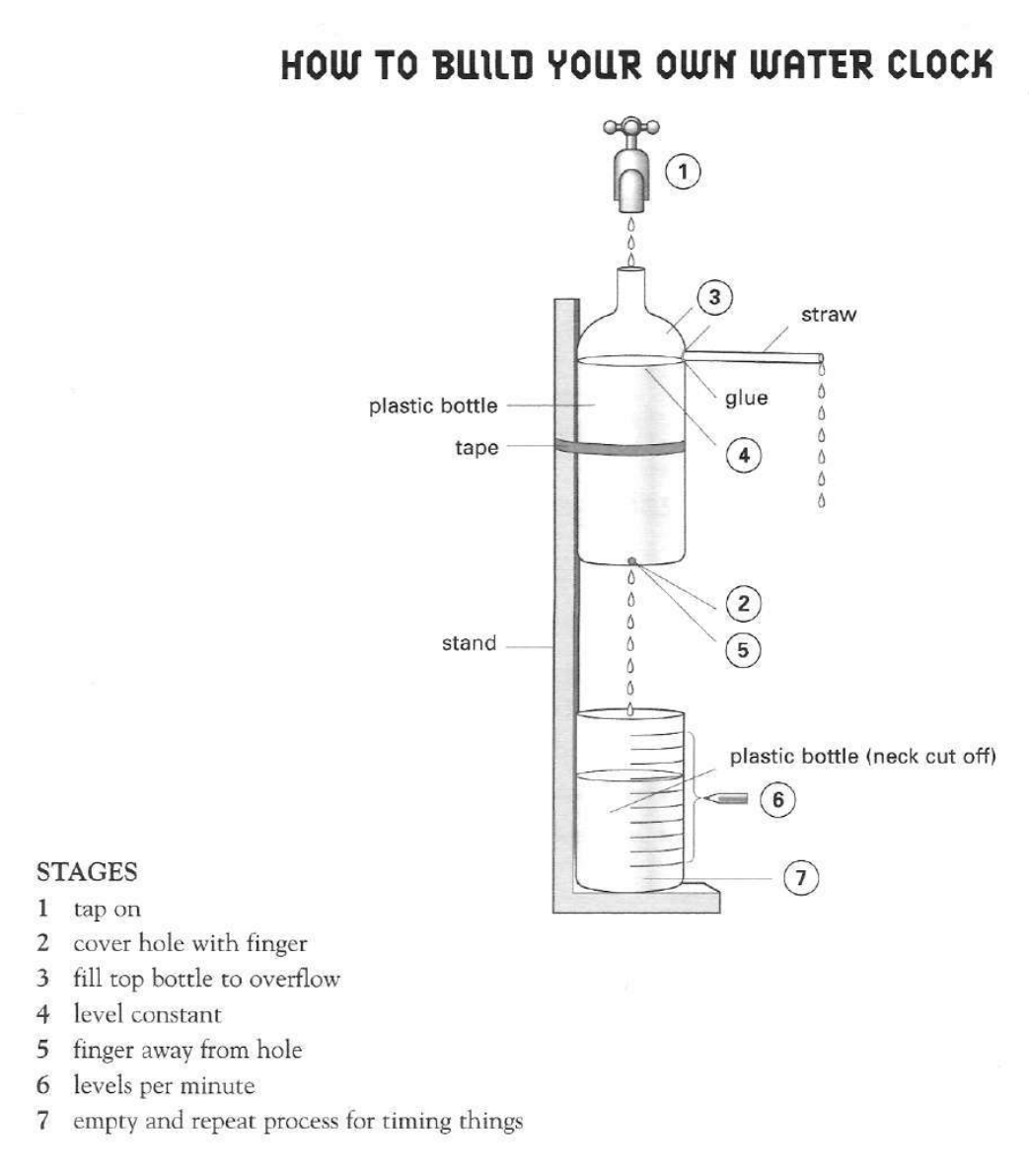
The diagram below shows the process for making a water clock.
Write a report for a university lecturer describing the information below.
HOW TO BUILD YOUR OWN WATER CLOCK
Student answer (Band 5.0)
The diagram illustrate the process for making a water clock.
Overall it is noticeable that, In the procces for making a water clock there are Seven stages Whereas three significant equipments of water clock.Tap, Plastic bottles and stand are these three major equipments. One plastic bottle is place at the top of stand sescond one is place at the stage of stand.
Initialy ,On the tap Water start fill in plastic bottle. Cover the hole with finger and water reach at the top of bottle.When the level of water is constant away finger from whole. Drops of water falls in the lower plastic bottle.
Moreover, Water start fill plastic bottle and this bottle have a measuring marks on it. When water comes in first level one minute was spent .This is a proccess of water clock
AI examiner evaluation
| Criterion | Band |
|---|---|
| Task Achievement / Task Response | 5.0 |
| Coherence and Cohesion | 5.5 |
| Lexical Resource | 5.0 |
| Grammatical Range and Accuracy | 5.0 |
| Overall | 5.0 |
Task Achievement / Task Response: Band 5.0
You identify the diagram as a water-clock process and mention several relevant stages, including filling the upper bottle, covering and then uncovering the hole, and collecting drops in the lower bottle. However, the account is only partial: it does not clearly explain the straw’s overflow function, the stand and bottle arrangement, or the final instruction to empty and repeat the process. The overview is also unclear, particularly the phrase “three significant equipments,” and the timing explanation (“When water comes in first level one minute was spent”) does not accurately describe that the marked levels indicate minutes. The response is 14 words below the required minimum, which limits the space available to describe the stages. A fuller, more accurate overview and a complete sequence would strengthen the report.
Coherence and Cohesion: Band 5.5
The response has a basic paragraph structure: an introduction, an attempted overview, and two paragraphs describing the process. Some sequencing is apparent through “Initialy” and “Moreover,” and the reader can follow the broad movement from the tap to the lower bottle. However, progression is not consistently clear. The overview combines the number of stages with equipment details in a confusing sentence, while “Moreover” introduces information that continues the same process rather than a distinct point. Several links between actions are missing, especially how the overflow straw maintains a constant level and how the markings are used to measure time. Use clearer stage-by-stage sequencing and refer consistently to the upper and lower bottles to improve cohesion.
Lexical Resource: Band 5.0
You use some relevant process vocabulary, including “tap,” “plastic bottle,” “stand,” “hole,” “drops,” and “measuring marks,” so the topic is generally recognisable. However, the range is limited and several word choices or forms make the description less precise, such as “equipments” for countable items and “water clock” repeated without variation. Spelling errors—including “procces,” “Initialy,” and “sescond”—are noticeable, and “water start fill” is not a natural way to describe the action. Choose precise process verbs and accurate equipment terms, and check spelling carefully. This would make the report clearer and more appropriate for an academic description.
Grammatical Range and Accuracy: Band 5.0
The response attempts both simple and linked sentences, for example, “Cover the hole with finger and water reach at the top of bottle,” but grammatical control is inconsistent. Errors in agreement and verb forms occur frequently: “The diagram illustrate,” “Water start fill,” and “Drops of water falls.” Articles and sentence construction are also problematic in phrases such as “at the stage of stand” and “When the level of water is constant away finger from whole,” where the intended sequence is difficult to follow. Most sentences rely on basic patterns, and the attempted longer constructions are often faulty. Practise forming clear passive or active process sentences, maintaining consistent present tense, and checking subject–verb agreement and articles.
See this exact question answered at other band scores. The same prompt compared across bands.
Browse more IELTS Writing model answers or get your own writing scored by the same AI examiner.