Band 5.5 IELTS Writing Task 1 Model Answer
Overall Band Score: 5.5 · IELTS Complete Catalyst · 2026-11-25
IELTS Writing Task 1 question
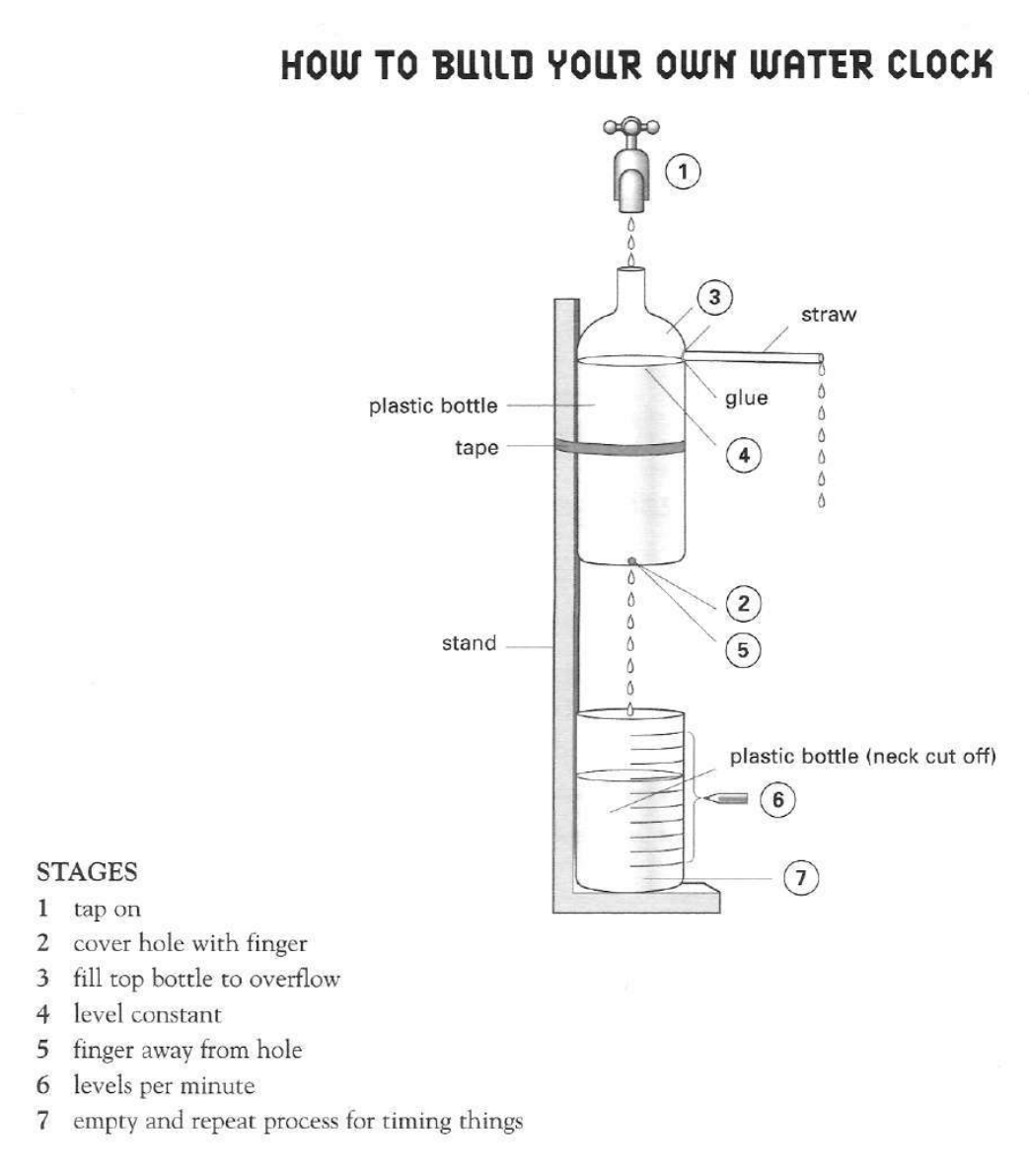
The diagram below shows the process for making a water clock.
Write a report for a university lecturer describing the information below.
HOW TO BUILD YOUR OWN WATER CLOCK
Student answer (Band 5.5)
The diagram demonstrates process fro making a water clock.
Overall, it's a linear process consist of 7 crutial stages starting from a tap stage where the water comes from to ending at repeating the process again to measure timing on a water clock. There are some vital things needed like, 2 water bottles one with a hole and another with top cutted, also stand and tape.
Firstly, in starting we need a working tap that's where the water is gonna come from. Moreover, a water bottle is required attached by tape on top of a stand, then make a hole on the first bottle on bottom firstly cover the hole so the water dosen't come and let it overflow. Furthermore, attach a straw on the first bottle water is gonna come out of it.
It should be at constant level of a straw now. Now remove the finger from the hole and let the water drop in the second bottle. The second bottle neck should be cutted out attach at the bottom of the stand with measuring lines on it. At the end measure the levels per minute of the second bottle by a pencil now you have a workable water clock. To reverse the process empy the bottle and repeat the process again now u have time measuring water clock.
AI examiner evaluation
| Criterion | Band |
|---|---|
| Task Achievement / Task Response | 6.5 |
| Coherence and Cohesion | 6.0 |
| Lexical Resource | 5.0 |
| Grammatical Range and Accuracy | 5.0 |
| Overall | 5.5 |
Task Achievement / Task Response: Band 6.5
The report covers the main sequence and gives a useful overview, identifying seven stages from turning on the tap to emptying and repeating the process. It also includes key components such as the two bottles, stand and tape. This shows good coverage of the diagram, with the main purpose—measuring time—made clear. Some details, however, are not fully accurate or clearly explained: the straw is described as something water comes out of, but its role is to drain overflow and maintain a constant level; the hole is said to be made during the process although it is part of the apparatus shown. The construction and calibration stages could also be described more precisely to make the account fully developed.
Coherence and Cohesion: Band 6.0
The response has a recognisable structure: an introduction and overview are followed by a chronological account, and sequencing words such as “Firstly,” “Moreover,” “Furthermore” and “At the end” help guide the reader. The stages are generally presented in the right order. However, some links feel mechanical, and the long first process paragraph combines several actions without clearly separating them. “It should be at constant level of a straw now” is also difficult to connect to the preceding instruction, while “To reverse the process” is not an accurate transition for repeating it. Use shorter stage-focused sentences and clearer references, such as “Once the water reaches the straw’s level…” to improve progression.
Lexical Resource: Band 5.0
The response uses enough process-related vocabulary to communicate the general procedure, including “overflow,” “attached,” “measuring lines” and “levels per minute.” However, the range is limited and several word choices or collocations are inaccurate, which sometimes makes the description less clear. For example, “a hole on bottom” and “water is gonna come out of it” are imprecise for a formal report, and “reverse the process” does not mean emptying and repeating it. Spelling and word-form errors such as “crutial,” “cutted” and “empy” are noticeable. Prefer precise, formal verbs such as “drain,” “mark” and “calibrate,” and check spelling and collocations.
Grammatical Range and Accuracy: Band 5.0
There are attempts to combine instructions and explanations, and the reader can usually follow the sequence. However, the range of sentence structures is limited, and errors occur often enough to affect clarity. For example, “Overall, it's a linear process consist of 7…” lacks a correctly formed verb phrase; “a water bottle is required attached by tape” has an incomplete grammatical construction; and “It should be at constant level” is missing an article. Several sentences also run together, as in “Now remove the finger from the hole and let the water drop in the second bottle.” Practise accurate passive forms (“is attached”), articles, and sentence boundaries, while varying simple and complex structures.
See this exact question answered at other band scores. The same prompt compared across bands.
Browse more IELTS Writing model answers or get your own writing scored by the same AI examiner.