Band 5.5 IELTS Writing Task 1 Model Answer
Overall Band Score: 5.5 · IELTS Complete Catalyst · 2026-11-26
IELTS Writing Task 1 question
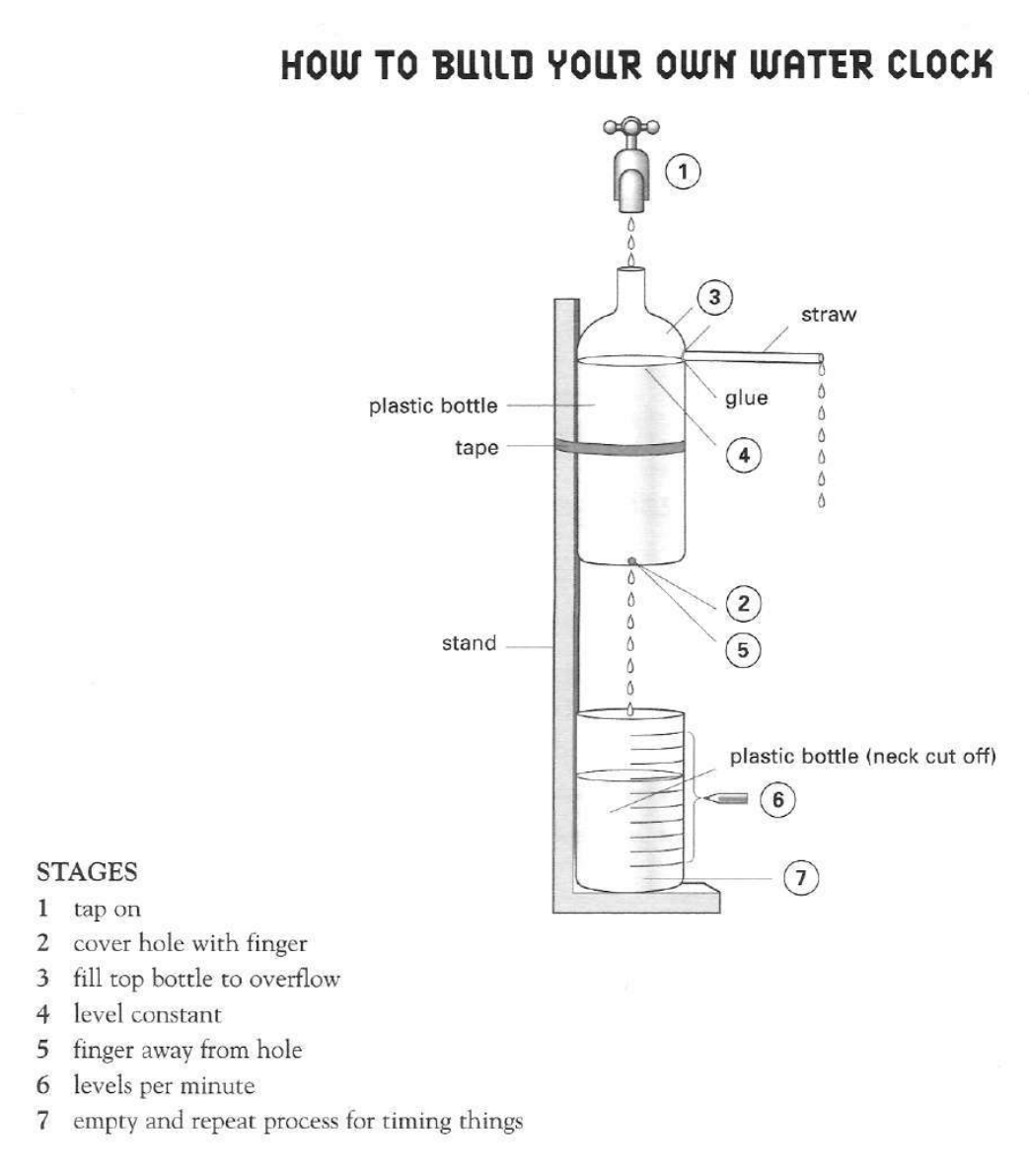
The diagram below shows the process for making a water clock.
Write a report for a university lecturer describing the information below.
HOW TO BUILD YOUR OWN WATER CLOCK
Student answer (Band 5.5)
The diagram illustrates the the water clock with the help of 7 stages. The water clock is made up of 7 things number 1 is the tap from which water will be filled into plastic bottle which is attached to a upper part of a stand with the tape. Then there is a straw attached to the upper part of the bottle with a glue. Then there is hole in the bottom of the platic bottle. Then a plastic bottle with neck cut off is placed at the bottom of the stand.
Now i will explain how the water clock will work with the 7 different stages. FIrst of all we will on the water tap and cover the bottom hole with the finger so no water drain out of the bottle we will fill the bottle to overflow till where the straw is attached than we take away the finger from the hole and make the minutes on the bottle which is indicated by a level. One level of water means one minute.In the last we will empty the plastic bottle and then repeat the same process for time calculation.
AI examiner evaluation
| Criterion | Band |
|---|---|
| Task Achievement / Task Response | 6.0 |
| Coherence and Cohesion | 6.0 |
| Lexical Resource | 5.0 |
| Grammatical Range and Accuracy | 5.0 |
| Overall | 5.5 |
Task Achievement / Task Response: Band 6.0
You cover both the apparatus and its operation, and the main sequence is recognisable: water is added to the upper bottle, the hole is released, and the lower bottle is used to record elapsed time. You also identify key components such as the straw, stand and cut-off lower bottle. However, some details are incomplete or unclear. The diagram’s straw acts as an overflow drain, and the upper bottle is filled until water reaches that level; this function is not explained. The calibration marks are made on the lower bottle, whereas “make the minutes on the bottle” does not clearly identify where or how. A more precise overview of the setup and the timed dripping process, followed by accurate stage details, would make the report more complete.
Coherence and Cohesion: Band 6.0
The response has a coherent overall arrangement: the first paragraph describes the equipment, and the second explains the stages. Sequencing expressions such as “First of all,” “Then,” and “In the last” help the reader follow the process. However, the progression is sometimes mechanical, and several ideas are joined into long sentences with repeated “and” or “then,” making the sequence less easy to track. The opening also repeats the idea of the seven stages before the process paragraph begins. Use clearer sentence boundaries and more precise links, such as “Once the bottle is full, the hole is uncovered,” to show how each action leads to the next. This would improve flow while retaining the useful paragraph structure.
Lexical Resource: Band 5.0
You use relevant vocabulary for describing the equipment and process, including “tap,” “straw,” “plastic bottle,” “overflow,” and “level.” This gives the reader a basic understanding of the diagram. However, the range is limited and some choices are imprecise or awkward: “7 things” is vague, “make the minutes on the bottle” does not clearly describe marking calibration lines, and “time calculation” is not a natural description of timing. There are also spelling and word-form slips, including “platic” and “FIrst,” which reduce accuracy. Choose more specific process vocabulary and use it consistently—for example, “components,” “mark intervals,” and “measure elapsed time”—to make the report clearer and more suitable for an academic description.
Grammatical Range and Accuracy: Band 5.0
You attempt both simple statements and longer sentences, and the overall meaning can usually be followed. However, errors in sentence structure, articles, agreement and punctuation are noticeable. For example, “the water clock with the help of 7 stages” lacks a complete, natural opening structure, while “attached to a upper part” has an article error. The sentence beginning “First of all we will on the water tap” is missing a verb form, and several actions are run together without clear punctuation. Tense and subject choices also shift between “we will” and descriptions of the apparatus. Practise forming complete passive or present-simple process sentences, and separate each stage into a clear clause; this will improve accuracy while allowing you to retain some complex sentence forms.
See this exact question answered at other band scores. The same prompt compared across bands.
Browse more IELTS Writing model answers or get your own writing scored by the same AI examiner.