Band 5.5 IELTS Writing Task 1 Model Answer
Overall Band Score: 5.5 · IELTS Complete Catalyst · 2026-11-27
IELTS Writing Task 1 question
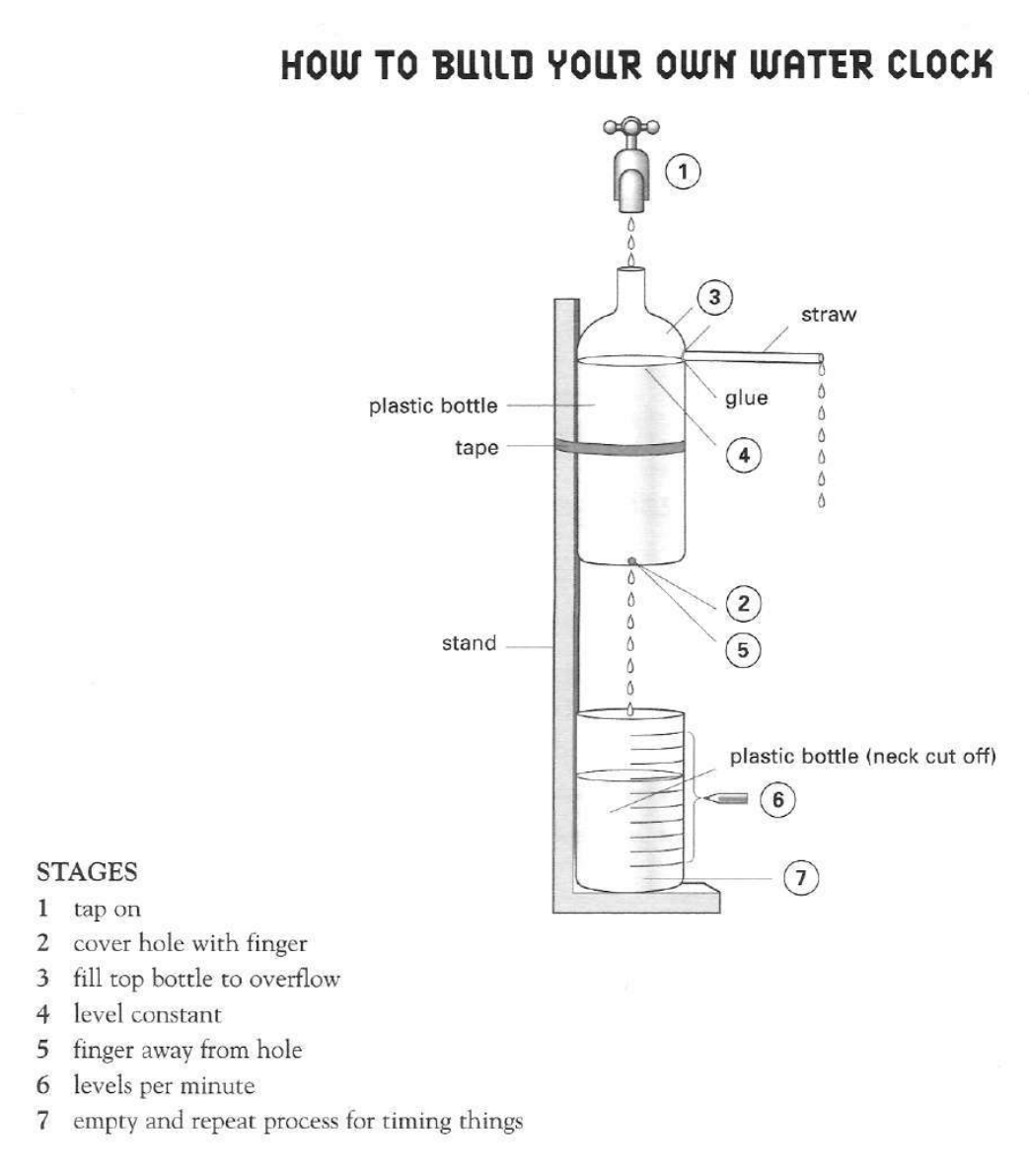
The diagram below shows the process for making a water clock.
Write a report for a university lecturer describing the information below.
HOW TO BUILD YOUR OWN WATER CLOCK
Student answer (Band 5.5)
The diagram below shows how to build our own waterclock. There are seven main steps that are being followed to achieve this.
The equipement consists of water tap, a plastic bottle, straw that is attached with the bottle using glue. The plastic bottle is taped with the stand at the top and a hole is made at the bottom of it whereas another plastic bottle (with its neck cut off) is placed at the bottom of the stand.
The procedure starts with filling the plastic bottle at the top and covering the bottom hole with a finger. Let the plastic bottle get filled and wait for it to overflow, Once the level is constant and all the access water has been overflowed, remove the finger from the hole. The water drip shows the level per minute. Now, we can empty the bottom plastic bottle nd keep repeting the process for timing things.
AI examiner evaluation
| Criterion | Band |
|---|---|
| Task Achievement / Task Response | 5.5 |
| Coherence and Cohesion | 6.0 |
| Lexical Resource | 5.5 |
| Grammatical Range and Accuracy | 5.5 |
| Overall | 5.5 |
Task Achievement / Task Response: Band 5.5
You identify the diagram as a seven-step process and describe the main equipment, including the upper bottle, straw, stand and lower bottle. The sequence from filling the upper bottle to releasing the water and repeating the process is also broadly represented. However, some important details are unclear or inaccurate: the finger should cover the hole before the upper bottle is filled, but your account says filling starts first. The calibration stage is reduced to “The water drip shows the level per minute,” which does not clearly explain that the lower bottle’s rising water level is marked to indicate elapsed minutes. A clearer overview of how the apparatus measures time, followed by a more precise account of the stages, would make the report more complete.
Coherence and Cohesion: Band 6.0
The response has a sensible overall arrangement: it introduces the process, describes the equipment, and then explains the procedure. Sequencing expressions such as “The procedure starts,” “Once,” and “Now” help the reader follow the stages. However, the process description is compressed into one long paragraph, and the transition from filling the bottle to waiting for overflow is not fully clear. The phrase “The water drip shows the level per minute” also leaves the relationship between dripping, the lower bottle and the timing marks uncertain. Use separate paragraphs for the overview/equipment and the stages, and connect each action explicitly—for example, explain what happens to the water after the finger is removed and how the marked levels are used.
Lexical Resource: Band 5.5
You use relevant vocabulary for describing the apparatus and process, including “plastic bottle,” “stand,” “overflow,” and “level,” so the topic is generally understandable. There is some useful variation in describing actions, such as “covering,” “remove,” and “empty.” However, several word choices or forms are inaccurate or imprecise: “access water” appears to mean “excess water,” “water drip” is not a natural description of the measurement, and “waterclock” is better written as “water clock.” Spelling errors such as “equipement” and “repeting,” along with “nd,” are noticeable. Aim for precise process vocabulary and check spelling; this will make the description clearer without requiring more complicated wording.
Grammatical Range and Accuracy: Band 5.5
You attempt a mix of sentence forms, including a relative clause in “another plastic bottle (with its neck cut off) is placed at the bottom of the stand” and a time clause beginning “Once the level is constant.” The main actions are usually expressed in a way that can be understood. However, some sentence structures and punctuation need more control. “There are seven main steps that are being followed” is an awkward passive construction; “The process involves seven main steps” is clearer. The sentence beginning “Let the plastic bottle get filled” shifts into an instruction, while the rest is mainly a report, and the comma after “overflow” creates a run-on sentence. Use consistent present-tense process language and divide long sentences into correctly punctuated steps.
See this exact question answered at other band scores. The same prompt compared across bands.
Browse more IELTS Writing model answers or get your own writing scored by the same AI examiner.