Band 6.0 IELTS Writing Task 1 Model Answer
Overall Band Score: 6.0 · IELTS Complete Catalyst · 2026-11-27
IELTS Writing Task 1 question
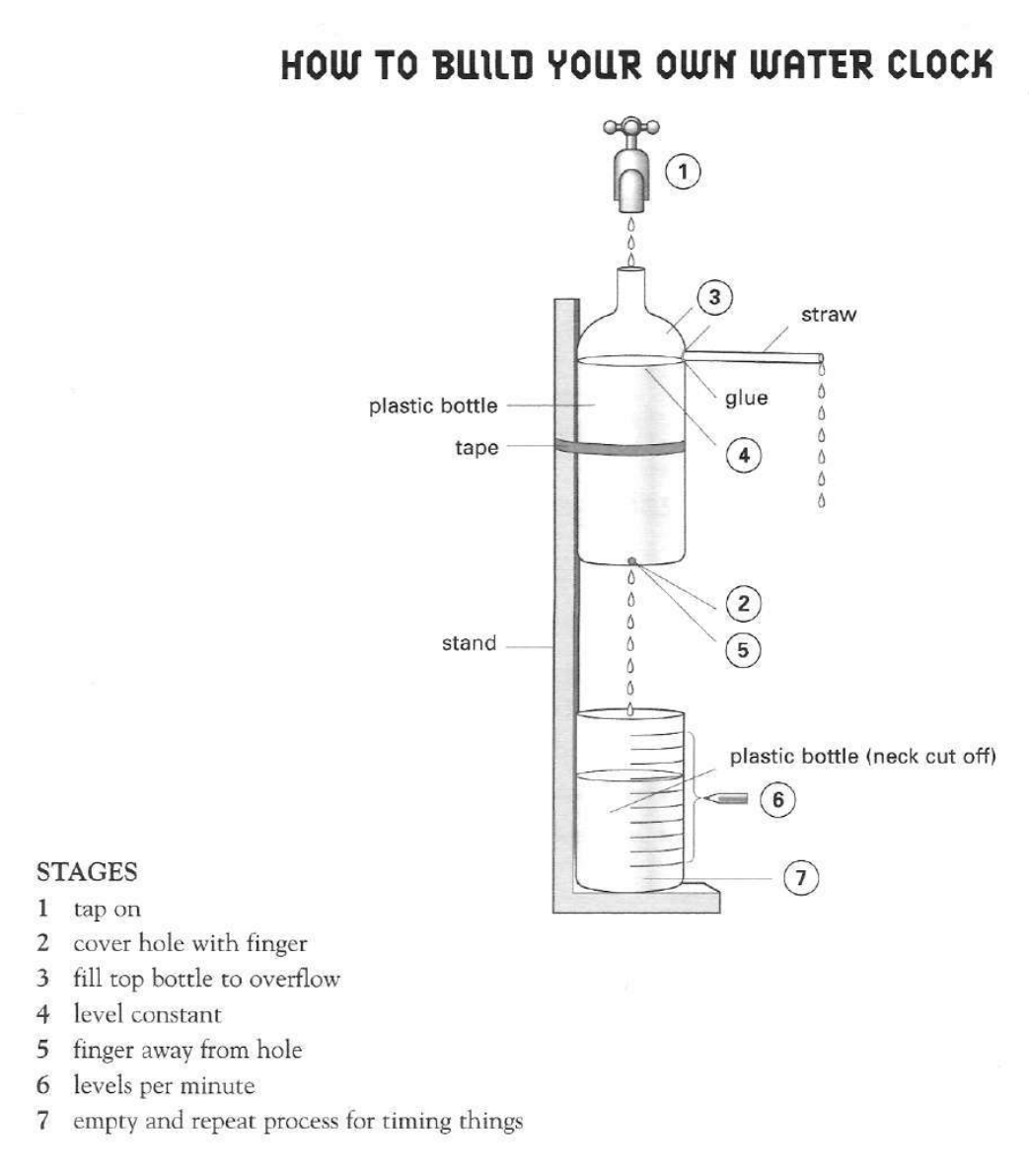
The diagram below shows the process for making a water clock.
Write a report for a university lecturer describing the information below.
HOW TO BUILD YOUR OWN WATER CLOCK
Student answer (Band 6.0)
The diagram presents the process of creating a water clock in seven steps.
Overall, it is manual process that begins with turning water tap on and complete with empty and repeat process for timing thing. Person has to craft materials to make a water clock by filling bottle, levelling and using fingers.
Initally, the water tap is turning on to fill the plastic bottle that is stick to a stand with tape around it. The plastic bottle has two holes one at the mouth side where straw is attached with help of glue and another is at the bottom. Afterward, the hole at the bottom is covered with finger to fill complete bottle to the overflow. The next step is to constant the level at the straw and let the excess water to pass through straw.
After then, move finger away from hole and let the water drop to the second plastic bottle which is cut off from neck. Then, meassure the water level as per miniute. At last, empty the bottle and continuous the same process for timing assessment.
AI examiner evaluation
| Criterion | Band |
|---|---|
| Task Achievement / Task Response | 6.5 |
| Coherence and Cohesion | 6.5 |
| Lexical Resource | 5.0 |
| Grammatical Range and Accuracy | 5.0 |
| Overall | 6.0 |
Task Achievement / Task Response: Band 6.5
The report covers the main sequence from switching on the tap to repeating the process, and it includes relevant construction details such as the stand, tape, straw, overflow and lower bottle. The opening overview also identifies the process as a seven-step procedure. Some details, however, are unclear or inaccurately described: the bottle is not said to have “two holes” in the diagram; the straw is attached near the top as an overflow outlet, rather than being a hole at the mouth. The calibration stage is also only briefly mentioned as measuring the level “per minute,” without explaining that the marks on the lower bottle record the changing water level. More precise coverage of these features would make the account more complete and developed.
Coherence and Cohesion: Band 6.5
The response has a clear overall shape: an introduction and overview are followed by two paragraphs describing the stages in sequence. Time markers such as “Afterward,” “After then” and “At last” help the reader follow the process, and the final step is easy to identify. However, some links are awkward or do not clearly show the relationship between actions. For example, “The next step is to constant the level at the straw” is difficult to connect to the preceding overflow stage, while “After then” is an unnatural transition. The overview also repeats the final instruction from the introduction rather than adding a distinct summary of how the clock works. Clearer stage-to-stage links and more precise referencing would improve progression.
Lexical Resource: Band 5.0
The response uses relevant process vocabulary, including “overflow,” “stand,” “straw,” “level” and “timing,” so the reader can generally identify the equipment and actions. However, the range is limited and several word-choice, collocation and spelling problems make parts less natural or occasionally unclear. Examples include “stick to a stand” for an object attached with tape, “constant the level” for keeping the water level constant, and “timing assessment” for timing activities. “Meassure” and “miniute” are misspelled, and “timing thing” is imprecise. Aim for accurate process verbs and standard spelling, and use specific terms such as “calibration marks” and “overflow outlet” where appropriate.
Grammatical Range and Accuracy: Band 5.0
The response attempts both simple and longer sentences, and the sequence is mostly understandable. However, grammatical control is inconsistent, particularly with articles, verb forms and sentence construction. For instance, “it is manual process” needs an article, while “begins with turning water tap on and complete with empty and repeat” does not maintain a parallel grammatical structure. In “The water tap is turning on,” the passive form is incorrect for describing the procedure; “the tap is turned on” would be suitable. The sentence beginning “Afterward” also has an unclear relationship between covering the hole and filling the bottle. Practise forming accurate passive instructions and keeping verb forms parallel; these changes would make the process easier to follow.
See this exact question answered at other band scores. The same prompt compared across bands.
Browse more IELTS Writing model answers or get your own writing scored by the same AI examiner.