Band 5.5 IELTS Writing Task 1 Model Answer
Overall Band Score: 5.5 · IELTS Complete Catalyst · 2026-11-27
IELTS Writing Task 1 question
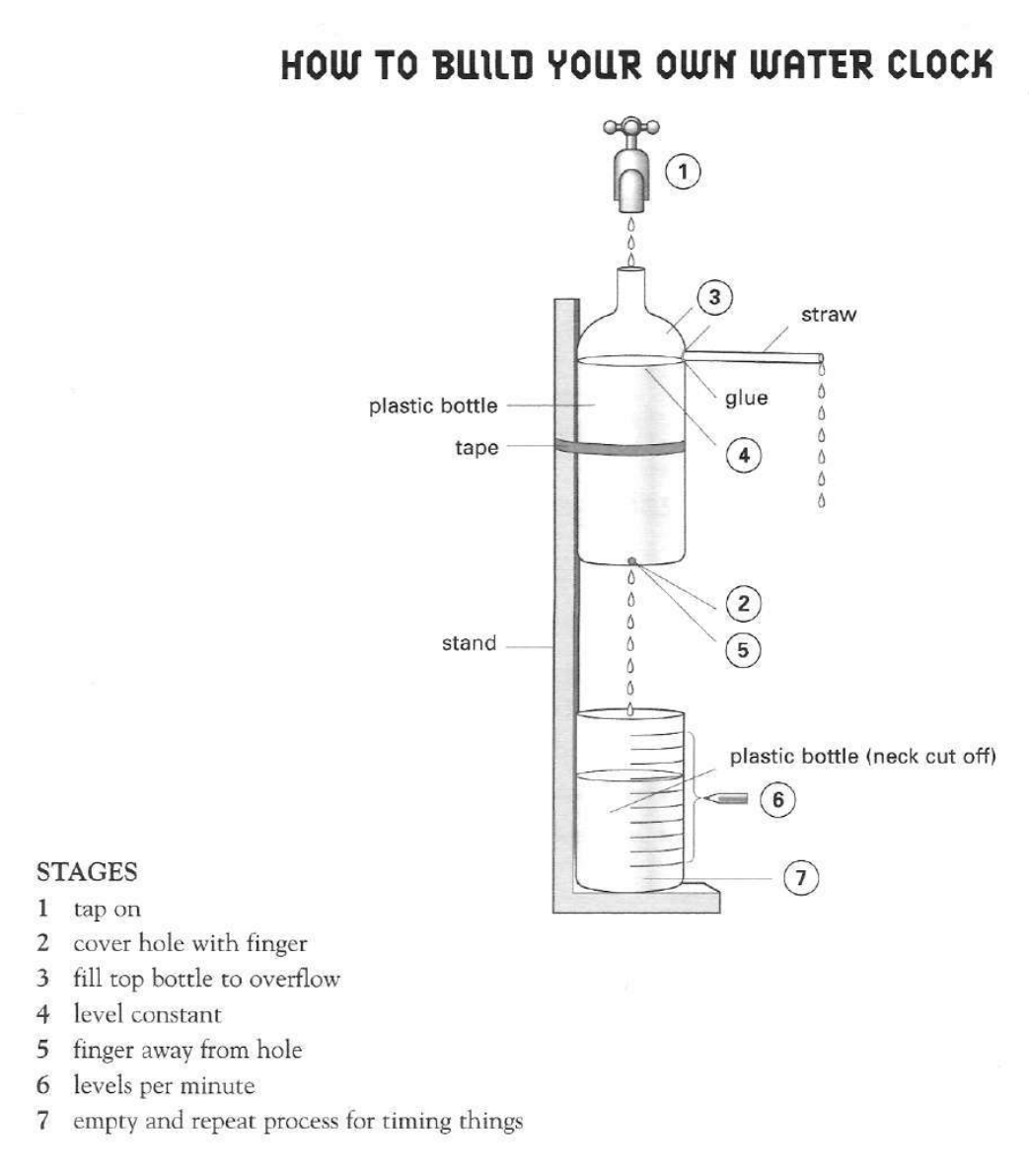
The diagram below shows the process for making a water clock.
Write a report for a university lecturer describing the information below.
HOW TO BUILD YOUR OWN WATER CLOCK
Student answer (Band 5.5)
The given diagram illustrates the process of building a water clock.
Overall, the diagram consists of seven primarly stages, which is a step-by-step process of how to make your own water clock with few objects. From the building of the construction to the using the final product normally.
Initially, everything starts with turning on the tap to pour the water into a plastic bottle which is taped to a stand. On the bottom of the stand there is a another plastic bottle and its neck is cut off to level bottle for per minute.
It is important to cut a hole in the first bottle and then cover it with a finger to strat the process on top of the bottle there is a straw glued to the construction, and when water is filled it comes out from that hole. Finally, your water clock is completed when cut bottle is filled, moreover you can empty it after time.
AI examiner evaluation
| Criterion | Band |
|---|---|
| Task Achievement / Task Response | 5.5 |
| Coherence and Cohesion | 6.0 |
| Lexical Resource | 5.0 |
| Grammatical Range and Accuracy | 5.0 |
| Overall | 5.5 |
Task Achievement / Task Response: Band 5.5
You identify the subject and give a broad sequence, including turning on the tap, filling the upper bottle, and using the lower bottle. However, several key stages are missing or unclear, so the process is only partly described. The diagram shows that the hole is covered before the upper bottle is filled to the overflow straw; water then drips into the lower bottle, where levels are marked to show minutes, before it is emptied and the process repeated. Your account instead says to cut a hole and suggests water comes out of the straw, which confuses the overflow outlet with the hole at the base. Develop the stages in their correct order and explain how the marked levels are used for timing.
Coherence and Cohesion: Band 6.0
The response has a recognisable introduction, overview, and sequence of details, and words such as “Initially,” “then,” and “Finally” help guide the reader. This gives the report an overall arrangement. However, progression is sometimes difficult to follow because several actions are combined in long sentences, and the order of the steps is not consistently clear. For example, the paragraph beginning “It is important to cut a hole” moves between covering the hole, the straw, and filling the bottle without clearly separating these stages. The overview sentence about “the using the final product normally” is also unclear. Use one paragraph for the overall process and organise the remaining steps in a clear chronological sequence, with precise links between actions.
Lexical Resource: Band 5.0
You use some relevant process vocabulary, including “tap,” “plastic bottle,” “stand,” “straw,” and “glued,” which helps identify the equipment. However, the range is limited, and several word choices or combinations are inaccurate enough to make parts of the process unclear. “Level bottle for per minute” does not clearly describe the lower container’s calibration marks, while “it comes out from that hole” leaves the reader unsure whether you mean water or the straw. There are also spelling and word-form errors, such as “primarly” and “strat.” Aim for precise terms for the apparatus and its function, such as “calibration marks,” “overflow,” and “water drips,” and check spelling before submitting.
Grammatical Range and Accuracy: Band 5.0
You attempt both simple and more extended sentences, and the basic meaning is often recoverable. However, complex constructions are frequently faulty, which sometimes makes the sequence hard to understand. For example, “From the building of the construction to the using the final product normally” is a sentence fragment, and “when cut bottle is filled” lacks a clear subject and article. There are also errors in articles and sentence structure in “there is a another plastic bottle,” as well as an unclear construction in “when water is filled it comes out.” Use complete sentences with an explicit subject for each stage, and check articles, verb forms, and punctuation. Shorter, controlled sentences would make the process clearer while you build accuracy.
See this exact question answered at other band scores. The same prompt compared across bands.
Browse more IELTS Writing model answers or get your own writing scored by the same AI examiner.