Band 5.5 IELTS Writing Task 1 Model Answer
Overall Band Score: 5.5 · IELTS Complete Catalyst · 2026-11-27
IELTS Writing Task 1 question
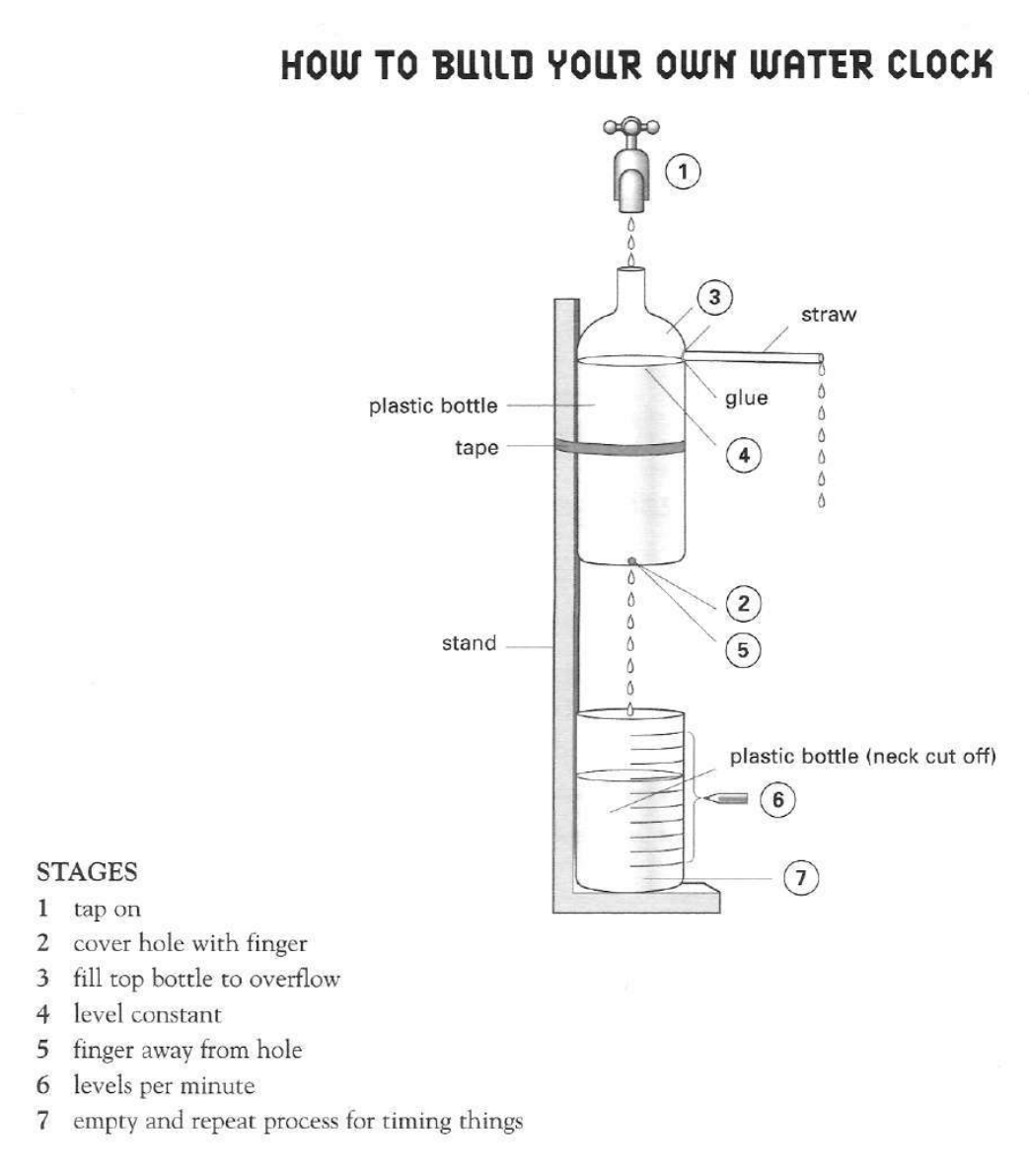
The diagram below shows the process for making a water clock.
Write a report for a university lecturer describing the information below.
HOW TO BUILD YOUR OWN WATER CLOCK
Student answer (Band 5.5)
The given diagram illustrates the process of making a water clock.
Overall, the whole procedure involves 7 steps including the use of a plastic bottle, tape, starw, and a stand.
The first steps requires filling the bottle that has been cut into two halves which is fixed with a stand using tape, and a straw is attached below the neck of the bottle using glue. A hole is inserted in the first half of the bottle which is coverd with finger. In the third step, bottle is filled with water until it overflows, and the level is made constant.
The finger is then removed away from the whole and the water level per minute is observed and noted by marking it using a pencil.The bottle is then emptied again, and the whole process is repeated several times for noting the time.In this was a water clock is build for own use.
AI examiner evaluation
| Criterion | Band |
|---|---|
| Task Achievement / Task Response | 6.0 |
| Coherence and Cohesion | 6.0 |
| Lexical Resource | 5.5 |
| Grammatical Range and Accuracy | 5.0 |
| Overall | 5.5 |
Task Achievement / Task Response: Band 6.0
You identify the diagram as a water-clock process and include several central stages: filling the upper bottle until it overflows, removing the finger, observing the water level, and emptying and repeating the process. The overview also correctly notes that there are seven steps. However, some construction details and stage relationships are unclear or inaccurate. For example, the diagram shows a hole at the base of the upper bottle, while your description says a hole is inserted and covered without clearly locating it. The straw is fixed near the top as an overflow drain, not below the bottle’s neck. The account also does not clearly explain that the lower, neck-cut bottle collects the dripping water and is marked to record levels. Covering these features would make the description more complete and precise.
Coherence and Cohesion: Band 6.0
The response has a clear overall shape: an introduction, a brief overview, and a sequence of process details. Sequencing expressions such as “In the third step,” “then,” and “The bottle is then emptied” help the reader follow the general order. However, the first body paragraph combines several construction and operating details in a way that makes the sequence difficult to track; for instance, “The first steps requires filling the bottle” does not clearly distinguish preparation from filling. Some references are also unclear, particularly “the whole” and “the bottle,” since the diagram contains upper and lower bottles. Organise the report into preparation and operation, and use precise references such as “upper bottle” and “lower container” to make the progression more consistently clear.
Lexical Resource: Band 5.5
You use relevant process vocabulary, including “overflows,” “attached,” “level,” and “repeated,” and the reader can generally understand the intended procedure. However, some word choices and collocations are imprecise or awkward: “the water level per minute is observed and noted” does not clearly express that levels are marked at one-minute intervals, while “removed away from the whole” is not a natural description of taking a finger away from the hole. There are also spelling errors, including “starw,” “coverd,” and “build.” Aim for accurate technical terms and natural process language, such as “overflow outlet,” “water drips,” and “mark the level at one-minute intervals.” This would make the description more precise and fluent.
Grammatical Range and Accuracy: Band 5.0
You attempt both simple and more developed sentences, including passive forms such as “is attached” and “is then emptied,” which suit a process description. However, errors in agreement, verb forms, articles, and sentence construction occur in several places. For example, “The first steps requires” has a plural-subject agreement problem, and “which is coverd with finger” needs a correct passive form and article. The final sentence, “In this was a water clock is build,” also contains faulty structure and verb form. Some long sentences join multiple stages without clear grammatical boundaries. Practise accurate passive constructions and check each sentence for a clear subject and correctly formed verb; this will improve control while retaining your attempts at varied structures.
See this exact question answered at other band scores. The same prompt compared across bands.
Browse more IELTS Writing model answers or get your own writing scored by the same AI examiner.