Band 4.5 IELTS Writing Task 1 Model Answer
Overall Band Score: 4.5 · IELTS Complete Catalyst · 2026-11-28
IELTS Writing Task 1 question
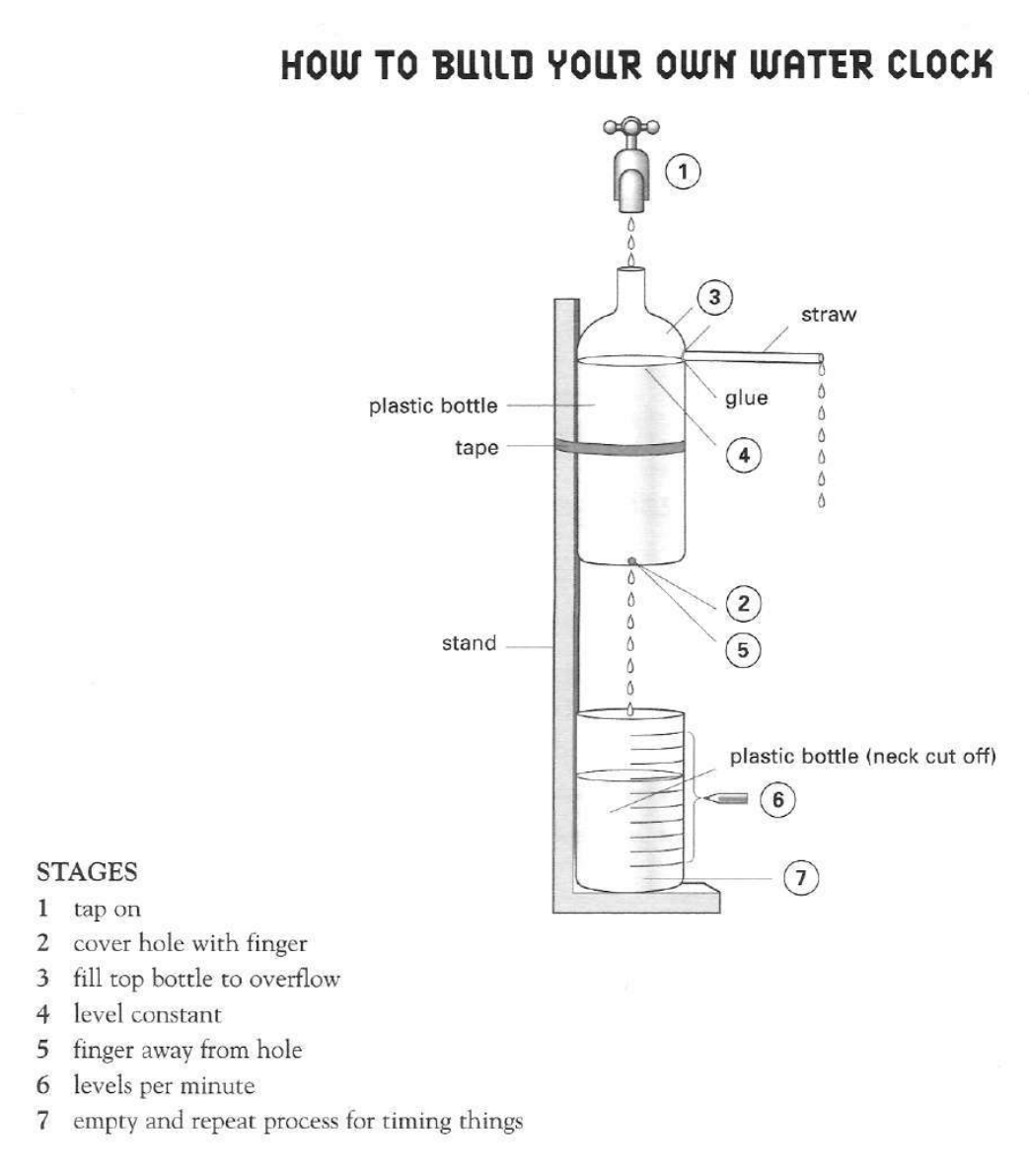
The diagram below shows the process for making a water clock.
Write a report for a university lecturer describing the information below.
HOW TO BUILD YOUR OWN WATER CLOCK
Student answer (Band 4.5)
so this diagharm give me information about water clock how to build own water clock so first of all i want a plastic bottle and then cut the bottle uper side and then put this bottle in stand and then i was put pipe so water easily down and up then i will putr glue and tap because water leak secondly i will add some water in bottle then i will give finger in bottle and see the water level then i will remove my finger and check the water how much time water can dowm and note the area 1 minute how water can down so last i will remove the water from bottle according my observation so how can find water clock so this is the best way and you can find easily water clock process so my opion this is 6 step and you can easily making a water clock
AI examiner evaluation
| Criterion | Band |
|---|---|
| Task Achievement / Task Response | 4.5 |
| Coherence and Cohesion | 4.5 |
| Lexical Resource | 4.5 |
| Grammatical Range and Accuracy | 4.5 |
| Overall | 4.5 |
Task Achievement / Task Response: Band 4.5
You identify the general purpose of the diagram and describe several relevant actions, including adding water, removing a finger, observing the water level and emptying the bottle. However, the report only minimally covers the process and includes important inaccuracies or omissions: the diagram shows seven stages, but you call it a “6 step” process, and you do not clearly explain that the upper bottle is filled until water overflows, that the water level is kept constant, or that the lower bottle is marked to measure levels per minute. Some construction details are also unclear. A more complete account of the apparatus and the full sequence would make the response more informative and accurate.
Coherence and Cohesion: Band 4.5
There is a basic sense of sequence, signalled by “first of all,” “then,” “secondly” and “so last,” and the reader can follow the broad idea of preparing and using the clock. However, the response is presented as one long, loosely connected passage, with several ideas joined by repeated “and then” or “so.” This makes the stages and the distinction between building the apparatus and operating it difficult to identify. Some references, such as “this bottle” and “the area,” are not sufficiently clear. Organise the report into a brief overview and ordered stages, using clear sequencing and more precise references.
Lexical Resource: Band 4.5
The vocabulary is basic and repetitive, with frequent reliance on general words such as “water,” “bottle,” “put” and “then.” Some wording communicates the intended action, for example “remove my finger,” but other choices are unclear or inaccurate, including “put pipe,” “note the area” and “water can dowm.” Spelling errors such as “diagharm,” “uper” and “opion” also make the report less clear. To improve, use specific process vocabulary from the diagram, such as “attach,” “overflow,” “drip,” “mark” and “calibrate,” and choose precise nouns for the components and measurements. This would make the description more accurate and easier to understand.
Grammatical Range and Accuracy: Band 4.5
The response relies mainly on simple clauses, and frequent errors in sentence formation and verb forms sometimes make the process difficult to follow. For example, “then i was put pipe” has an unclear verb construction, while “i will add some water” shifts into future tense even though the report describes the diagram’s procedure. Articles and sentence boundaries are also often missing, as in “i want a plastic bottle and then cut the bottle uper side.” Capitalisation and punctuation are inconsistent, and several clauses run together. Practise writing short, complete sentences in the present simple, such as “Water is added to the upper bottle,” before attempting longer linked sentences.
See this exact question answered at other band scores. The same prompt compared across bands.
Browse more IELTS Writing model answers or get your own writing scored by the same AI examiner.