Band 6.0 IELTS Writing Task 1 Model Answer
Overall Band Score: 6.0 · IELTS Complete Catalyst · 2026-11-28
IELTS Writing Task 1 question
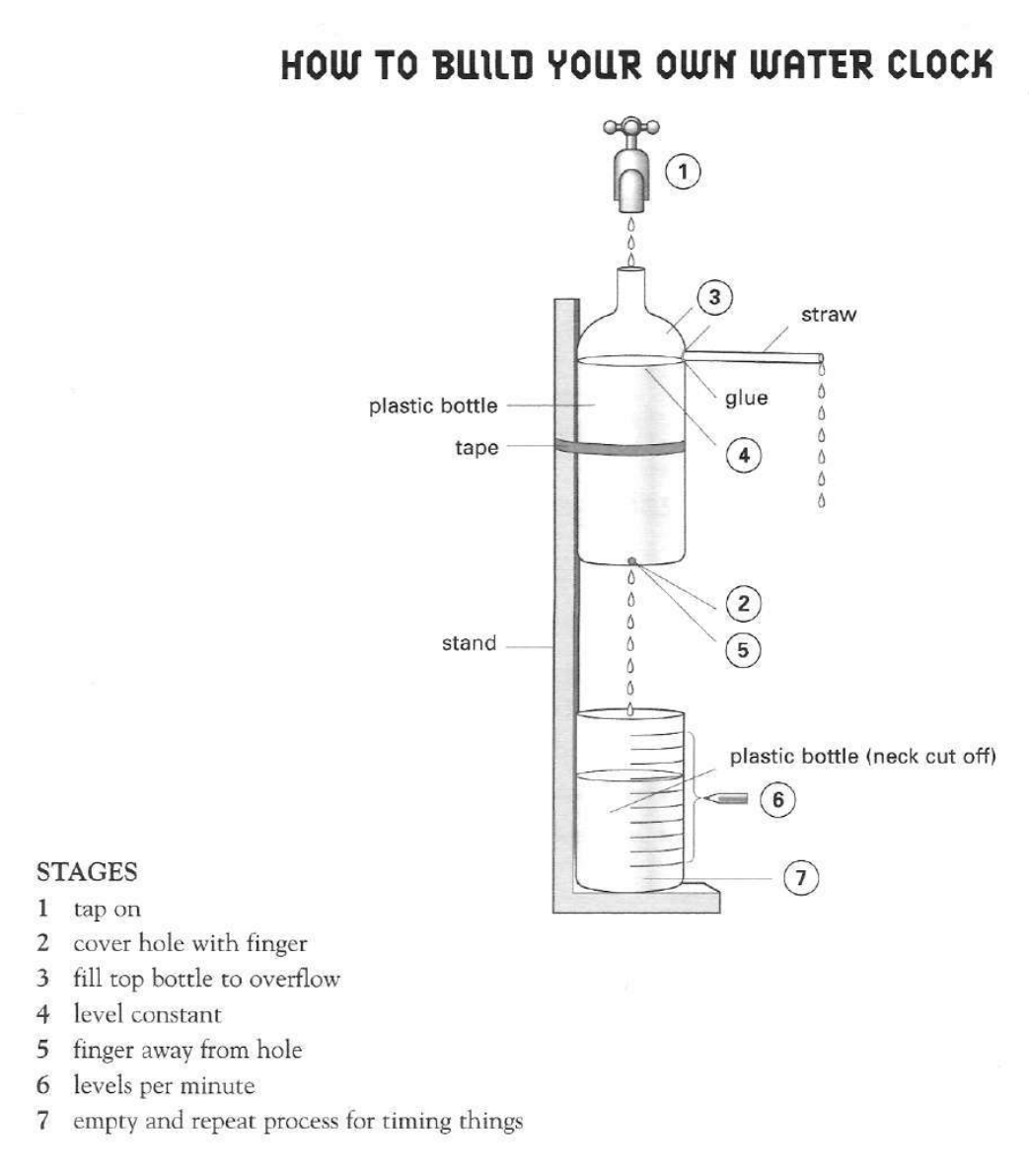
The diagram below shows the process for making a water clock.
Write a report for a university lecturer describing the information below.
HOW TO BUILD YOUR OWN WATER CLOCK
Student answer (Band 6.0)
The given diagram illustrates the procedure of making a water clock.
Overall, this process contains 7 stages. it begins with the tap on and ends with empty the plastic bottle and repeat process for timing things. It contain a stand, tape, glue, a tap, straw and two plastic bottles.
Firstly, the tap is on and water is filled in a bottle by a tap attached at the upper end of a stand. In addition, the bottle is attached with the stand by a tape. Furthermore, there is a holes at the bottom of the bottle attached on the upper end. These holes are covered with finger and top bottle is filled to overflow. However, the straw is also attached by a glue with upper end of the top bottle.
The level of water is constant in top bottle. Move finger away from the holes. Moreover, The water drains into the lower bottle attached at lower end of the stand. For instance, the neck of the lower bottle is cut off and level of water per minute is mentioned on it. At the end, empty the water bottles and repeat the process to measure the time.
AI examiner evaluation
| Criterion | Band |
|---|---|
| Task Achievement / Task Response | 6.5 |
| Coherence and Cohesion | 6.0 |
| Lexical Resource | 5.5 |
| Grammatical Range and Accuracy | 5.5 |
| Overall | 6.0 |
Task Achievement / Task Response: Band 6.5
The report covers the main stages and gives a clear overall summary: it identifies seven stages, from turning on the tap to repeating the process, and mentions the key equipment. It also describes the upper bottle, overflow straw, lower container and water draining between them, so the account is relevant and generally accurate. Some details are less fully or precisely explained, however. The diagram shows the water level in the upper bottle becoming constant before the finger is removed, while the response says this but does not clearly explain how the lower bottle’s markings are used to measure time. The final step is also described as emptying both bottles, whereas the instruction is to empty and repeat the process. More precise coverage of the calibration and sequence would strengthen the report.
Coherence and Cohesion: Band 6.0
The response has a recognisable structure: an introduction and overview are followed by descriptions of the apparatus and the operating stages. Sequencing words such as “Firstly,” “In addition,” and “At the end” help the reader follow the process. However, progression is sometimes uneven: the paragraph moves between construction details and operating steps, and “The level of water is constant in top bottle” begins a new paragraph without a clear link to the preceding actions. Some connectors are mechanical or do not express the intended relationship, as with “For instance” before the lower bottle’s features. Grouping the construction of the apparatus separately from the sequence of use, and using clearer references between steps, would make the organisation more consistently smooth.
Lexical Resource: Band 5.5
The response uses relevant process vocabulary, including “procedure,” “overflow,” “drains,” “stand,” and “attached,” and the reader can generally identify the components and actions. However, the range is somewhat limited, with repeated use of “bottle,” “attached,” and “water,” and several word choices or collocations are imprecise. For example, “level of water per minute is mentioned on it” does not clearly convey that calibration marks are drawn on the lower bottle, while “holes” is used where the diagram shows a single hole at the base. “Timing things” is understandable but informal for a report. More precise terms such as “markings,” “calibrated,” and “container” would improve clarity and suit the academic task better.
Grammatical Range and Accuracy: Band 5.5
There is an attempt to combine simple and complex sentences, including clauses with “and,” “while,” and “which”-type descriptions, and the main sequence remains understandable. Some grammatical errors persist in agreement, articles, verb forms and sentence construction. For example, “It contain a stand” should be “It contains a stand,” and “there is a holes” has a mismatch between the singular verb and plural noun. The overview’s “ends with empty” needs a gerund or infinitive construction, such as “ends with emptying.” Capitalisation is also inconsistent in “it begins” and “Moreover, The water.” These errors do not usually prevent understanding, but more reliable control of agreement and complete sentence patterns is needed.
See this exact question answered at other band scores. The same prompt compared across bands.
Browse more IELTS Writing model answers or get your own writing scored by the same AI examiner.