Band 5.5 IELTS Writing Task 1 Model Answer
Overall Band Score: 5.5 · IELTS Complete Catalyst · 2026-11-28
IELTS Writing Task 1 question
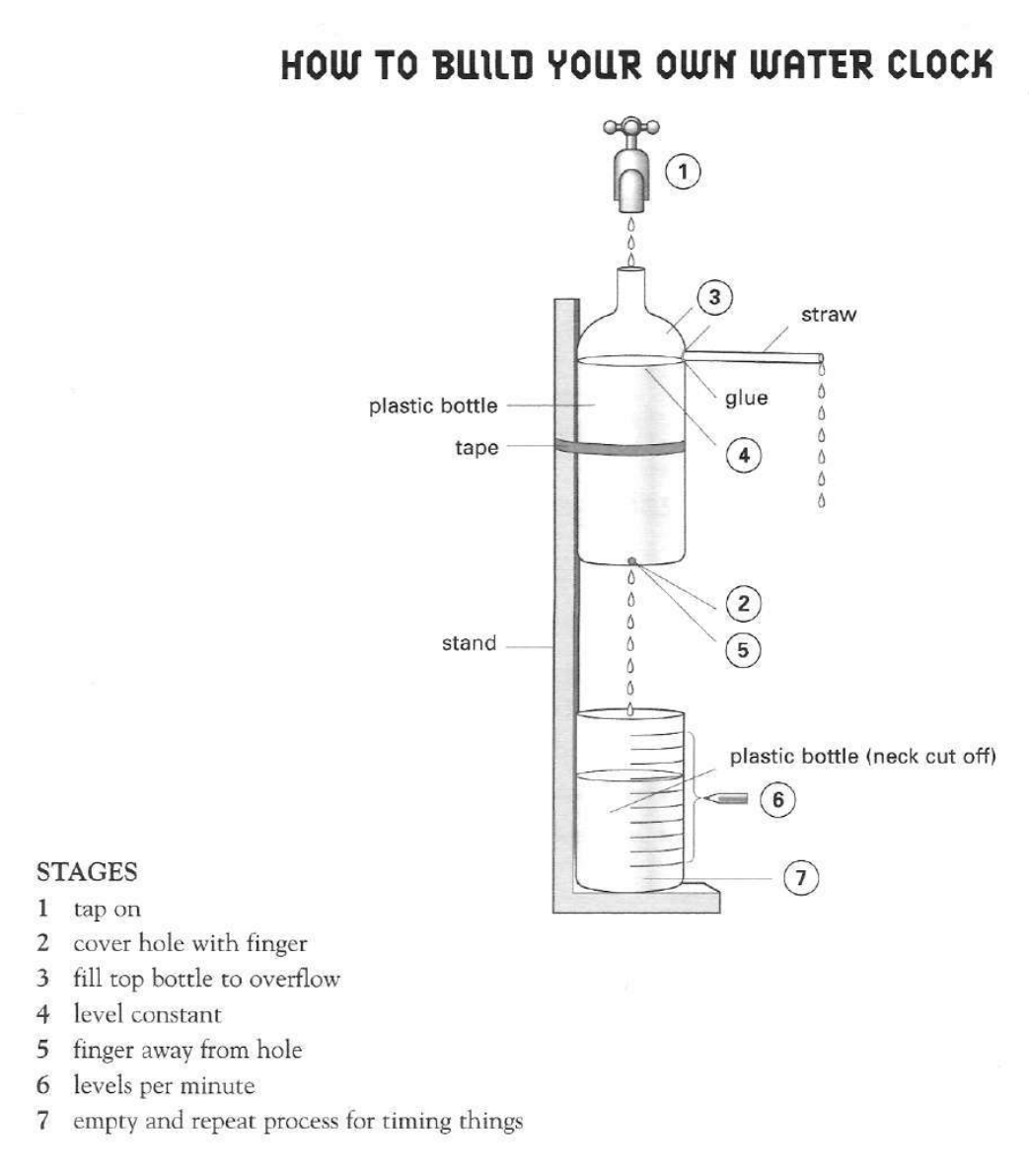
The diagram below shows the process for making a water clock.
Write a report for a university lecturer describing the information below.
HOW TO BUILD YOUR OWN WATER CLOCK
Student answer (Band 5.5)
The given image is illustrating the steps for building a water clock.
Overall, the process starts from filling bottle with water, whereas it ends with emptying the bottle and repeat the process.
Intially, the process shows that on the tap and fill the plastic bottle with water and that bottle is attached on the top of the stand with the help of the tape, also pipe is attached with that bottle with the help of the glue, after that there is a hole in the bottle which is covered with the finger and fill top bottle to overflow, when level get constant then finger get away from the hole. Subsequently, there is a beaker under the plastic bottle which shows the neck cut off and marked with the pencil, also analyse the levels per minute. In the last step, the water gets out from the beaker and again the repetition of this process held for timing things. So, it is the process which makes the other understand that how to build your own water clock.
AI examiner evaluation
| Criterion | Band |
|---|---|
| Task Achievement / Task Response | 6.0 |
| Coherence and Cohesion | 6.0 |
| Lexical Resource | 5.5 |
| Grammatical Range and Accuracy | 5.0 |
| Overall | 5.5 |
Task Achievement / Task Response: Band 6.0
You identify the diagram as a process and give an overall account of its beginning and ending, including filling the bottle and repeating the procedure for timing. Several relevant construction and operating details are also included, such as the stand, tape, glue, overflow pipe and lower bottle. However, some stages are unclear or inaccurately ordered: the tap is turned on before the hole is covered, and the upper bottle is filled until it overflows before the water level becomes constant and the finger is removed. Your account instead combines these actions in a confusing sequence. The calibration marks and the purpose of measuring levels per minute are mentioned, but not clearly explained. A more precise, stage-by-stage description would make the key features more fully covered.
Coherence and Cohesion: Band 6.0
The response has a recognisable overall structure: an introduction, an overview, and a body that follows the process towards its final stage. Sequencing expressions such as “Overall,” “after that,” “Subsequently,” and “In the last step” help the reader follow the general progression. However, most of the details are packed into one long body sentence, so the order of actions becomes difficult to track. For example, the filling, overflow, constant level and removal of the finger are joined together without clear boundaries. Some references, such as “that bottle” and “the bottle,” are also not always precise about which container is meant. Separate the construction from the operating stages and use shorter, clearly linked sentences.
Lexical Resource: Band 5.5
You use a reasonable range of task-related vocabulary, including “stand,” “overflow,” “hole,” “levels per minute,” and “timing things,” so the main subject is generally understandable. There are also attempts to describe components and actions rather than relying only on basic words. However, several choices are imprecise or unnatural for a process report: “pipe” is less accurate than “straw,” “beaker” misidentifies the lower plastic bottle, and “the repetition of this process held” does not express the final instruction naturally. Spelling errors such as “Intially” also reduce accuracy. Choose the labels shown in the diagram and use standard process vocabulary consistently to improve precision and fluency.
Grammatical Range and Accuracy: Band 5.0
You attempt both simple statements and longer sentences with sequencing clauses, and the overall meaning can usually be understood. However, the longer structures are not controlled consistently, and some errors make the sequence harder to follow. For example, “on the tap and fill” lacks a clear grammatical subject and verb form, while “when level get constant then finger get away” has problems with articles and subject–verb agreement. The final sentence, “the repetition of this process held,” also has an incorrect verb construction. There are some sentence-boundary and punctuation problems, particularly where several actions are joined by commas. Use complete clauses with consistent present-simple verbs, and divide the process into shorter sentences.
See this exact question answered at other band scores. The same prompt compared across bands.
Browse more IELTS Writing model answers or get your own writing scored by the same AI examiner.