Band 6.0 IELTS Writing Task 1 Model Answer
Overall Band Score: 6.0 · IELTS Complete Catalyst · 2026-11-28
IELTS Writing Task 1 question
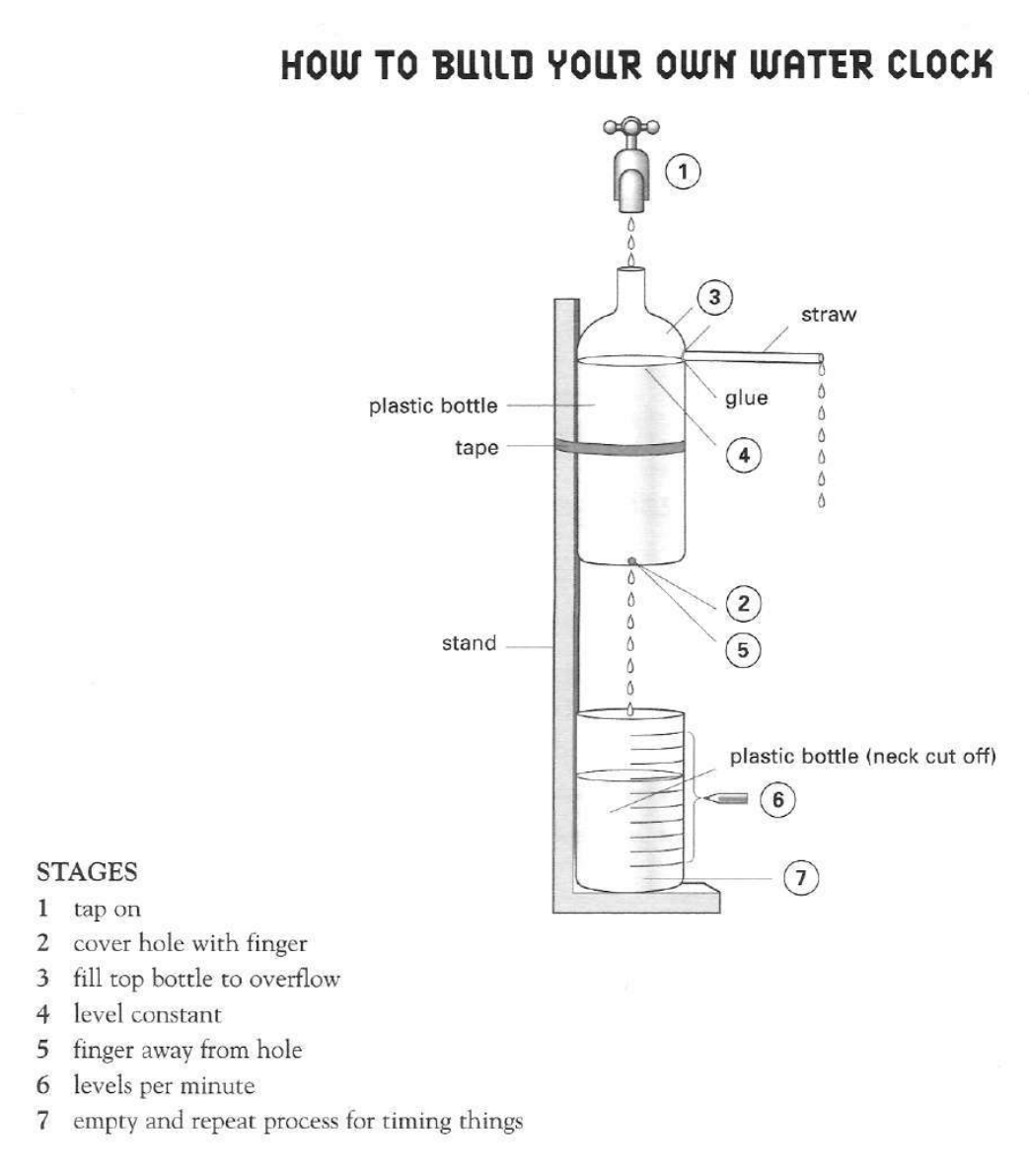
The diagram below shows the process for making a water clock.
Write a report for a university lecturer describing the information below.
HOW TO BUILD YOUR OWN WATER CLOCK
Student answer (Band 6.0)
The diagram illustrates the procedure to build a water clock. First of all a plastic bottle needs to be secured with tape on a stand. The process begins with placing the bottle secured to the stand under the tap, a hole needs to be poked on the bottom of the plastic bottle and a finger is placed over it. The tap is turned on and the bottle is filled up to the rim till it overflows then a straw is glued on to rim of the bottle so that it doesnot overflows and remains on a constant level. Once the bottle is filled with water then the finger is removed from the hole.
Another plastic bottle (neck cut off) is is placed right under the plastic bottle secured to the stand, the water droplets start to fall down into this plastic bottle. This neck cut bottle is marked with levels per minute. Eventually, the droplets keep on falling and the time measured according to the markings. Once the beaker is filled the time is measured. Afterwards, the bottle is emptied out and the whole process is repeated again.
AI examiner evaluation
| Criterion | Band |
|---|---|
| Task Achievement / Task Response | 5.5 |
| Coherence and Cohesion | 6.5 |
| Lexical Resource | 6.0 |
| Grammatical Range and Accuracy | 5.5 |
| Overall | 6.0 |
Task Achievement / Task Response: Band 5.5
You identify the overall purpose and describe the main sequence, including filling the upper bottle, releasing the water, collecting it below, and repeating the process. However, some details are inaccurate or unclear: the diagram says to cover the hole before filling, whereas your account introduces the finger after describing the bottle’s preparation; it also shows the straw attached near the top as an overflow drain, not added after filling. The calibration marks are on the lower bottle, but saying it is “marked with levels per minute” does not clearly explain that these marks are made as the water level changes. The claim that timing occurs once the container is filled is not shown. A more complete, accurate account of the setup and numbered stages would strengthen coverage.
Coherence and Cohesion: Band 6.5
The report has a generally clear progression, moving from assembling the upper bottle to collecting water below and repeating the process. The paragraph break also helps distinguish the apparatus from its use. Sequencing expressions such as “First of all,” “Once,” “Eventually,” and “Afterwards” guide the reader, and the overall arrangement is coherent. To make the progression more precise, follow the diagram’s numbered order consistently: the tap is turned on, the hole is covered, and the upper bottle is filled to overflow before the finger is removed. Some links are slightly awkward or repetitive, particularly the repeated references to “the plastic bottle,” and “Once” introduces two different stages. Clearer referencing and more controlled transitions would improve cohesion.
Lexical Resource: Band 6.0
You use an adequate range of vocabulary for describing a process, including “secured,” “overflows,” “droplets,” and “markings.” These choices help communicate the apparatus and its operation, and the meaning is generally understandable. Some wording is imprecise or not well matched to the diagram: “beaker” is not the container shown, and “levels per minute” does not clearly describe calibration marks. There are also spelling and form issues in “doesnot” and “neck cut bottle,” as well as repetition of “plastic bottle.” Use more exact process vocabulary and vary references to the containers; this would make the description more precise and natural.
Grammatical Range and Accuracy: Band 5.5
You attempt both simple and complex sentences, using time clauses such as “Once the bottle is filled with water” and a passive construction in “is placed right under.” The sequence remains understandable, but some errors in sentence structure, agreement, articles, and punctuation reduce accuracy. For example, “a straw is glued on to rim” needs an article before “rim,” while “so that it doesnot overflows” has an incorrect verb form after “does not.” The opening sentence also runs several actions together, making the order harder to follow. There is a duplicated “is” in “is is placed,” and extra spacing and missing punctuation affect readability. Check verb forms and divide long sentences into clearer stages.
See this exact question answered at other band scores. The same prompt compared across bands.
Browse more IELTS Writing model answers or get your own writing scored by the same AI examiner.