Band 6.5 IELTS Writing Task 1 Model Answer
Overall Band Score: 6.5 · IELTS Complete Catalyst · 2026-11-28
IELTS Writing Task 1 question
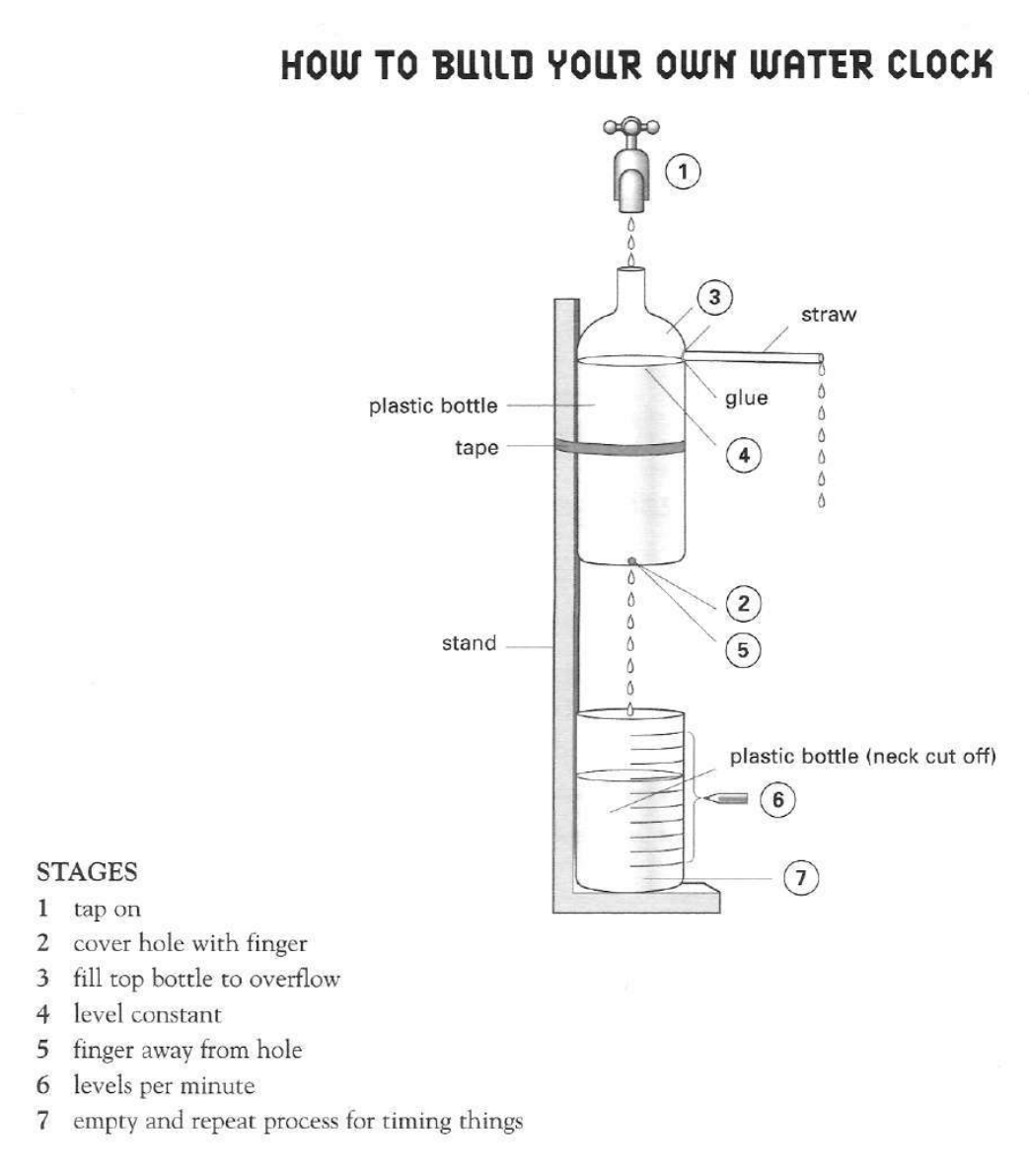
The diagram below shows the process for making a water clock.
Write a report for a university lecturer describing the information below.
HOW TO BUILD YOUR OWN WATER CLOCK
Student answer (Band 6.5)
The diagram illustrates the process to build your own water clock.
Overall, the stages show a science of water flowing down from the tap into the water bottle, which has a hole to further flow water into a different plastic bottle.
Firstly, the tap is on, for water to flow into the opening of the bottle. Further, the plastic bottle is sticked with a stand through a tape. Later, a hole at the bottom centre is covered with finger, in the second stage of the process. The water started overflowing the bottle, against which, a straw was glued at the 1/4th of the bottle from top as the constant level.
Meanwhile, the finger was pulled away from the hole to release the flow of water falling down in another plastic bottle kept below it. This plastic bottle neck was cut off and levels per minute were marked to keep a track. This second bottle can be emptied to repeat the process as many times as needed for timing things.
AI examiner evaluation
| Criterion | Band |
|---|---|
| Task Achievement / Task Response | 7.0 |
| Coherence and Cohesion | 6.5 |
| Lexical Resource | 6.0 |
| Grammatical Range and Accuracy | 5.5 |
| Overall | 6.5 |
Task Achievement / Task Response: Band 7.0
The report covers the main process from turning on the tap through to repeating the timing procedure, and it includes relevant construction details such as the stand, tape, straw and cut-off lower bottle. The overview identifies the general downward flow of water, while the final sentence captures the clock’s repeated use. This gives the reader a clear account of the diagram’s purpose and principal stages. Some details are less precise: the straw is described as being at “the 1/4th of the bottle from top,” whereas the diagram identifies it as an overflow outlet near the top, and the constant level is not clearly explained as the water level maintained by that outlet. Clarifying these functions would make the description more fully developed.
Coherence and Cohesion: Band 6.5
The response is arranged in a sensible sequence, with an opening, an overview and a chronological account that ends with emptying and repeating the process. Linking expressions such as “Firstly,” “Later” and “Meanwhile” help signal progression, and the reader can generally follow how water moves between the containers. However, some connections are awkward or unclear: “Further” does not naturally introduce the bottle’s attachment to the stand, and “against which” makes the relationship between overflow and the straw difficult to follow. The overview also repeats the basic flow rather than previewing the stages clearly. More precise transitions and clearer links between each action and its purpose would strengthen the progression.
Lexical Resource: Band 6.0
The response uses a reasonable range of process vocabulary, including “overflowing,” “glued,” “release the flow” and “marked,” and most of the equipment is identified clearly. These choices allow the reader to understand the general procedure. Some word choices and collocations are inaccurate or informal, however: “a science of water flowing down” is not a natural description of the process, “sticked” is not the correct form, and “kept below it” is less precise than describing the lower bottle’s position. “Constant level” also needs a clearer expression of what remains constant. Aim for accurate technical phrasing and natural collocations, especially when describing the apparatus and the function of each component.
Grammatical Range and Accuracy: Band 5.5
There is an attempt to use both simple and more developed sentence forms, including a relative clause in “which has a hole” and a passive construction in “was glued.” The sequence is usually understandable, but grammatical control is uneven. For example, “The water started overflowing” shifts into the past tense while the rest of the report mainly uses present forms; “a hole … is covered with finger” is missing an article; and “This plastic bottle neck was cut off” needs clearer grammatical phrasing. The sentence beginning “The water started overflowing the bottle, against which…” also has an unclear clause connection. Use consistent present tense for a process diagram and check articles, verb forms and clause links.
See this exact question answered at other band scores. The same prompt compared across bands.
Browse more IELTS Writing model answers or get your own writing scored by the same AI examiner.