Band 5.0 IELTS Writing Task 1 Model Answer
Overall Band Score: 5.0 · IELTS Complete Catalyst · 2026-11-06
IELTS Writing Task 1 question
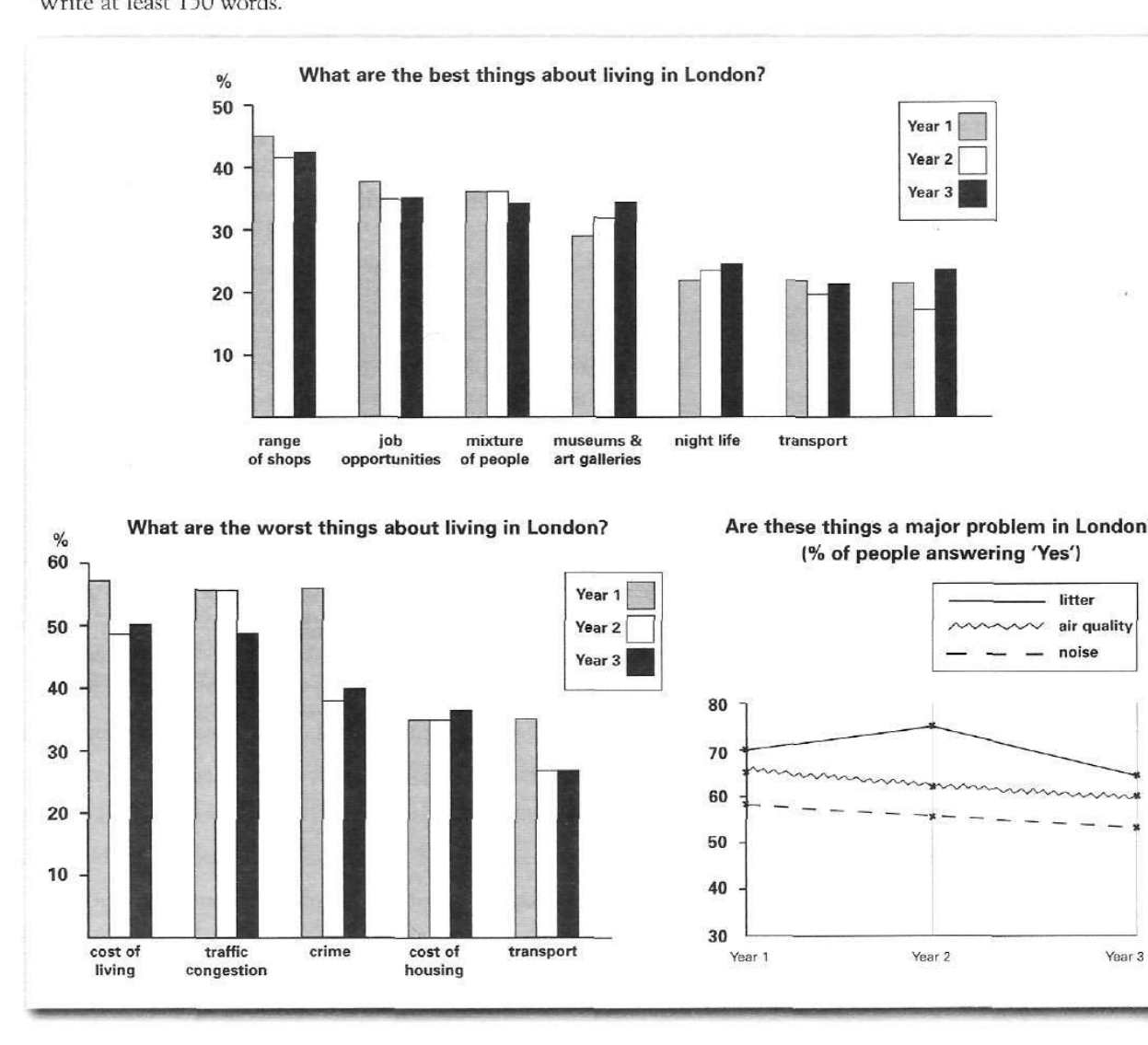
The bar charts and line graph below show the results of a survey conducted over a three-year period to discover what people who live in London think of the city.
Write a report for a university lecturer describing the information below.
What are the best things about living in London?
Student answer (Band 5.0)
The bar chart provided here, According to a survey depicts what people who are from London, think of the city. The bar chart is a result of the research that has been conducted by a university lecturer.
First we can talk what the best things about living in the city are, Firstly range of shops and stores in london were at its peak in year 1 after which it dropped a little, but the following year the percentage rose up again. There were decent job oppurtunities in london in the first year which it plummeted and stayed basically the same in both next years. Diversity of people in london stayed high and same for 2 years after which it declined a bit. Night life in a city like london has only just grown over the years and fluctuations can also be seen in transport.
Worst things when living in london include cost of living, high traffic, increasing crime, housing costs and transport, with these factors air quality and noise has stayed the same, Meanwhile litter grew till the second year after which it reduced to normal.
AI examiner evaluation
| Criterion | Band |
|---|---|
| Task Achievement / Task Response | 4.5 |
| Coherence and Cohesion | 5.0 |
| Lexical Resource | 5.5 |
| Grammatical Range and Accuracy | 5.0 |
| Overall | 5.0 |
Task Achievement / Task Response: Band 4.5
You identify several relevant categories and describe some broad movements, such as the slight recovery in the range of shops after Year 2 and litter peaking in Year 2 before falling. However, the report only partially covers the charts: it gives no figures, omits the separate chart showing whether litter, air quality and noise were considered major problems, and offers no clear overview of the main patterns. Some descriptions are inaccurate or too vague: job opportunities fell from Year 1 and then remained stable, rather than “plummeted,” while diversity was unchanged in Year 2 before declining. The claim that air quality and noise “stayed the same” also misses their gradual decreases. Select the most notable comparisons and support them with approximate percentages.
Coherence and Cohesion: Band 5.0
There is some organisation: the response moves from positive features to negative aspects, and phrases such as “after which” and “Meanwhile” help connect events. However, the progression is not consistently clear. The opening repeats the task and incorrectly says the research was conducted by a university lecturer, and the body combines several chart topics in one long paragraph without a distinct overview or clear grouping. The final sentence also shifts abruptly from costs and transport to air quality, noise and litter. Use separate paragraphs for the best features, worst features and problem ratings, and add a concise overview before the details. More precise links between each category and its trend would make the report easier to follow.
Lexical Resource: Band 5.5
You use a reasonable range of topic vocabulary, including “range of shops,” “job opportunities,” “diversity,” “traffic” and “fluctuations,” so the main subject is generally understandable. However, some wording is informal, imprecise or repetitive for an academic report. “Plummeted” exaggerates the modest fall in job opportunities, while “normal” does not clearly describe litter returning to a lower level. There are also spelling and capitalisation errors, including “oppurtunities” and repeated lowercase “london.” Aim for accurate chart language and consistent formal phrasing; terms such as “declined slightly,” “remained stable” and “recovered” would describe the data more precisely. Avoid adding unsupported descriptions such as “decent.”
Grammatical Range and Accuracy: Band 5.0
The response attempts some longer sentences with time clauses, for example, “after which it dropped a little,” and the meaning is usually recoverable. However, sentence control is uneven, with frequent problems in sentence boundaries, agreement and clause construction. The opening has awkward punctuation and capitalisation after “According to a survey,” while “First we can talk what…” is missing a grammatical link such as “about.” In “which it plummeted,” the clause structure is faulty, and “these factors air quality and noise has stayed” has unclear construction and subject–verb disagreement. Several ideas are joined by commas where full stops or clearer conjunctions are needed. Build shorter, accurate sentences first, then add controlled complex clauses.
See this exact question answered at other band scores. The same prompt compared across bands.
Browse more IELTS Writing model answers or get your own writing scored by the same AI examiner.