Band 4.5 IELTS Writing Task 1 Model Answer
Overall Band Score: 4.5 · IELTS Complete Catalyst · 2026-11-13
IELTS Writing Task 1 question
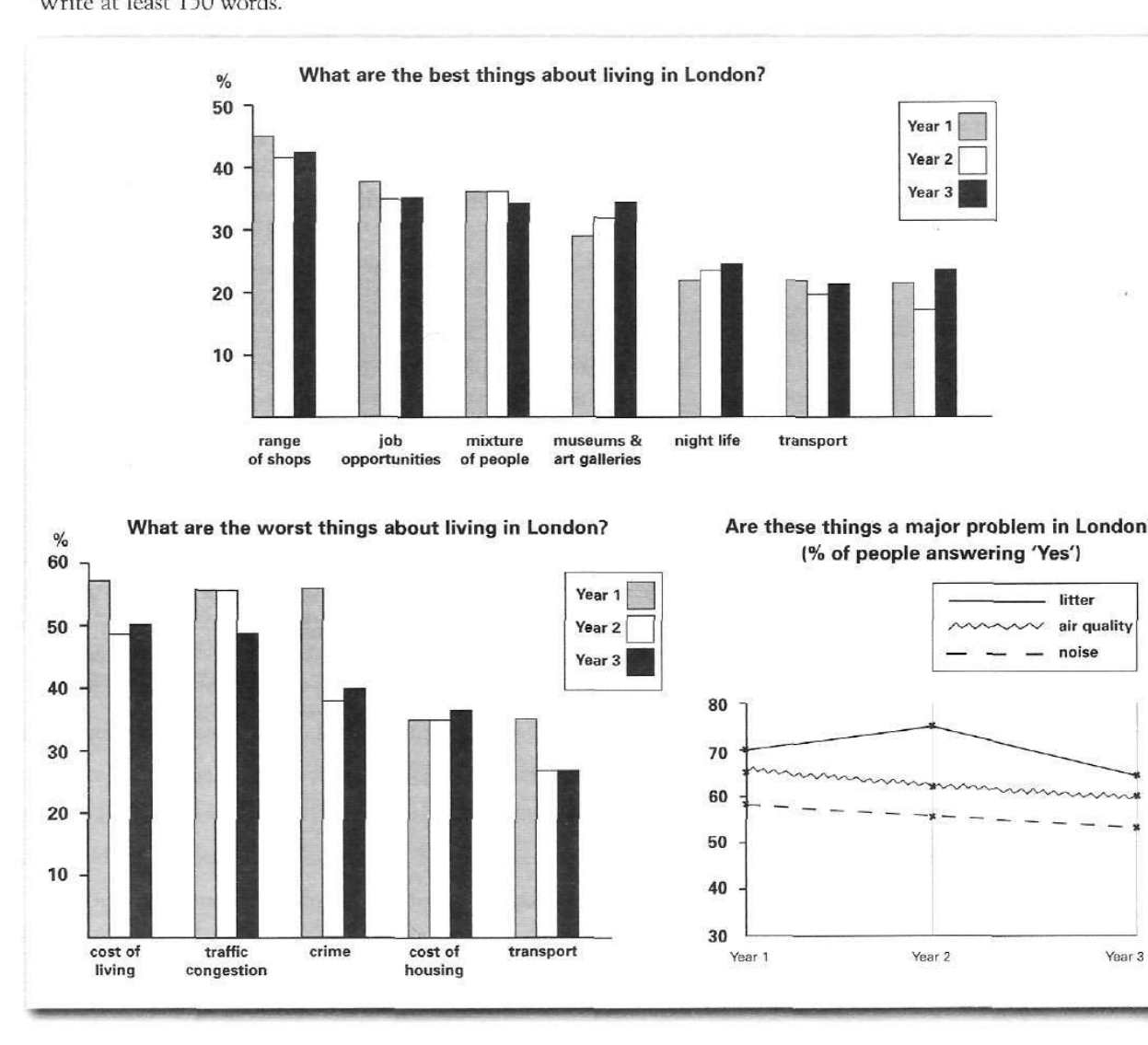
The bar charts and line graph below show the results of a survey conducted over a three-year period to discover what people who live in London think of the city.
Write a report for a university lecturer describing the information below.
What are the best things about living in London?
Student answer (Band 4.5)
The above bar and chart graph illustrates the result of a survey conducted over a three-year period to discover what people who live in London think of the city.
Here the bar and chart shows us a survey which was conducted over a three year period to search answers of what is the best things about living london and what is the worst things. There is also a survey which shows us the percentage value of those things are the major problem or not in London.
The bar and chart, reflected the best things of london were range of shops, job opportunities, mixtures of people, museums and art gallery, night life and transportation. All of these things were gradually increased in the three years of time period which reflects how best these things are. The value of 1st and 2nd year were almost identical whereas 3rd year value are lowest most of the cases.
AI examiner evaluation
| Criterion | Band |
|---|---|
| Task Achievement / Task Response | 3.0 |
| Coherence and Cohesion | 4.5 |
| Lexical Resource | 5.0 |
| Grammatical Range and Accuracy | 5.0 |
| Overall | 4.5 |
Task Achievement / Task Response: Band 3.0
You identify the survey’s subject and mention several relevant categories, including shops, jobs, museums and nightlife. However, the report is substantially incomplete: it describes only the positive features and does not report the worst things or the separate results for litter, air quality and noise. The claim that all positive features increased is inaccurate; for example, the range of shops fell from about 45% in Year 1 to 41.5% in Year 2, and transport also declined before a small recovery. There is no clear overview of the main patterns or meaningful numerical comparisons. The response is 134 words, below the required 150; the 21 words copied from the prompt are excluded from this count. Cover all three charts, select key comparisons, and support them with accurate figures.
Coherence and Cohesion: Band 4.5
The response has a basic sequence: it introduces the survey, explains its subject, and then begins describing the positive categories. This gives the reader some sense of the topic. However, the first two paragraphs repeat much of the same information, and the report does not progress through the full set of charts. The final paragraph groups several categories together without comparing their results, while phrases such as “Here” and “The bar and chart” do little to connect specific findings. Use a clear introduction, an overview of the main trends, and separate body paragraphs for the positive and negative findings, including the problem-rating graph. Link comparisons explicitly with terms such as “whereas” and “by contrast.”
Lexical Resource: Band 5.0
You use relevant topic vocabulary such as “job opportunities,” “range of shops,” “percentage,” and “night life,” so the reader can identify the subject matter. However, the range is limited and several phrases are imprecise or unnatural, including “search answers,” “the best things,” and “the value of 1st and 2nd year.” “Bar and chart graph” is also an unclear, repetitive label for the visuals. These choices sometimes make the intended meaning harder to follow, and the response relies on broad wording rather than precise language for describing data. Build a small set of accurate chart-reporting expressions, such as “accounted for,” “rose slightly,” “fell,” and “remained stable,” and use category names consistently.
Grammatical Range and Accuracy: Band 5.0
You attempt both simple and longer sentences, including a relative clause in “a survey which was conducted over a three-year period.” However, the range is limited, and errors recur in sentence construction and agreement. For example, “what is the best things” should use a plural construction, while “The value of 1st and 2nd year were” has an unclear subject and faulty agreement. The sentence beginning “All of these things were gradually increased” also uses an unsuitable passive form for describing trends. Articles and prepositions are sometimes missing or awkward, as in “living london.” Aim for direct, controlled sentences with a clear subject and verb, and practise accurate comparative structures such as “the figure for shops fell from Year 1 to Year 2.”
See this exact question answered at other band scores. The same prompt compared across bands.
Browse more IELTS Writing model answers or get your own writing scored by the same AI examiner.