Band 4.0 IELTS Writing Task 1 Model Answer
Overall Band Score: 4.0 · IELTS Complete Catalyst · 2026-11-18
IELTS Writing Task 1 question
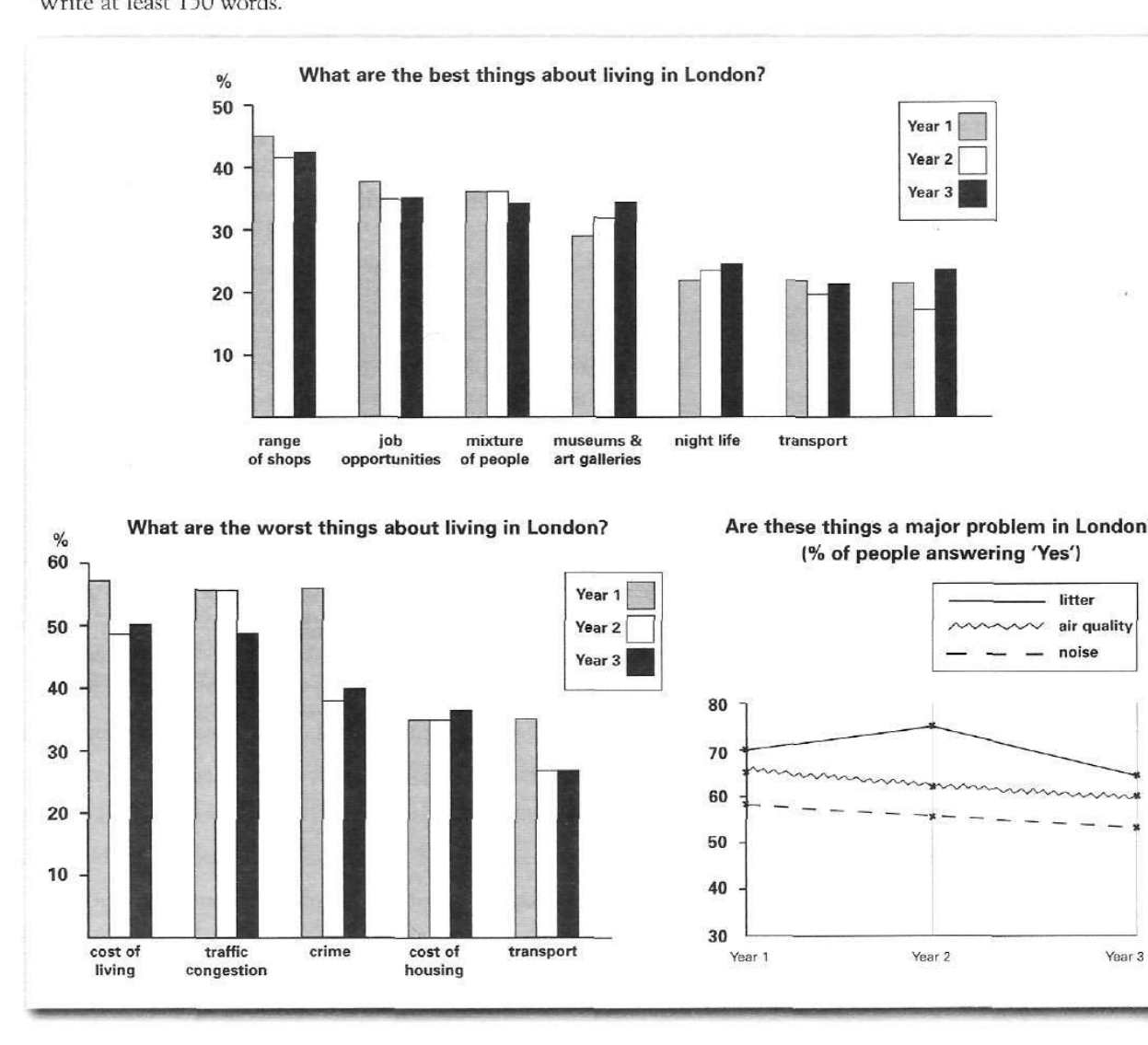
The bar charts and line graph below show the results of a survey conducted over a three-year period to discover what people who live in London think of the city.
Write a report for a university lecturer describing the information below.
What are the best things about living in London?
Student answer (Band 4.0)
in this diagram a graph show different things about living in london when you live in london in you have see 45 percent ranges of shop in our first year in london you have 40 percent chances of job opportunities
in london we see different types of people and we also see different types of nationallities and in centeral london we see many musem and art galleries
in london people chossee different transport some people use own private car and somebody use public transport in london we have many opportunities for better future in london if you are a hardworker you also have many best opportunities
i also perefer london for better future and i also live in london for better future and best study
AI examiner evaluation
| Criterion | Band |
|---|---|
| Task Achievement / Task Response | 3.0 |
| Coherence and Cohesion | 3.5 |
| Lexical Resource | 4.5 |
| Grammatical Range and Accuracy | 4.5 |
| Overall | 4.0 |
Task Achievement / Task Response: Band 3.0
The response makes a few relevant references to the charts, including “45 percent” for shops and “40 percent” for job opportunities, but the latter is not an accurate match for the chart’s approximate figure of 35–38%. Most of the report describes personal opinions or general facts about London rather than summarising the survey. It omits the worst-things chart and the line graph, and gives no clear overview of the main patterns across the three years. The task’s 150-word minimum is also not met. To improve, report the key comparisons from all three visuals, use accurate figures, and avoid personal comments such as “i also perefer london.”
Coherence and Cohesion: Band 3.5
There is a basic sequence of ideas, moving from shops and jobs to people, attractions, transport, and personal comments. However, the response is presented as one continuous block, with no clear introduction, overview, or organised body paragraphs. Connections between points are often unclear: for example, the sentence about transport shifts into “many opportunities for better future” without explaining how this relates to the chart. Repeated phrases such as “in london” and “we also see” do not create clear progression. Group the information by chart or by positive and negative features, and use simple linking phrases to show comparisons and changes over the three years.
Lexical Resource: Band 4.5
The response uses some relevant topic vocabulary, including “job opportunities,” “public transport,” and “museums and art galleries,” so the reader can identify several intended chart categories. However, the range is basic and repetitive, and some word choices are inaccurate or unclear, such as “ranges of shop” and “different types of nationallities.” Frequent spelling errors, including “chossee,” “musem,” and “perefer,” also reduce clarity and control. Personal phrases such as “better future” are repeated and are not useful for describing survey data. Build a more precise set of terms for reporting proportions and comparisons, and check spelling and collocations before submitting.
Grammatical Range and Accuracy: Band 4.5
The response attempts some longer sentences using “and,” “when,” and “if,” but most structures are simple or joined loosely, and grammatical control is inconsistent. The opening, “in this diagram a graph show different things,” has problems with articles, subject–verb agreement, and sentence structure. Other examples include “when you live in london in you have see” and “somebody use public transport,” where verb forms and agreement are faulty. Capitalisation and punctuation are also weak, making sentence boundaries difficult to follow. Practise accurate simple sentences first, then combine related ideas with controlled clauses, for example: “The proportion choosing shops was highest in Year 1, then rose slightly in Year 3.”
See this exact question answered at other band scores. The same prompt compared across bands.
Browse more IELTS Writing model answers or get your own writing scored by the same AI examiner.