Band 4.5 IELTS Writing Task 1 Model Answer
Overall Band Score: 4.5 · IELTS Complete Catalyst · 2026-11-18
IELTS Writing Task 1 question
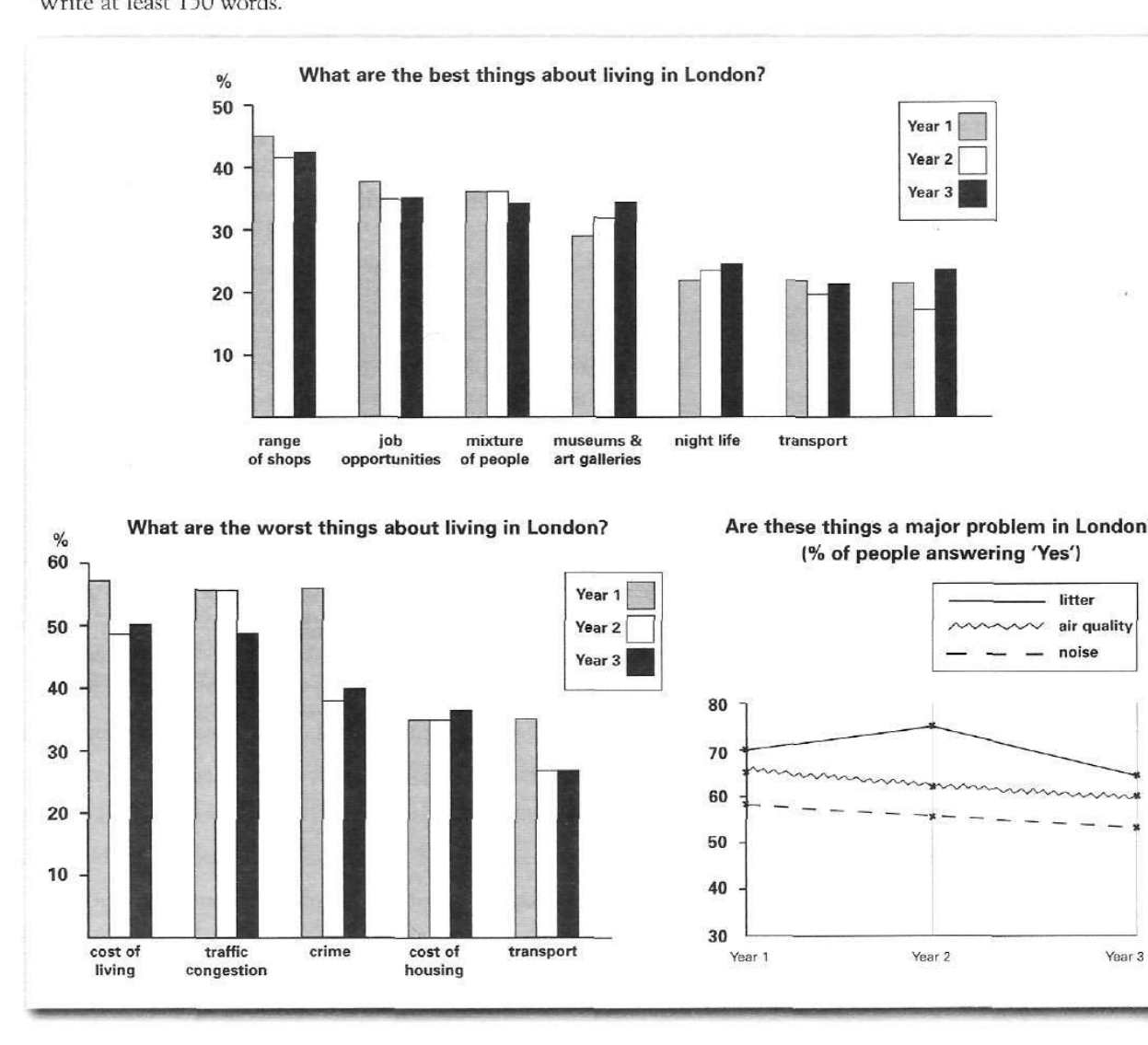
The bar charts and line graph below show the results of a survey conducted over a three-year period to discover what people who live in London think of the city.
Write a report for a university lecturer describing the information below.
What are the best things about living in London?
Student answer (Band 4.5)
the bar chart give us the information about the people who lives in London.In details there perspective according to the survey of last three year of people who lives there.The overcome feedback of people according to the living in London city we can see in the bar chart.The best thing about the London city is there are alot of benefits for people like range of shop,job opportunities, museum and art galleries these are things from which people prefer London over other cities.moving to the worest thing about the London city is cost of living which shoes there are to many inflation in London the percentage of cost of living is first year 60 percentage after one year it's shift to 45 percentage then next year the percentage is 55.The second most eritateing thing is crime rate .The crime rate in London is to much according to other city from which the fear increase in the heart of people.if we talk the percentage of last there year so first year was 60 then second year was 35 next year the percentage increase to 40 which was no good for the people who want to move this city
AI examiner evaluation
| Criterion | Band |
|---|---|
| Task Achievement / Task Response | 4.0 |
| Coherence and Cohesion | 4.0 |
| Lexical Resource | 5.0 |
| Grammatical Range and Accuracy | 5.0 |
| Overall | 4.5 |
Task Achievement / Task Response: Band 4.0
The response identifies some relevant features, including shops, job opportunities, cost of living and crime, and attempts to compare figures across the three years. However, it addresses the charts only minimally: it omits the separate chart about whether litter, air quality and noise are major problems, and gives no clear overview of the main patterns. Several figures are also inaccurate: cost of living is about 57%, 49% and 50%, not 60%, 45% and 55%; crime is about 56%, 38% and 40%, rather than 60%, 35% and 40%. The discussion of positive features is mostly a list without data. To improve, summarise the main trends across all three visuals and select accurate comparisons to support them.
Coherence and Cohesion: Band 4.0
There is a basic attempt to move from positive aspects to negative ones, signalled by phrases such as “The best thing” and “moving to the worst thing.” This gives the reader some sense of topic progression. However, the response is presented as one long paragraph, and ideas within it are not clearly grouped or ordered. The opening repeats the survey context without establishing an overview, while the final sentence ends on crime without a concluding summary. Linking phrases such as “if we talk” are conversational and do not clarify relationships between the data. Use separate paragraphs for an overview, positive features and problems, and connect comparisons explicitly with phrases such as “by contrast” or “over the period.”
Lexical Resource: Band 5.0
The response uses some task-related vocabulary, including “percentage,” “job opportunities,” “crime rate” and “cost of living,” so the reader can identify the general subject. However, the range is limited and several word choices or spellings make the report difficult to follow. Examples include “overcome feedback” for the survey results, “worest” for worst, “shoes” for shows, and “eritateing” for irritating. Phrases such as “to much inflation” and “fear increase in the heart of people” are also unnatural for an academic report. Aim for precise chart language, such as “the proportion of respondents,” “rose,” “fell” and “remained relatively stable,” and check spelling and collocations carefully.
Grammatical Range and Accuracy: Band 5.0
The response attempts to combine ideas using clauses, for example, “which was no good for the people who want to move this city,” but complex sentences are often faulty and the range of structures remains limited. Errors in agreement and verb forms appear in “the bar chart give us” and “people who lives,” while tense and sentence construction are unclear in “after one year it's shift to 45 percentage.” Missing or misplaced punctuation also causes run-on sentences, particularly in the opening, where several statements are joined without full stops. Practise accurate simple sentences first, then add controlled comparisons using “while,” “whereas” and “compared with.” Check subject–verb agreement, articles and sentence boundaries during editing.
See this exact question answered at other band scores. The same prompt compared across bands.
Browse more IELTS Writing model answers or get your own writing scored by the same AI examiner.