Band 4.0 IELTS Writing Task 1 Model Answer
Overall Band Score: 4.0 · IELTS Complete Catalyst · 2026-11-19
IELTS Writing Task 1 question
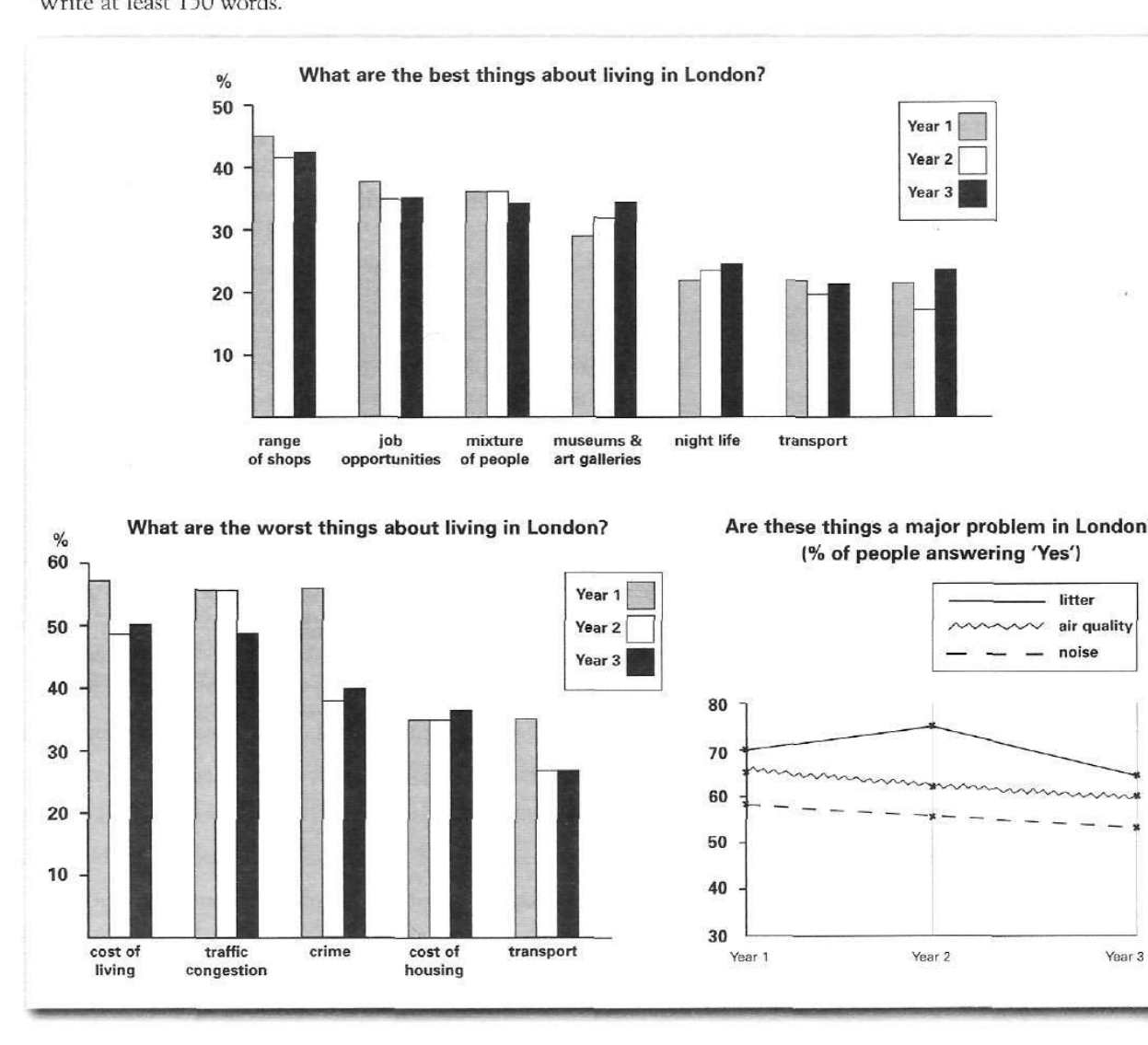
The bar charts and line graph below show the results of a survey conducted over a three-year period to discover what people who live in London think of the city.
Write a report for a university lecturer describing the information below.
What are the best things about living in London?
Student answer (Band 4.0)
According to the bar chart and line graph we can understand the ratio of education in the UK. If we see the ratio of transport from one year to 3 year it become more and more changed becouse at the start its not go in good position but while in the last the shop oppurtunity range are go forwerd. But when we see it in the past its go slowelly and gradually high. Their measurement in the past is so low down as comparred to the last. The measurement of that in,Transport, Measure and art gallaries are so in low quality but while we see in the last it become more and more highly.
While in the job oppurtunity its go aheda in high ranking .So nothing is go down with the passege of time iif someone have want to do.
AI examiner evaluation
| Criterion | Band |
|---|---|
| Task Achievement / Task Response | 3.0 |
| Coherence and Cohesion | 3.5 |
| Lexical Resource | 4.5 |
| Grammatical Range and Accuracy | 4.5 |
| Overall | 4.0 |
Task Achievement / Task Response: Band 3.0
The response makes a limited attempt to describe the charts, but it does not accurately identify the survey’s subject: it calls the data “the ratio of education in the UK,” whereas the charts concern residents’ views of London. It mentions shops, transport, museums and job opportunities, but gives no reliable figures and makes unsupported claims such as “nothing is go down” over time. Several trends are unclear or inaccurate; for example, the range of shops does not rise steadily, and transport changes only slightly. There is no clear overview of the main positive and negative findings, and the worst-things chart and problem line graph are essentially omitted. The response is also 9 words below the required minimum. To improve, summarise the main patterns and support them with accurate comparisons from all three charts.
Coherence and Cohesion: Band 3.5
There is a basic attempt to connect ideas through phrases such as “But when we see” and “while,” and the response broadly moves from one feature to another. However, it is presented as one paragraph without a clear introduction, overview or organised detail, so the reader cannot follow a logical report structure. References such as “it,” “that” and “their measurement” are unclear, and the repeated time references (“in the past,” “in the last”) do not establish which year or category is being discussed. Some linking words also create confusing relationships between ideas. Use separate paragraphs for an overview and key comparisons, and name the category and year directly rather than relying on vague pronouns.
Lexical Resource: Band 4.5
The response attempts some topic-related vocabulary, including “transport,” “job opportunity,” “shop” and “art galleries,” so the reader can recognise a few chart categories. However, the range is narrow and several choices are inaccurate or unnatural, such as “ratio of education,” “shop opportunity range” and “high ranking.” Spelling errors—including “becouse,” “oppurtunity,” “forwerd,” “gallaries” and “comparred”—also reduce clarity. Repeated general words such as “good,” “low” and “high” do not describe the data precisely. Build a small set of accurate chart-reporting expressions, for example “the proportion of respondents,” “ranked highest,” “rose slightly” and “remained broadly stable,” and check spelling before submitting.
Grammatical Range and Accuracy: Band 4.5
The response attempts to form longer sentences using time clauses and contrast, as in “when we see it in the past” and “But when we see it…,” but control is weak and sentence patterns are repetitive. Verb forms and agreement are often incorrect: “it become,” “its not go,” and “the shop… are go” make the relationships difficult to understand. Articles and prepositions are also frequently missing or misplaced, and punctuation is inconsistent, including the comma in “in,Transport.” These errors occur throughout, although the general topic can sometimes be inferred. Practise accurate simple comparisons first—such as “The figure for transport remained stable”—then add controlled clauses with “while” or “whereas.”
See this exact question answered at other band scores. The same prompt compared across bands.
Browse more IELTS Writing model answers or get your own writing scored by the same AI examiner.