Band 5.0 IELTS Writing Task 1 Model Answer
Overall Band Score: 5.0 · IELTS Complete Catalyst · 2026-11-21
IELTS Writing Task 1 question
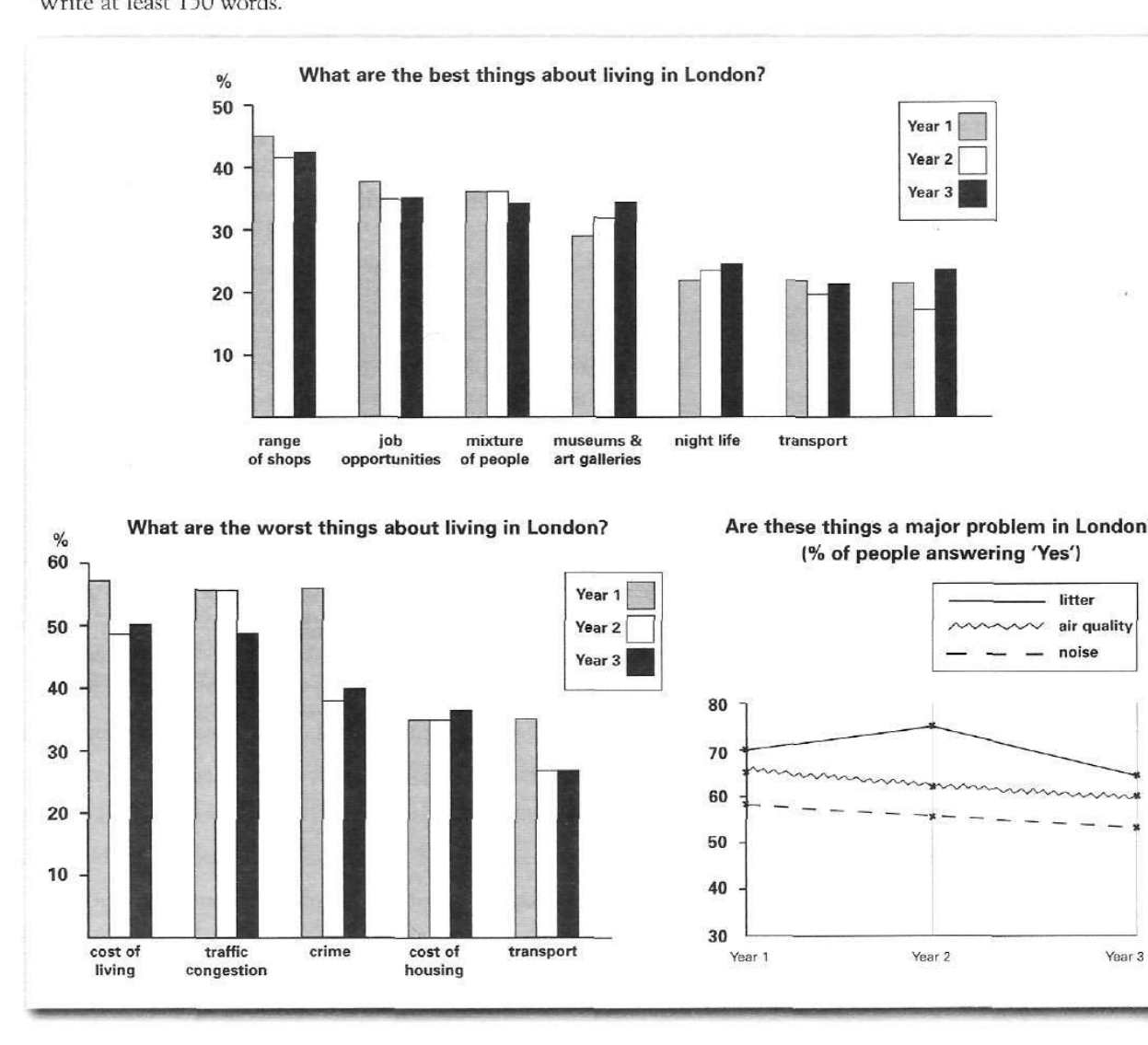
The bar charts and line graph below show the results of a survey conducted over a three-year period to discover what people who live in London think of the city.
Write a report for a university lecturer describing the information below.
What are the best things about living in London?
Student answer (Band 5.0)
The figures shows the results of a three year period survey which was meant to know how people of London think about their city.
It was conducting on three main questions about the best things about living, the worst and if problems like the litter, air quality and noise are considered major problems or not. The first two questions were categories and the last was true or false.
Regarding the first question, more than 40% of the people says that the range of shops are the best and this result last for the 3 years. Another main finding here is that the museums and art galleries percentages was going up which may indicate that their quality was increasing.
For the second question, most people complain about the cost of living, the traffic congestion and the crime. The crime rate dropped around 20% in the second year. The transport was the least one on both questions so people seem to be neutral about it.
The last question's results was decreasing over the three years.
AI examiner evaluation
| Criterion | Band |
|---|---|
| Task Achievement / Task Response | 5.0 |
| Coherence and Cohesion | 5.5 |
| Lexical Resource | 5.0 |
| Grammatical Range and Accuracy | 5.0 |
| Overall | 5.0 |
Task Achievement / Task Response: Band 5.0
You identify the three survey topics and report several relevant findings, including the prominence of shops, the rise in mentions of museums and galleries, and the decline in the final set of results. However, the report only partially covers the data: it gives few figures and omits important comparisons across years. The claim that shops were selected by “more than 40%” throughout is broadly accurate, but the crime figure did not drop by around 20% in Year 2; it fell from about 56% to 38%, a decrease of roughly 18 percentage points, then rose slightly. The statement that transport was least in both questions is inaccurate: it is the lowest listed positive feature, but not the lowest negative feature in every year. Add a clear overview and more precise comparisons.
Coherence and Cohesion: Band 5.5
The response has a basic, sensible sequence: an introduction, a description of the survey, and separate paragraphs for the three questions. Phrases such as “Regarding the first question” and “For the second question” help readers follow the topic changes. However, the progression within the paragraphs is limited, and the final sentence gives only a broad statement without identifying which results declined or how they compare. Some linking is also mechanical, with repeated references to “the first/second/last question.” Grouping related trends and using clearer references—for example, “the percentages for litter, air quality and noise all fell”—would make the report more cohesive. A concise overview after the introduction would also give the information a clearer overall structure.
Lexical Resource: Band 5.0
You use enough topic vocabulary to communicate the main subject, including “range of shops,” “job opportunities,” “traffic congestion,” and “air quality.” There are also attempts at more formal reporting language, such as “main finding” and “results.” However, the range is limited, and several word choices or collocations are noticeably unnatural: “meant to know,” “people of London,” and “the least one” are not idiomatic in this context. “The first two questions were categories and the last was true or false” also describes the chart inaccurately rather than using precise survey terminology. Build a wider set of natural reporting expressions, such as “respondents,” “was regarded as,” and “accounted for,” and use them accurately to describe the data.
Grammatical Range and Accuracy: Band 5.0
The response includes mostly short, straightforward sentences, with a few attempts to add clauses, as in “which may indicate that their quality was increasing.” However, grammatical errors occur frequently and sometimes make the intended meaning less clear. Examples include “The figures shows,” “It was conducting,” “more than 40% of the people says,” and “the results was decreasing”; these show problems with agreement and verb forms. There are also errors in sentence construction, such as “the best things about living” without specifying the city, and “the first two questions were categories.” Practise accurate subject–verb agreement and past-tense reporting, then combine simple sentences with controlled clauses. Proofreading each sentence for its subject and verb would improve clarity.
See this exact question answered at other band scores. The same prompt compared across bands.
Browse more IELTS Writing model answers or get your own writing scored by the same AI examiner.