Band 5.0 IELTS Writing Task 1 Model Answer
Overall Band Score: 5.0 · IELTS Complete Catalyst · 2026-11-17
IELTS Writing Task 1 question
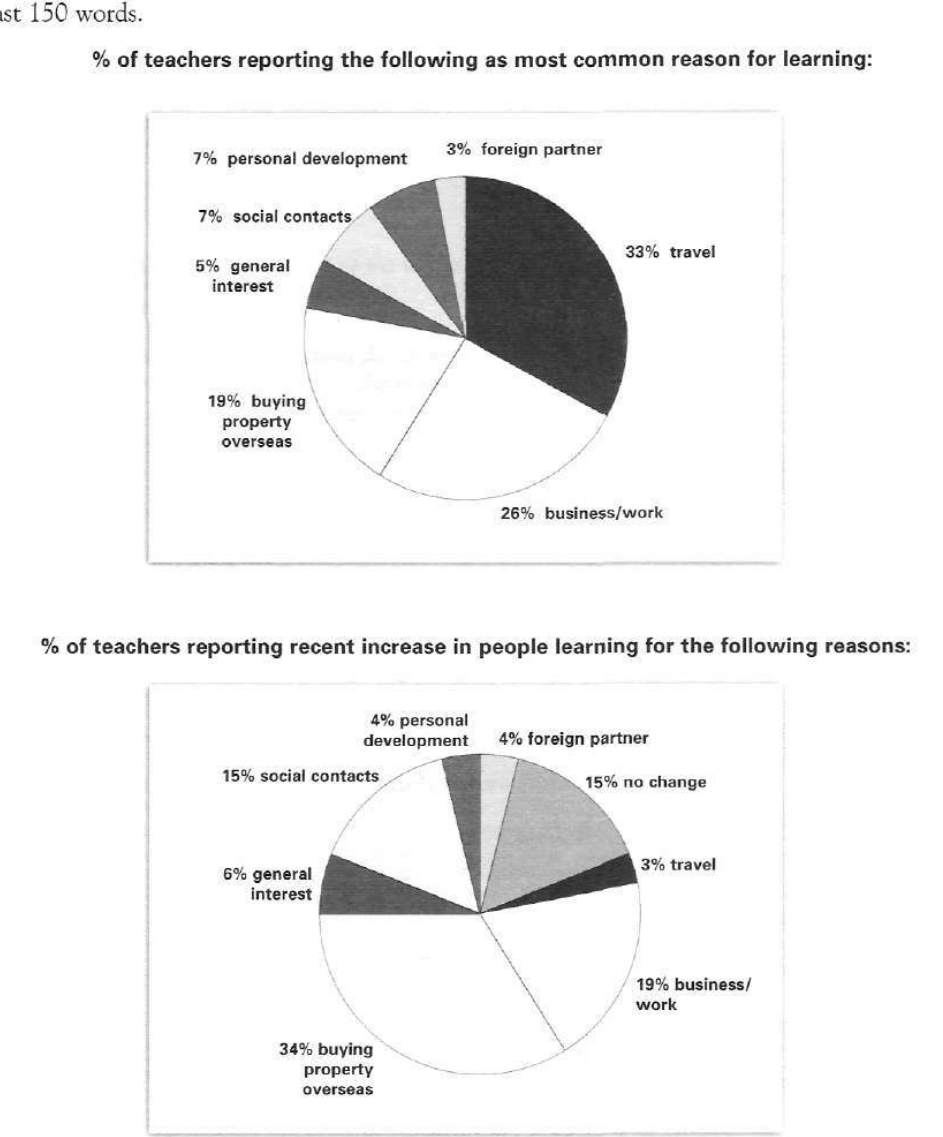
The pie charts below show responses by teachers of foreign languages in Britain to a survey concerning why their students are learning a foreign language. The first chart shows the main reason for learning a foreign language. The second chart shows how many teachers felt that there has been a recent change in the reason.
Write a report for a university lecturer describing the information below.
% of teachers reporting the following as most common reason for learning:
Student answer (Band 5.0)
This pie charts illustrate responses by teachers of foreign languages in Britain to a survey cocerning why their students are learning a foreign language.
the pie chart gives us a general infirmations about the cause of studying new language different from the mother one , in the first pie chart we can confirm that a huge number of people want to learn new language beacuse they want to travel abroad ,in the other hand a lower oercent for humans who has foreign partner, general interest, social contacts and personal development in contrast good number of who learn for bussines work and for individuals who learn in order to byuing preperty oversease is not large number.
the seconde pie chart confirm that a hight number of people learn language to buy property oversease but a very lower percentage of those who learn fo travel purposes while social contact and no change has the same percentage and personal development alsp very lower.
AI examiner evaluation
| Criterion | Band |
|---|---|
| Task Achievement / Task Response | 4.0 |
| Coherence and Cohesion | 5.0 |
| Lexical Resource | 5.0 |
| Grammatical Range and Accuracy | 5.0 |
| Overall | 5.0 |
Task Achievement / Task Response: Band 4.0
You identify the broad topic and mention several relevant reasons, including travel, business/work and buying property overseas. However, the report only minimally describes the charts: it gives no figures and does not clearly compare the two sets of responses. Some statements are inaccurate or unclear—for example, you say social contacts and “no change” have the same percentage, although they are 15% and 15% in the second chart, while the first chart’s social-contacts figure is 7%; you also describe buying property as “not large” in the first chart without explaining its 19% share. There is no clear overview of the main contrasts. The response is 140 words, below the required 150, which further limits coverage. Add an overview and accurate key figures.
Coherence and Cohesion: Band 5.0
The response has a basic sequence: it introduces the charts, discusses the first, and then turns to the second. This gives the reader some sense of the subject and order. However, the ideas are crowded into two long paragraphs, with no clear overview or well-defined comparison between charts. Linking phrases such as “in the other hand” and “in contrast” are used awkwardly, and the second paragraph lists observations without showing how they relate to the first chart. Several clauses run together, making the progression difficult to follow. Use separate paragraphs for an overview and the main details, and organise comparisons around the most important figures rather than listing reasons in a loose sequence.
Lexical Resource: Band 5.0
You use some relevant topic vocabulary, including “foreign partner,” “travel,” “business/work,” and “personal development,” so the reader can recognise the chart categories. However, the range is limited and several spelling and word-choice errors make the report less clear, such as “infirmations,” “beacuse,” “bussines,” “preperty,” and “oversease.” Phrases such as “a huge number of people” and “a very lower percentage” are imprecise or unnatural for describing percentages. Use accurate chart-reporting language, for example “the largest share,” “accounted for,” and “the smallest proportion,” and check the spelling of category labels. More precise vocabulary would help distinguish the teachers’ reported reasons from the students themselves.
Grammatical Range and Accuracy: Band 5.0
You attempt to combine ideas using clauses, as in “people want to learn new language because they want to travel abroad,” but sentence structures are often faulty or run together. Errors include missing articles and plural forms (“This pie charts,” “learn new language”), subject–verb agreement (“a lower percent for humans who has”), and incomplete or unclear clause construction. Capitalisation and punctuation are also inconsistent: the response begins a new sentence with lowercase “the,” and long clauses are joined mainly by commas. These problems sometimes make relationships between ideas difficult to understand. Practise writing shorter, complete sentences with a clear subject and verb, then add controlled complex structures using accurate articles, agreement and punctuation.
See this exact question answered at other band scores. The same prompt compared across bands.
Browse more IELTS Writing model answers or get your own writing scored by the same AI examiner.