Band 5.5 IELTS Writing Task 1 Model Answer
Overall Band Score: 5.5 · IELTS Complete Catalyst · 2026-11-25
IELTS Writing Task 1 question
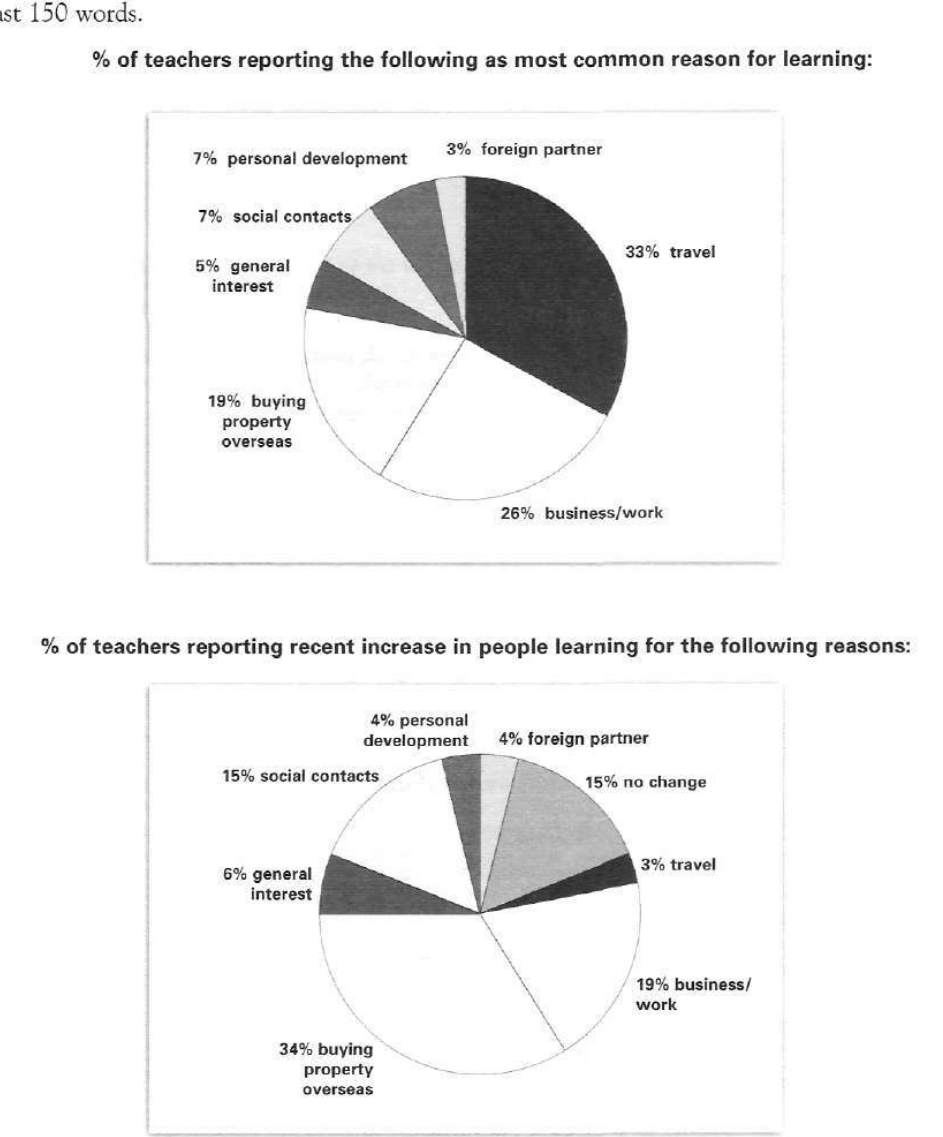
The pie charts below show responses by teachers of foreign languages in Britain to a survey concerning why their students are learning a foreign language. The first chart shows the main reason for learning a foreign language. The second chart shows how many teachers felt that there has been a recent change in the reason.
Write a report for a university lecturer describing the information below.
% of teachers reporting the following as most common reason for learning:
Student answer (Band 5.5)
The pie charts propotion shows reasons for students to learn foreign languages and the other one for what are the reasons in recent growth of learners.
Overall, the reason for learning different language has massively changed in recent report. Before the biggest reason was travel however now it is the lowest reason for learning new language. Buying property overseas increased and became the biggest reason to learn following it second come the work/business maintaining its position. Other reasons are working stabally.
Travel position from 33% decreased to only 3% and oversea buyer becomes the first reason 34% propotion for learning language. It is also because of 15% of no change in people. Work/ business came down from 26% to 19% yet remaining second biggest reason for learnig.
Personal development and social contact both had different inexperience in new report where both were at same rate of 7% now personal development came down to 4% and social contact grown to 15%. General interest and foreign partner remained lowest of all reason with 6% and 4%.
AI examiner evaluation
| Criterion | Band |
|---|---|
| Task Achievement / Task Response | 6.0 |
| Coherence and Cohesion | 6.0 |
| Lexical Resource | 5.0 |
| Grammatical Range and Accuracy | 5.0 |
| Overall | 5.5 |
Task Achievement / Task Response: Band 6.0
You identify the main contrast accurately: travel falls from 33% to 3%, while buying property overseas is the leading reason for recent growth at 34%, and business/work remains second at 19%. The report also includes several smaller categories, so it addresses the chart’s key information. However, the overview says the reasons have “massively changed” and that travel is now the lowest reason for learning; the second chart reports perceived increases, not the current distribution of reasons, and travel is not the lowest figure there because it is 3% versus 4% for two categories. The claim that work/business maintained its position is also unclear, as its share falls. Clarify what each chart measures and compare the remaining categories more precisely.
Coherence and Cohesion: Band 6.0
The response has a recognisable structure: an introduction, an overview, and two paragraphs presenting comparisons. This helps the reader follow the main figures, and linking words such as “however,” “yet,” and “where” show attempts to connect ideas. Some connections are nevertheless unclear or mechanical. For example, “It is also because of 15% of no change in people” does not explain how the no-change figure relates to the increase in property-related learning. The overview also moves from past to present even though the charts show reasons and reported recent increases, which weakens the progression. Organise the details by chart or by clear comparisons, and use explicit references such as “in the second chart” to make relationships easier to follow.
Lexical Resource: Band 5.0
You use relevant chart vocabulary, including “increased,” “decreased,” “position,” and “rate,” and you attempt to describe comparisons rather than simply list figures. However, a number of word choices and collocations are inaccurate or unclear, such as “pie charts propotion,” “oversea buyer,” “working stabally,” and “different inexperience.” These errors sometimes make the intended meaning difficult to understand. Spelling slips such as “propotion” and “learnig” also reduce precision. Aim for standard expressions used in data reports, such as “the proportion of teachers reporting,” “buying property overseas,” and “remained stable.” More accurate phrasing will make your comparisons clearer without requiring more elaborate vocabulary.
Grammatical Range and Accuracy: Band 5.0
You attempt both simple and more complex sentence forms, including contrast clauses with “however” and “yet,” and the overall meaning can usually be followed. Some grammatical errors, however, affect clarity. For example, “the reason for learning different language has massively changed” has problems with number and article use, while “became the biggest reason to learn following it second come the work/business” has an unclear clause structure and verb form. In “both had different inexperience,” the sentence structure does not express the intended comparison. Practise forming complete comparison sentences with a clear subject and verb, and check articles, plurals, and tense consistency. This will help you retain your range while making the relationships between figures more accurate.
See this exact question answered at other band scores. The same prompt compared across bands.
Browse more IELTS Writing model answers or get your own writing scored by the same AI examiner.