Band 5.5 IELTS Writing Task 1 Model Answer
Overall Band Score: 5.5 · Cambridge IELTS 21 · 2026-11-05
IELTS Writing Task 1 question
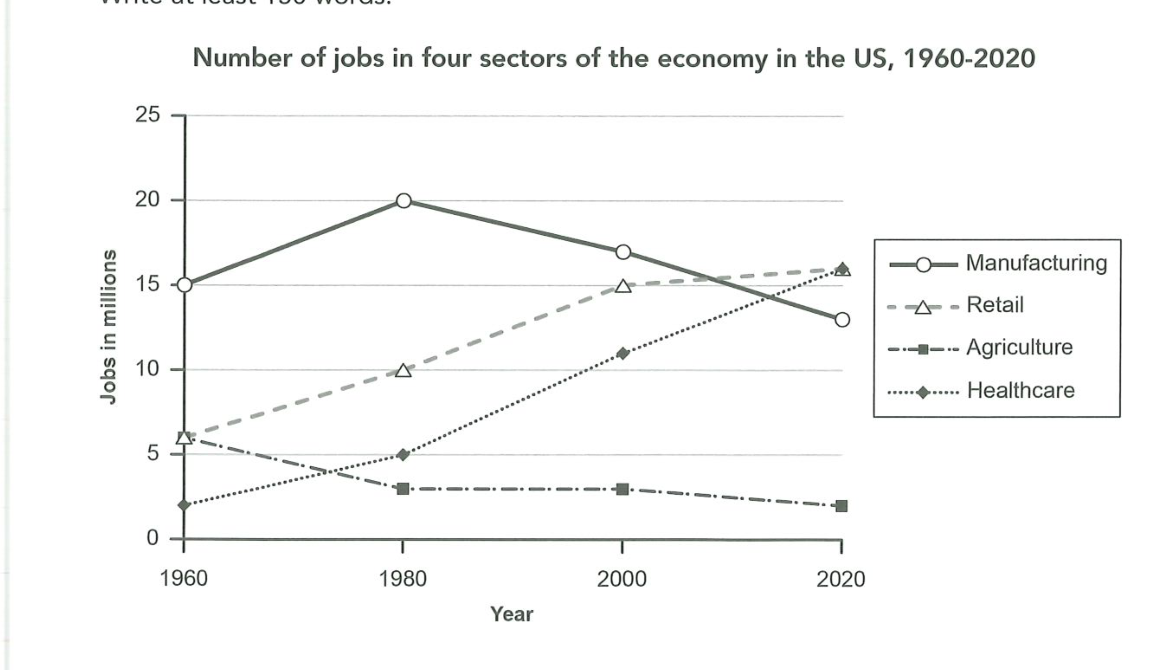
The graph below gives information about the number of jobs in four sectors of the economy in the US between 1960 and 2020.
Summarise the information by selecting and reporting the main features, and make comparisons where relevant.
Number of jobs in four sectors of the economy in the US, 1960-2020
Student answer (Band 5.5)
The line graph gives a data about the numbes of jobs in a diffent organizations in the united states between 1960 and 2020.
overall, the graph shows a riseup as wll as a downfall in differnt sectors over the time.
Manufacturing jobs were 15 millions in 1960 which rise up gradually and reached to 20 million in 1980.While,after thats its start his downfall and decreased to almost 13 million in 2020. Retail jobs were 6 million in 1960 which incresed dramatically over the time and reached to almost 16 milion between 1960 to 2020.;
Agricultural jobs wee 6 million in 1960 which decreased slightly to 4 million between 1960 to 1980 after that its remains unchanged for 20 years and the again slightly decreased to 3 milliion in the mid of 2000 to 2020. Healthcare jobs were at the least point in 1960 which was almost 2 milion but after that its shows a sharply climed over the time and reached to 18 million between 1960 to 2020.
AI examiner evaluation
| Criterion | Band |
|---|---|
| Task Achievement / Task Response | 5.5 |
| Coherence and Cohesion | 5.5 |
| Lexical Resource | 5.0 |
| Grammatical Range and Accuracy | 5.0 |
| Overall | 5.5 |
Task Achievement / Task Response: Band 5.5
You report all four sectors and identify the main contrasting patterns: manufacturing rises before falling, while retail and healthcare grow and agriculture declines. However, the overview is too general (“a riseup as wll as a downfall”) and does not clearly state the key end-point comparison: retail and healthcare both finish at about 16 million, while agriculture is lowest. Some figures and periods are inaccurate or unclear: agriculture is about 3 million in 1980 and 2000, then 2 million in 2020, rather than 4 and 3; healthcare ends at about 16 million, not 18. Phrases such as “between 1960 to 2020” also obscure when changes occurred. Select the most important comparisons and report the approximate values accurately to make the summary more complete and clear.
Coherence and Cohesion: Band 5.5
The response has a basic overall structure, moving from an introduction and overview to descriptions of the four sectors. This makes the information broadly followable. However, progression within the body is weakened by long, crowded sentences and inconsistent punctuation, such as “1980.While,after thats its start his downfall,” and the semicolon after the retail description. Linking words are sometimes used mechanically or inaccurately: “While” does not connect the manufacturing clauses correctly, and “after that” is repeated without always clarifying the time sequence. Grouping the rising sectors together and the declining sector separately, with clear time markers such as “by 1980” and “thereafter,” would create a more logical flow and make comparisons easier to follow.
Lexical Resource: Band 5.0
You use some relevant vocabulary for describing trends, including “decreased,” “unchanged,” and “reached,” so the reader can recognise the intended patterns. However, the range is limited and several choices are inaccurate or informal for an academic report. “Riseup,” “downfall,” and “climed” are not appropriate forms in this context, while “dramatically” and “sharply” are used without precise support. Spelling errors such as “numbes,” “diffent,” “incresed,” and “milliion” are frequent enough to distract. Aim for a small, accurately spelled set of trend verbs and nouns, and use them consistently—for example, “increased,” “declined,” “peaked,” and “employment.”
Grammatical Range and Accuracy: Band 5.0
You attempt to combine information in longer sentences, but control is inconsistent, and errors often make relationships between figures and time periods difficult to interpret. Examples include “Manufacturing jobs were 15 millions … which rise up,” where the tense and plural form are faulty, and “after thats its start his downfall,” which has problems with pronouns, verb form, and sentence construction. Articles and prepositions are also unreliable, as in “a data” and “between 1960 to 2020.” Punctuation and spacing errors, including “1980.While,” further affect readability. Practise accurate past-tense reporting and simple comparative structures first, then add subordinate clauses only when you can control their grammar and punctuation.
See this exact question answered at other band scores. The same prompt compared across bands.
Browse more IELTS Writing model answers or get your own writing scored by the same AI examiner.