Band 6.0 IELTS Writing Task 1 Model Answer
Overall Band Score: 6.0 · Cambridge IELTS 21 · 2026-11-05
IELTS Writing Task 1 question
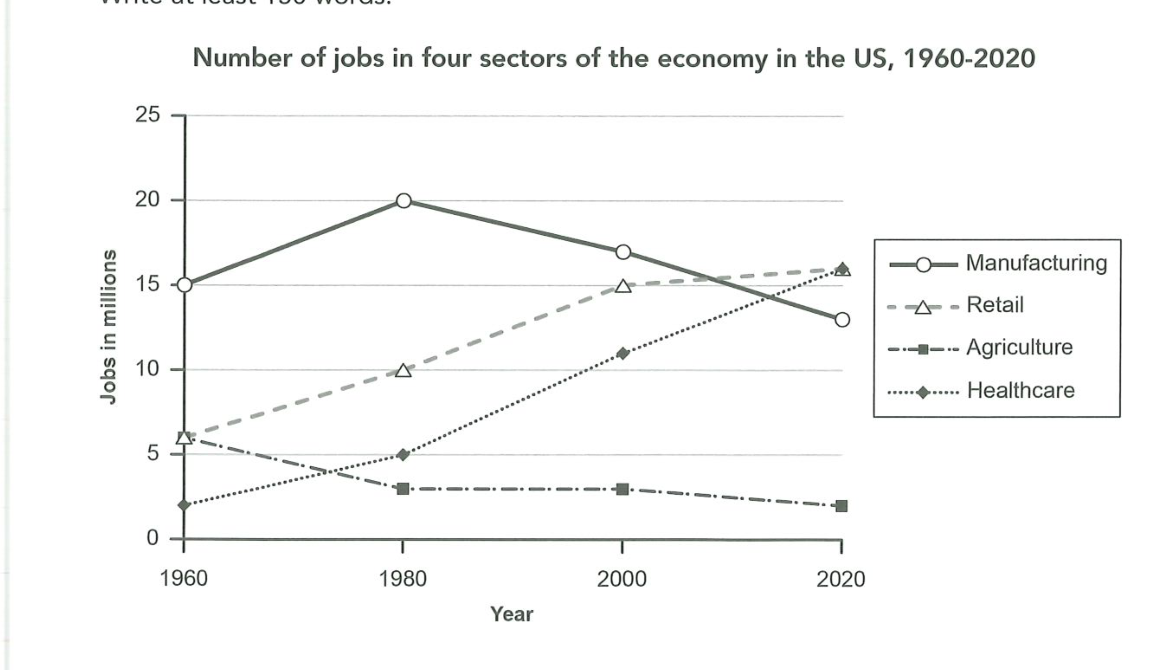
The graph below gives information about the number of jobs in four sectors of the economy in the US between 1960 and 2020.
Summarise the information by selecting and reporting the main features, and make comparisons where relevant.
Number of jobs in four sectors of the economy in the US, 1960-2020
Student answer (Band 6.0)
This line graph illustrates the evolution of jobs in economics four sectors in the US between 1960 and 2020.
This graph differentiates between four sectors of economy on the basis of job. Retail and agriculture was having same number of jobs in 1960. However, retailing sector gradually increased and become the most demanded sector at the enf of 2020 where as, agriculture faced downfall till 2020 and had a small ratio of job.
In 1960, healthcare sector was not reknown occupation but with the time it raised its worth and compete with the retailing sector. In contrast, manufacturing was on the lead in 1960 and increased till 1980 then suddenly it faced downfall till the end of 2020 and lost its worth.
To sum up all, this line chart illustrates that the employment rate depends on the economical needs in relevant year. From 1960 to 2020 every sector has vary from lower rate to higher rate and vice versa.
AI examiner evaluation
| Criterion | Band |
|---|---|
| Task Achievement / Task Response | 6.0 |
| Coherence and Cohesion | 6.0 |
| Lexical Resource | 5.5 |
| Grammatical Range and Accuracy | 5.5 |
| Overall | 6.0 |
Task Achievement / Task Response: Band 6.0
You identify several important trends: manufacturing peaks in 1980 before declining, agriculture falls overall, and healthcare rises to match retail by 2020. These points are broadly consistent with the graph, and the response covers all four sectors. However, the overview is not sufficiently precise: saying every sector varied “from lower rate to higher rate and vice versa” does not clearly summarise the contrasting patterns. Some details are also unclear or inaccurate. Retail and agriculture begin at the same level, but retail does not become the sole leading sector in 2020; it ties with healthcare at about 16 million. Healthcare is described as competing with retail, but its rise and final equality could be stated more directly. Select the main comparisons and report them accurately with key figures.
Coherence and Cohesion: Band 6.0
The response has a recognisable structure, moving from an introduction to sector comparisons and then a concluding statement. Paragraphing helps separate the information, and connectors such as “However” and “In contrast” signal relationships between trends. At times, though, the progression is less clear because several sectors are grouped together without a consistent comparison, and the final paragraph repeats the general idea of change rather than adding a useful overview. Some linking is also mechanical, while references such as “it” in the healthcare and manufacturing discussion require the reader to infer the sector being discussed. Organise the body into clearer comparisons—for example, rising sectors versus declining sectors—and use explicit references to maintain a smoother progression.
Lexical Resource: Band 5.5
You attempt a range of vocabulary relevant to describing trends, including “gradually increased,” “faced downfall,” “on the lead,” and “compete.” This shows an effort to move beyond basic repetition, and the general meaning is usually understandable. However, several choices are inaccurate or unnatural for graph description: “jobs in economics four sectors,” “most demanded sector,” and “lost its worth” do not express employment figures precisely. There are also spelling errors such as “enf” and “reknown,” alongside awkward phrases such as “small ratio of job.” Use standard collocations for data, such as “number of jobs,” “employment,” “rose,” “declined,” and “the largest employer,” and check spelling and word forms carefully.
Grammatical Range and Accuracy: Band 5.5
You use both simple statements and longer sentences with contrast, as in “In contrast, manufacturing was on the lead in 1960 and increased till 1980 then suddenly it faced downfall.” This gives the response some structural variety, and the main message can generally be followed. Some grammatical errors remain, particularly with agreement, tense, articles, and sentence construction. For example, “Retail and agriculture was having” should use a plural subject and a more suitable past form; “every sector has vary” is not a correct verb construction; and “increased till 1980 then suddenly it faced” needs clearer punctuation and coordination. Aim for accurate past-tense reporting throughout, and separate linked clauses with appropriate punctuation. More controlled complex sentences would improve clarity.
See this exact question answered at other band scores. The same prompt compared across bands.
Browse more IELTS Writing model answers or get your own writing scored by the same AI examiner.