Band 5.5 IELTS Writing Task 1 Model Answer
Overall Band Score: 5.5 · Cambridge IELTS 21 · 2026-11-05
IELTS Writing Task 1 question
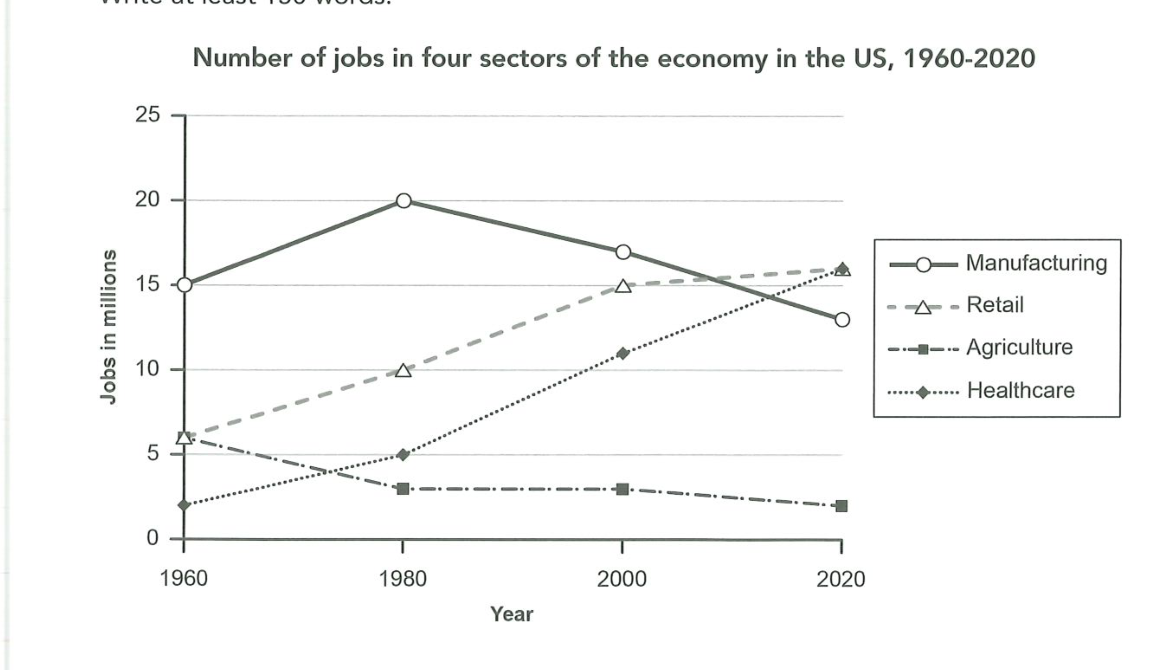
The graph below gives information about the number of jobs in four sectors of the economy in the US between 1960 and 2020.
Summarise the information by selecting and reporting the main features, and make comparisons where relevant.
Number of jobs in four sectors of the economy in the US, 1960-2020
Student answer (Band 5.5)
The graph illustrates between no. of jobs in millions and four different sectors manufacturing, retails, agriculture and healthcare in USA, [redacted phone].
In graph vertical line represent the no. of jobs in millions in which 0 million is minimum and 25 million is maximum and Horizontal represents the years from 1960 to 2020.
The manufacturing indusrty in 1960 is 15 millions and in 1980 is 20 millions which is highest among of them. Retails and agriculture are in 1960 is same around 6 millions but retail industry grew upto 16 millioons after 2020 and agriculture industry was getting down until 2.5 millions. Healthcare industry in 1960 was minimum around 2.5 millions but after the time period it grows and reached 16 million in 2020 as same like retail industy both are same at this year and highest economy industy in 2020.
Overall the economy of USA in different industy was differ over the time period.
AI examiner evaluation
| Criterion | Band |
|---|---|
| Task Achievement / Task Response | 5.5 |
| Coherence and Cohesion | 5.5 |
| Lexical Resource | 5.0 |
| Grammatical Range and Accuracy | 5.0 |
| Overall | 5.5 |
Task Achievement / Task Response: Band 5.5
You identify several important patterns: manufacturing peaks at 20 million in 1980, agriculture declines, and healthcare and retail both reach about 16 million by 2020. These details show a relevant attempt to summarise the graph. However, the overview is too vague: “the economy … was differ over the time period” does not clearly state the main contrast between declining manufacturing and agriculture and the growth of retail and healthcare. Some figures are also imprecise or inaccurate: agriculture is about 2 million in 2020, not 2.5 million, and the response does not report manufacturing’s fall to about 13 million by 2020. Develop a clearer overview and compare the sectors’ overall directions, using the key figures to support it.
Coherence and Cohesion: Band 5.5
The response has a basic sequence: it introduces the graph, describes the axes, reports sector details, and ends with an overview. This gives the reader some organisation, and the comparisons between manufacturing and the other sectors are relevant. However, the progression is not consistently clear because the axis explanation takes space without advancing the summary, while several trends are crowded into one long paragraph. The final overview is too general to bring the main points together. Use distinct paragraphs for the introduction, overview, and key details, and group related trends—for example, the two growing sectors together and the declining sectors together. Clearer sentence boundaries and more precise links between comparisons would make the information easier to follow.
Lexical Resource: Band 5.0
You use relevant topic vocabulary such as “manufacturing,” “agriculture,” “healthcare,” “grew,” and “reached,” so the reader can identify the sectors and their broad movements. However, the range is limited and several word choices or forms are inaccurate, including “retails,” “industy,” and “highest economy industy.” Phrases such as “getting down” and “same like” are informal or unnatural for an academic graph summary, and “different industy” is too vague to describe the trends. These errors sometimes make the intended comparison less clear. Aim for precise trend language and accurate sector names, such as “declined,” “rose steadily,” “remained level,” and “the largest employment sector.”
Grammatical Range and Accuracy: Band 5.0
The response attempts both simple statements and longer sentences, and the reader can generally understand the main trends. However, the range is limited, and complex sentences are often faulty. For example, “Retails and agriculture are in 1960 is same” has incorrect verb structure and agreement, while “the manufacturing indusrty in 1960 is 15 millions” uses an unsuitable tense and number form. The sentence beginning “Healthcare industry in 1960 was minimum” also lacks a clear grammatical comparison, and the final sentence has errors in verb form and agreement. Use past-tense reporting consistently, check singular and plural forms, and divide long sentences into shorter, complete statements. Practising accurate comparative structures would improve control.
See this exact question answered at other band scores. The same prompt compared across bands.
Browse more IELTS Writing model answers or get your own writing scored by the same AI examiner.