Band 5.0 IELTS Writing Task 1 Model Answer
Overall Band Score: 5.0 · Cambridge IELTS 21 · 2026-11-06
IELTS Writing Task 1 question
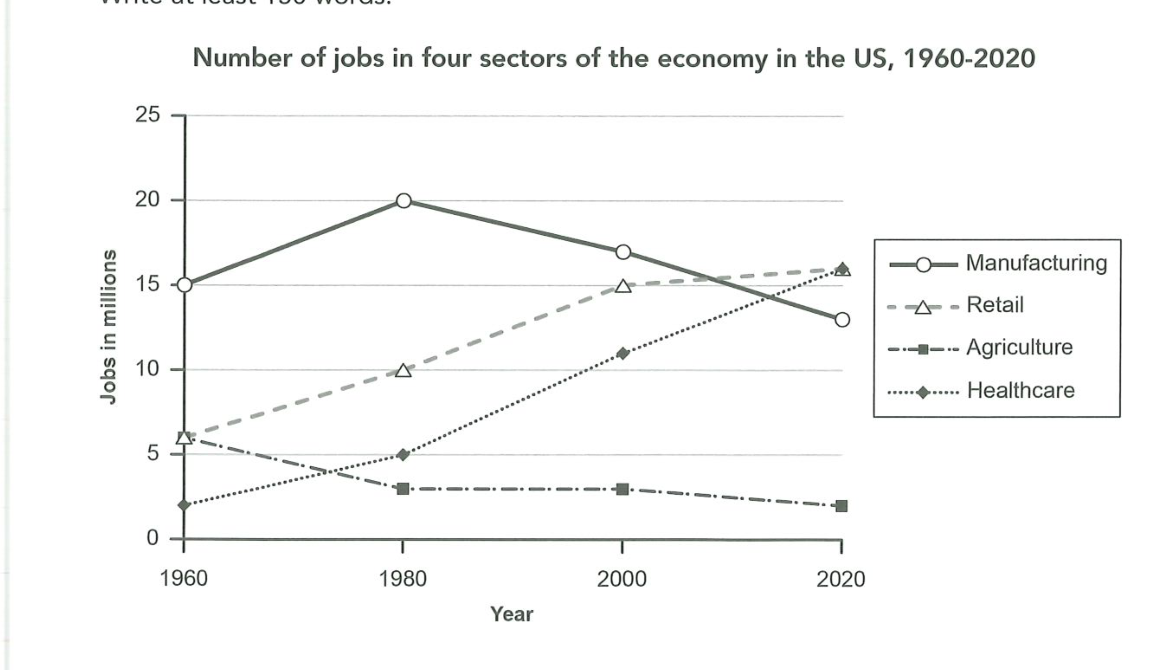
The graph below gives information about the number of jobs in four sectors of the economy in the US between 1960 and 2020.
Summarise the information by selecting and reporting the main features, and make comparisons where relevant.
Number of jobs in four sectors of the economy in the US, 1960-2020
Student answer (Band 5.0)
The line chart is about the economy as well as the number of jobs in four sectors in the US between 1960 and 2020. we have the 4 sectors that is Manufacturing, retail, Agriculture and Healthcare.
Firstly, we have the number of years 1960 to 2020 and the number of jobs in millions which start from 0 and it will go on 25 million jobs in certain years. In 1960, the number of jobs is limited in Healthcare that is around 3 million jobs but after 1960 it will gradually increase after every 10 years. On the other hand, Agriculture sector is decreasing every 10 years like; 6 million jobs in 1960 and it will gradually decrease. In addition to this, Retail sector is increasing and it has no decline between 1960 to 2020. Moreover, Manufacturing sector is increasing from 15 million jobs and also increase in 1980 and then decline.
AI examiner evaluation
| Criterion | Band |
|---|---|
| Task Achievement / Task Response | 5.0 |
| Coherence and Cohesion | 5.5 |
| Lexical Resource | 5.0 |
| Grammatical Range and Accuracy | 5.0 |
| Overall | 5.0 |
Task Achievement / Task Response: Band 5.0
You identify all four sectors and report several broad trends that match the chart: healthcare and retail rise, agriculture falls, and manufacturing peaks before declining. However, the response only partly summarises the main features. It gives no clear overall overview, and several trends are vague: for example, healthcare rises from about 2 million in 1960 to around 16 million in 2020, while retail reaches a similar level by the end. The statement that healthcare increases “after every 10 years” is not precise, since the chart shows four points spaced 20 years apart. Include key comparisons and selected figures, and make the overall pattern explicit rather than describing the axes or listing sectors.
Coherence and Cohesion: Band 5.5
The response has a basic sequence, moving from an introduction to descriptions of individual sectors, and linking phrases such as “On the other hand” and “Moreover” help signal shifts. However, the progression is not consistently clear: the opening paragraph combines the topic with a list of sectors, while the next begins by describing the axes rather than presenting an overview. The sector details are also compressed into one paragraph, with limited comparison between them. Some linking is mechanical, particularly the repeated use of “In addition to this” and “Moreover.” Organise the report into a clear introduction, an overview of the main trends, and grouped detail paragraphs, using links only where they clarify relationships.
Lexical Resource: Band 5.0
You use relevant topic vocabulary, including “sectors,” “Manufacturing,” “Agriculture,” and “decline,” so the reader can generally understand which trends you mean. However, the range is limited and several expressions are imprecise or repetitive. “The number of years 1960 to 2020” does not accurately describe the horizontal axis, and “the number of jobs is limited in Healthcare” is an awkward way to describe the lowest starting figure. Repeated forms of “increase” and “decrease” also make the account less precise. Use vocabulary suited to describing data, such as “employment,” “rose steadily,” “fell,” “peaked,” and “remained stable,” and choose phrases that clearly distinguish a sector’s job total from the chart’s time scale.
Grammatical Range and Accuracy: Band 5.0
The response communicates its basic meaning through mostly simple sentences and some attempts at longer structures. However, grammatical errors are frequent, and the longer constructions are often not controlled. For example, “we have the 4 sectors that is” has a subject–verb agreement error, while “it will gradually increase” uses an unsuitable future form to describe historical data. The sentence beginning “In 1960, the number of jobs is limited” also shifts into the present tense, and “and also increase in 1980” is incomplete as a clause. Capitalisation is inconsistent, including the lowercase opening “we.” Use past-tense verbs consistently for the historical figures, check agreement, and build complete sentences with clear subjects and verbs.
See this exact question answered at other band scores. The same prompt compared across bands.
Browse more IELTS Writing model answers or get your own writing scored by the same AI examiner.