Band 6.0 IELTS Writing Task 1 Model Answer
Overall Band Score: 6.0 · Cambridge IELTS 21 · 2026-11-06
IELTS Writing Task 1 question
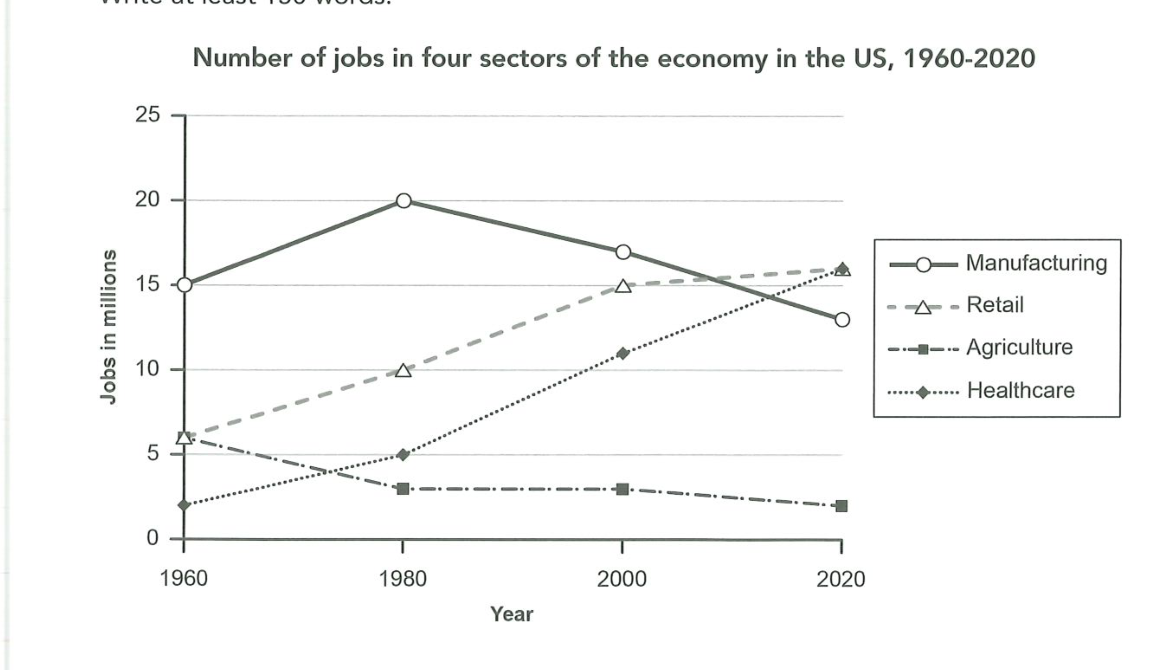
The graph below gives information about the number of jobs in four sectors of the economy in the US between 1960 and 2020.
Summarise the information by selecting and reporting the main features, and make comparisons where relevant.
Number of jobs in four sectors of the economy in the US, 1960-2020
Student answer (Band 6.0)
The line graph illusrtrates the number of job in four sectors of the economy in the U.S from 1960 to 2020.
Overall, it clear that more people workeed in manufacturing and took at hight point, then decline significantly, while, the retail and the healthcare went up gradually over the years.
The data are measured by million.
On the one hand, the number of manufacturing job went up from 15 million in 1960 to 20 million in 1980. Then it went down to around 13 milion in 2020. While the number of retail job rose roughly 6 million in 1960 to 15 million in 2000, then it increased minimally around 16 million in 2020.
On the other hand, the agriculture stood at roughly 6 million in 1960, then it droped to around 4 million in 1980 and minimaly declined at 2 million in 2020. Whereas, the healthcare stood at 2 million in 1960, following this it rise minimally reached at 16 million in 2020.
AI examiner evaluation
| Criterion | Band |
|---|---|
| Task Achievement / Task Response | 6.0 |
| Coherence and Cohesion | 6.0 |
| Lexical Resource | 5.5 |
| Grammatical Range and Accuracy | 5.5 |
| Overall | 6.0 |
Task Achievement / Task Response: Band 6.0
You identify the main broad patterns: manufacturing reaches a peak before declining, while retail and healthcare rise, and agriculture falls. The response also includes relevant figures, such as manufacturing at 15 million in 1960 and 20 million in 1980, and healthcare rising from 2 to 16 million. However, some details are incomplete or inaccurate: manufacturing is reported as falling to 13 million without noting its intermediate level of 17 million in 2000, and agriculture is given as about 4 million in 1980 rather than 3 million. The overview also says retail and healthcare rose “gradually,” which understates healthcare’s substantial growth. A clearer overview and more precise comparisons across the four years would make the key features more fully developed.
Coherence and Cohesion: Band 6.0
The response has a clear overall structure: an introduction, an overview, and two body paragraphs grouping manufacturing with retail and agriculture with healthcare. This makes the information easy to follow. Linking phrases such as “On the one hand” and “On the other hand” help signal the shift between groups, although the contrast they imply is not always meaningful, and “While” and “Whereas” are sometimes used mechanically. The overview is separated from the details, but the sentence about measurement interrupts the summary rather than fitting naturally into the introduction. To improve progression, organise the overview around the main contrasts, then compare related trends directly within the body paragraphs and use referencing that clearly identifies each sector.
Lexical Resource: Band 5.5
You use relevant task vocabulary, including “rose,” “decline,” “stood at,” and “reached,” and the reader can generally understand the trends you describe. However, the range is somewhat repetitive, and several word choices or collocations are imprecise: “took at hight point” is unclear, “declined at 2 million” is not a natural way to report a final figure, and “increased minimally” understates the rise in healthcare. There are also spelling errors, including “illusrtrates,” “milion,” and “minimaly,” which reduce accuracy. Aim for precise trend language and check spelling carefully; for example, distinguish a peak from a general rise and use “fell to” when giving a final value.
Grammatical Range and Accuracy: Band 5.5
You attempt a mix of sentence forms, including clauses beginning with “while” and “whereas,” and most of the intended comparisons remain understandable. Some grammatical errors, however, recur in basic sentence patterns. For example, “Overall, it clear” needs a verb, and “the number of job … went up” requires a plural noun and more accurate agreement. In “the healthcare stood at 2 million … following this it rise,” the verb form and sentence connection are faulty. Several clauses beginning with “While” or “Whereas” are left as fragments rather than joined to a complete main clause. Practise accurate subject–verb agreement, past-tense forms, articles and plural nouns, and punctuate dependent clauses as part of complete sentences.
See this exact question answered at other band scores. The same prompt compared across bands.
Browse more IELTS Writing model answers or get your own writing scored by the same AI examiner.