Band 5.0 IELTS Writing Task 1 Model Answer
Overall Band Score: 5.0 · Cambridge IELTS 21 · 2026-11-08
IELTS Writing Task 1 question
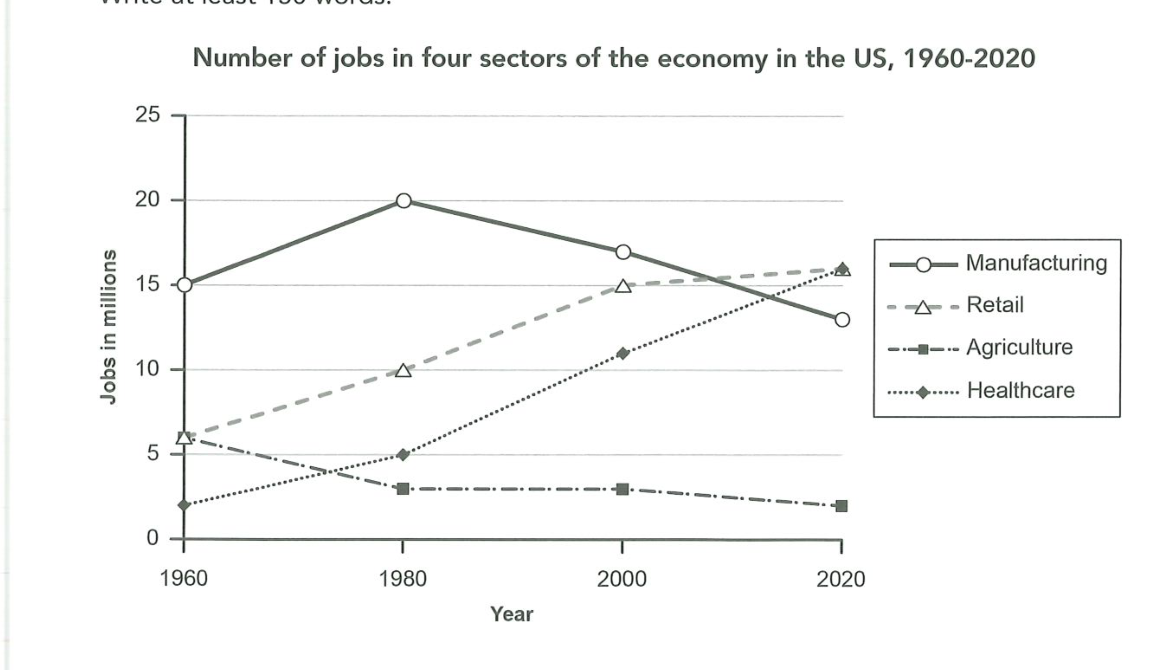
The graph below gives information about the number of jobs in four sectors of the economy in the US between 1960 and 2020.
Summarise the information by selecting and reporting the main features, and make comparisons where relevant.
Number of jobs in four sectors of the economy in the US, 1960-2020
Student answer (Band 5.0)
In report we elobrate the number of jobs in four sectors of the economy in US between 1960 to 2020. these jobs are Manufacturing,Retail,Agriculture and Healthcare.
In 1960, manufacturing had most number of jobs around 15 millions and least for healthcare which was around 3 millions and in agriculture and retail most had same numbers of jobs around 6 millions .
In manufacturing the number of jobs increase to 20 million in year 1980 after that it was start decreasing and reached at 13 million in year 2020.
In healthcare department the number of jobs increases every year and in 2020 the number of jobs was around 16 millions .
The number of jobs decreases gradually in agricultural department and in year 2020 the number of jobs was arond 3 million which was the least number of jobs amoung these four.
in retail , in reached at 16 million jobs in year 2020 which was the joined highest number of jobs between retail and health care .
AI examiner evaluation
| Criterion | Band |
|---|---|
| Task Achievement / Task Response | 5.0 |
| Coherence and Cohesion | 5.5 |
| Lexical Resource | 5.0 |
| Grammatical Range and Accuracy | 5.0 |
| Overall | 5.0 |
Task Achievement / Task Response: Band 5.0
You identify all four sectors and report several key movements, including manufacturing peaking at about 20 million in 1980 and then falling, and healthcare rising to about 16 million by 2020. You also note that agriculture ends as the smallest sector. However, the response only partly summarises the graph: it lacks a clear overall overview of the contrasting trends and gives limited comparisons across the period. Some details are inaccurate: healthcare began at about 2 million, not 3 million, and agriculture ended at about 2 million, not 3 million. Retail and healthcare were joint highest in 2020, which you correctly report. A clearer overview and more accurate, selective comparisons would strengthen the report.
Coherence and Cohesion: Band 5.5
The response follows a generally understandable sequence, moving from the 1960 figures to changes in manufacturing, healthcare, agriculture and retail. This gives the reader a basic sense of how the sectors changed. However, the information is presented as a series of separate statements rather than grouped into a clear overview and logically organised detail paragraphs. Connections between trends are limited, and phrases such as “after that” and repeated openings with “In…” make the progression somewhat mechanical. The final retail point is also compressed and awkwardly linked to the preceding information. Grouping the rising sectors together and the declining sectors together, with a concise overview first, would make the organisation clearer.
Lexical Resource: Band 5.0
You use relevant topic vocabulary, including “number of jobs,” “increases,” “decreases gradually,” and “highest,” so the main trends are usually understandable. However, the range is limited and several word choices or collocations are unnatural, such as “most number of jobs,” “healthcare department,” and “joined highest.” There are also noticeable spelling errors, including “elobrate,” “arond,” and “amoung,” which reduce the accuracy and polish of the report. Aim for precise chart language and check spelling carefully; for example, use “the largest number of jobs,” “healthcare sector,” and “joint highest.” This would make the description more natural and easier to follow.
Grammatical Range and Accuracy: Band 5.0
You communicate the main points using simple sentences and make some attempts to link clauses, as in “In manufacturing the number of jobs increase to 20 million… after that it was start decreasing.” However, verb forms and sentence construction are frequently inaccurate: “increase” should be “increased,” and “it was start decreasing” needs a correct past-tense form such as “it then began to decline.” There are also problems with articles, plurals and punctuation, for example “In report,” “15 millions,” and missing spaces after commas. Most sentences rely on basic patterns, so the range is limited, and errors sometimes make the reader pause. Practise accurate past-tense descriptions and build controlled comparisons using clauses such as “while” and “whereas.”
See this exact question answered at other band scores. The same prompt compared across bands.
Browse more IELTS Writing model answers or get your own writing scored by the same AI examiner.