Band 6.0 IELTS Writing Task 1 Model Answer
Overall Band Score: 6.0 · Cambridge IELTS 21 · 2026-11-08
IELTS Writing Task 1 question
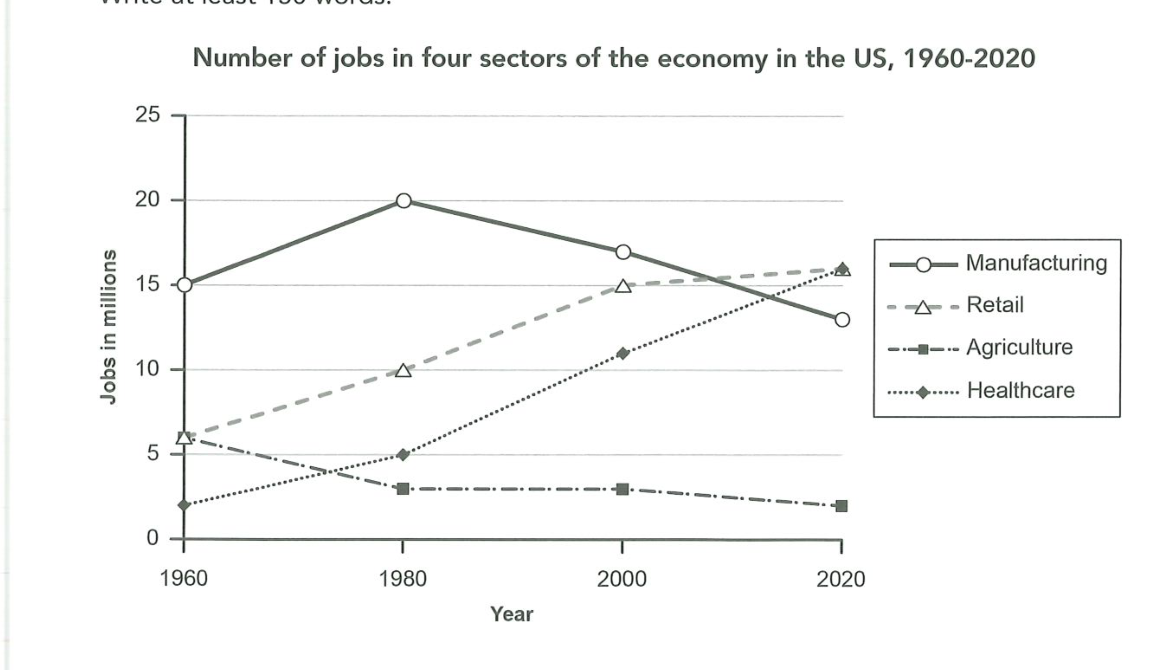
The graph below gives information about the number of jobs in four sectors of the economy in the US between 1960 and 2020.
Summarise the information by selecting and reporting the main features, and make comparisons where relevant.
Number of jobs in four sectors of the economy in the US, 1960-2020
Student answer (Band 6.0)
The illustration shows the information about jobs in different fields from 1960 to 2020. Overall, healthcare and retailing secured the highest point among the other field jobs, while on the hand argriculture found the lowest point.
It is quite evident from the line chart that numbers of jobs in three different sectors which is manufacturing , retail and healthcare were increasing from 1960 to 1980, whereas, in between 1960 and 1980, the argicultural jobs were drcreasing and became nearly half in 1980.
In 1960, healthcare had having the lowest jobs round about 2.5 million jobs and manufacturing had having the highest of 15 millions job, whereas, argriculture and retail both were having nearly 5 million jobs.
Furthermore, after the 1980 the job in manufacturing industry was declining significantly and jobs were about constant in the argriculture field. On the other side, we witnessed a lot of new jobs in the sector of retailing and healthcare. In 2020, both were having almost 16 millions jobs.
AI examiner evaluation
| Criterion | Band |
|---|---|
| Task Achievement / Task Response | 6.5 |
| Coherence and Cohesion | 6.5 |
| Lexical Resource | 5.5 |
| Grammatical Range and Accuracy | 5.5 |
| Overall | 6.0 |
Task Achievement / Task Response: Band 6.5
You identify the main broad patterns: manufacturing peaks before declining, agriculture falls and remains low, and retail and healthcare rise to about 16 million by 2020. The overview also recognises agriculture as the smallest sector. These are relevant features, and the final comparison is accurate. However, some details are unclear or imprecise: the claim that manufacturing, retail and healthcare all increased from 1960 to 1980 overlooks that manufacturing later falls, while the description of agriculture as “nearly half” does not specify its approximate change from 6 to 3 million. The overview could more clearly state the contrasting long-term trends and identify the leading sectors at the end. More precise comparisons across the four dates would make the report more complete.
Coherence and Cohesion: Band 6.5
The response has a recognisable structure: an introduction and overview are followed by details for the early period and then the later years. This gives the reader a generally coherent route through the chart, and connectors such as “Furthermore” and “On the other side” signal relationships between points. Some progression is less clear, however. The second paragraph combines a broad trend with the 1960 figures, and “whereas” is used repeatedly, making the links feel mechanical. The phrase “after the 1980” also leaves the time period less precise than it could be. Grouping the information consistently—for example, early figures first, then changes from 1980 to 2020—would strengthen the logical flow and make comparisons easier to follow.
Lexical Resource: Band 5.5
You use relevant chart vocabulary, including “line chart,” “declining,” “constant,” and “sector,” so the meaning is generally recoverable. There are also attempts to vary wording, such as “a lot of new jobs.” However, several word choices and collocations are noticeably inaccurate or unnatural: “secured the highest point,” “on the hand,” and “had having” do not express the intended comparisons naturally. Spelling errors such as “argriculture,” “drcreasing,” and “argicultural” also reduce accuracy. Use standard terms such as “number of jobs,” “rose,” “fell,” and “remained stable,” and check spelling carefully. More precise vocabulary for trends and comparisons would improve clarity and control.
Grammatical Range and Accuracy: Band 5.5
You attempt both simple and complex sentences, including a contrast with “whereas” and a time clause beginning “after.” The overall meaning is usually understandable, but errors in verb forms, agreement, articles, and sentence construction remain noticeable. For example, “healthcare had having” and “manufacturing had having” use an incorrect verb pattern; “numbers of jobs … which is” has a number-agreement problem; and “both were having” is not an appropriate construction for reporting chart figures. Some punctuation and spacing around commas are also inconsistent. Practise concise reporting structures such as “Healthcare had about two million jobs” and “Both sectors reached approximately 16 million.” Greater accuracy in these common patterns would make your range more effective.
See this exact question answered at other band scores. The same prompt compared across bands.
Browse more IELTS Writing model answers or get your own writing scored by the same AI examiner.