Band 6.0 IELTS Writing Task 1 Model Answer
Overall Band Score: 6.0 · Cambridge IELTS 21 · 2026-11-08
IELTS Writing Task 1 question
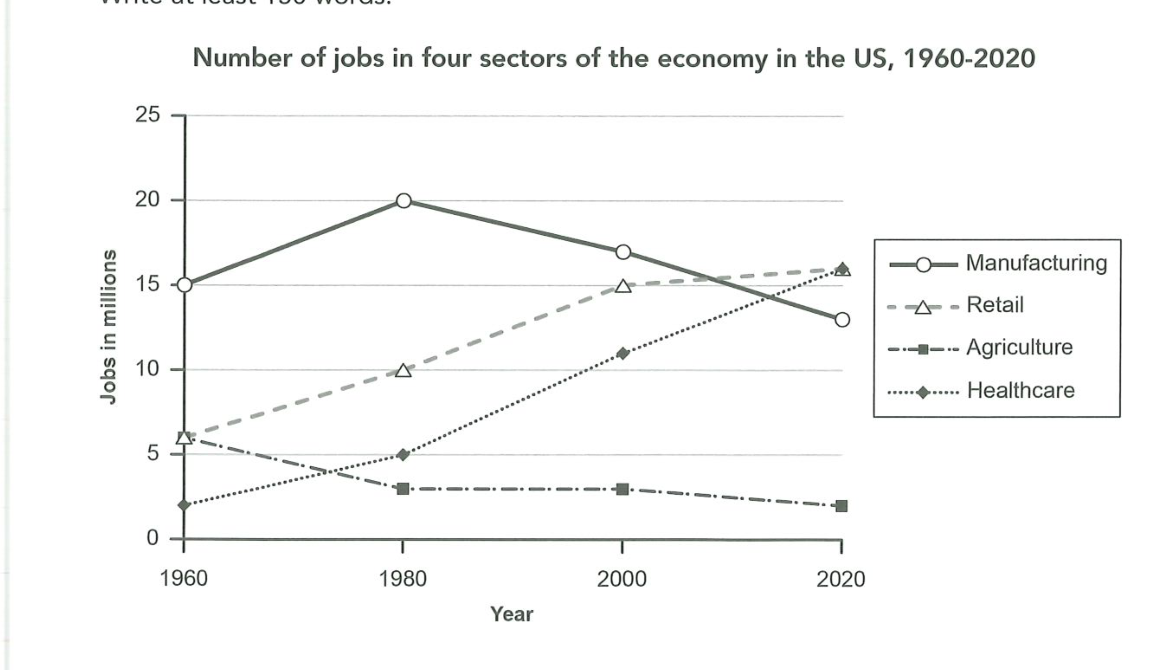
The graph below gives information about the number of jobs in four sectors of the economy in the US between 1960 and 2020.
Summarise the information by selecting and reporting the main features, and make comparisons where relevant.
Number of jobs in four sectors of the economy in the US, 1960-2020
Student answer (Band 6.0)
The graph illustrates the details about the jobs in four sectors of the economy in the US from the time period from 1960 to 2000. Overall, the chart shows fluctuation across different sectors with retail and healthcare departments surging. While, manufacturing and agriculture plummeting.
From the time period of 1960 to 1980, manufacturing, retail, healthcare departments show a steady increase in the number of jobs. With numbers of manufacturing emerging from 15 to 20 and Retail and healthcare emerging to 5 to 10 and 0 to 5 respectively. While agriculture jobs dropped from the start 5 to 2 or 3. But the things changed in upcoming years. Retails and healthcare department keep growing constantly over the years from 1980 to 2020. Retail jobs increased then from 10 to 15 then to 20 at the end in 2020. Healthcare numbers showed the most substantial increase from 5 to 12 or 13 and in 2020 about 16. Whereas, Agriculture numbers keeps decreasing at the end by 2020 they were around 2 or 3. Unlike, others manufacturing which increased by the year 1980 but after that it decreased constantly 20 to 16 or 17 by 2000 and by the end of 2020 it was around 12 or 13.
AI examiner evaluation
| Criterion | Band |
|---|---|
| Task Achievement / Task Response | 6.5 |
| Coherence and Cohesion | 6.0 |
| Lexical Resource | 6.0 |
| Grammatical Range and Accuracy | 5.0 |
| Overall | 6.0 |
Task Achievement / Task Response: Band 6.5
You identify the main contrasting trends: retail and healthcare rise, while agriculture declines, and manufacturing peaks before falling. The overview captures these broad patterns, and the body includes relevant comparisons across the period. Several figures are also close to the chart, such as manufacturing at 15 in 1960 and 20 in 1980, and healthcare reaching about 16 by 2020. However, the opening says the graph covers 1960 to 2000, omitting the final year, and some figures are inaccurate: retail ends at about 16, not 20, and healthcare rises from about 2 to 5 by 1980, not from 0. The overview also calls manufacturing and agriculture both “plummeting,” which overstates their declines. More precise reporting would strengthen an otherwise relevant summary.
Coherence and Cohesion: Band 6.0
The response has a recognisable structure, with an overview followed by a chronological account, and the reader can generally follow the comparisons. Grouping the rising sectors together before discussing agriculture and manufacturing is a useful organising choice. However, progression is sometimes weakened by mechanical or unclear linking, including repeated uses of “While,” “But,” and “Whereas,” and the fragment “Unlike, others manufacturing.” The first body paragraph also moves through several sectors in one long sentence, making the comparisons harder to track. Use clearer paragraphing and topic sentences, and connect each comparison directly to its time period. For example, separate the 1960–1980 changes from the later trends and avoid starting a sentence with an incomplete contrast.
Lexical Resource: Band 6.0
You use a reasonable range of trend vocabulary, including “steady increase,” “dropped,” “keep growing,” and “substantial increase,” which helps describe the graph. Some choices, however, are imprecise or unnatural for this task. “Departments” is not the best label for economic sectors, and “emerging” does not naturally describe job numbers rising. “Plummeting” is too strong for the relatively gradual declines shown, while “the things changed” is vague and informal. There is also inconsistent naming, such as “Retail” and “Retails.” Aim for accurate, consistent terms and collocations that describe the scale and direction of change. This would make the account more precise while retaining its accessible vocabulary.
Grammatical Range and Accuracy: Band 5.0
You attempt a mix of simple and complex sentences, including clauses introduced by “While” and “Whereas,” and the overall meaning is usually recoverable. However, grammatical control is uneven, with errors in sentence formation, agreement, and tense. For example, “While, manufacturing and agriculture plummeting” is a fragment, and “Agriculture numbers keeps decreasing” has subject–verb disagreement. The phrase “from the time period of 1960 to 1980” is also awkwardly constructed, and “they were around 2 or 3” has an unclear reference. Some sentences combine several comparisons without clear grammatical boundaries. Practise complete sentences, consistent past-tense reporting, and accurate agreement; then check punctuation around contrast clauses.
See this exact question answered at other band scores. The same prompt compared across bands.
Browse more IELTS Writing model answers or get your own writing scored by the same AI examiner.