Band 6.5 IELTS Writing Task 1 Model Answer
Overall Band Score: 6.5 · Cambridge IELTS 21 · 2026-11-09
IELTS Writing Task 1 question
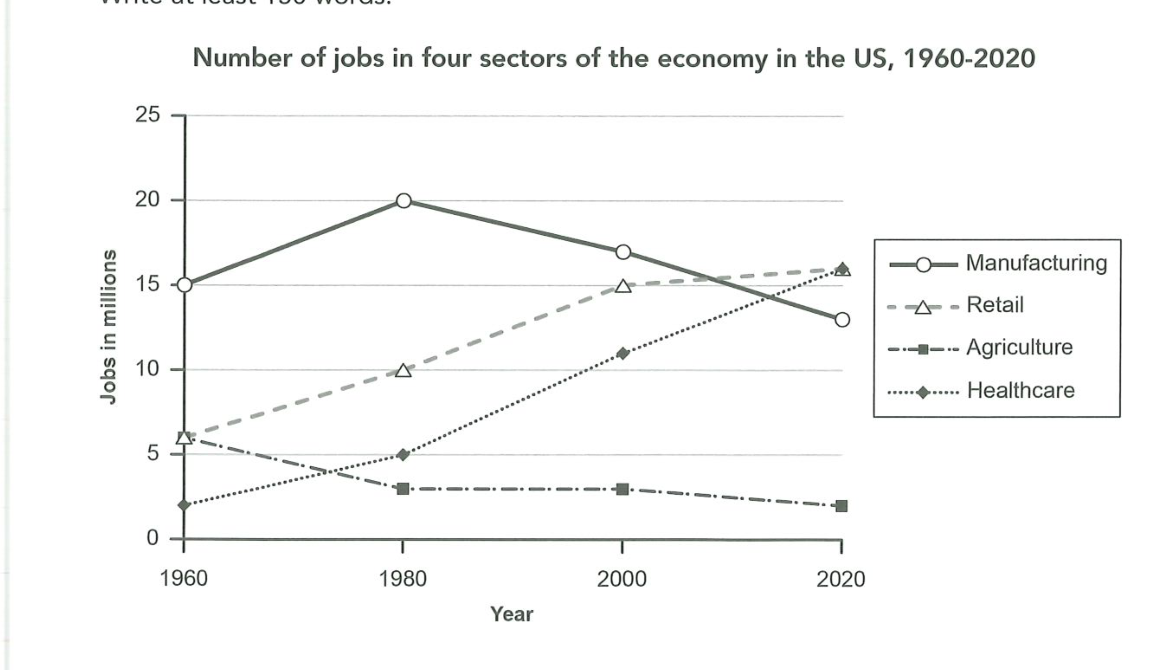
The graph below gives information about the number of jobs in four sectors of the economy in the US between 1960 and 2020.
Summarise the information by selecting and reporting the main features, and make comparisons where relevant.
Number of jobs in four sectors of the economy in the US, 1960-2020
Student answer (Band 6.5)
The line graph illustrated the information about the number of jobs in four sectors namely Manufacturing, Retail, Agriculture and Healthcare in the US between 1960 and 2020.
Overall, Healthcare and Retail sector shared the major contribution in hiring people in the United States. On the other hand, agriculture accounted for the lowest contribution on proving jobs.
One noticeable change was seen in manufacturing industry as they provided 15 million jobs in 1960 and rose to 20 million in 1980 and then they fell dramatically with just 13 million jobs in 2020. Healthcare sector started at giving 2.5 million jobs in 1960 and then escalated to 16 million as equal to retail sector in 2020.
Retail on the other hand, started at providing jobs to 6 million citizens of the United States equal to agriculture at that time in 1960 and then it rose significantly to 16 million in 2020.
In contrary to this, Agriculture as mentioned above started at providing jobs to 6 million people in 1960 and then it substantially dipped to 2 million.
AI examiner evaluation
| Criterion | Band |
|---|---|
| Task Achievement / Task Response | 6.5 |
| Coherence and Cohesion | 6.5 |
| Lexical Resource | 6.0 |
| Grammatical Range and Accuracy | 6.0 |
| Overall | 6.5 |
Task Achievement / Task Response: Band 6.5
You identify the four sectors and give a relevant overview: healthcare and retail become the largest employers by 2020, while agriculture remains the smallest. The manufacturing figures and the broad rise in retail and healthcare are also reported accurately. However, some details are incomplete or imprecise. Healthcare begins at about 2 million, not 2.5 million, and its rise to 16 million is not described by the intermediate stages. Agriculture falls to 3 million by 1980, stays level in 2000, and then reaches 2 million; the response gives only its starting and ending points. The overview also says the two leading sectors shared the major contribution without clarifying that manufacturing led initially and that retail and healthcare reached equal levels at the end. More precise coverage of these changes would strengthen the summary.
Coherence and Cohesion: Band 6.5
The response has a clear overall structure, moving from an introduction and overview to paragraphs describing the sector trends. Comparisons such as retail and agriculture both starting at 6 million, and retail and healthcare ending at 16 million, help connect the information. Some progression is less smooth, however: the manufacturing and healthcare trends are combined in one paragraph, while retail and agriculture are then discussed separately, making the grouping feel somewhat uneven. Linking phrases such as “On the other hand” and “In contrary to this” are used mechanically or awkwardly, and “as mentioned above” refers back without adding much clarity. Grouping the two rising sectors together and the declining sectors together, with clearer references and transitions, would make the organisation more effective.
Lexical Resource: Band 6.0
You use a reasonable range of vocabulary for describing trends, including “rose,” “fell,” “escalated,” “dipped,” and “significantly.” The sector names and employment figures are generally communicated clearly. However, several choices are inaccurate or unnatural for this task: “major contribution in hiring people” and “lowest contribution on proving jobs” do not express employment levels naturally, while “shared” is not the best way to describe the sectors’ equal figures. “Dramatically” also overstates the manufacturing decline, which is a gradual fall across the later years. These issues do not prevent understanding, but more precise collocations and restrained trend language would improve control. Aim to describe the number of jobs directly, rather than framing sectors as making contributions.
Grammatical Range and Accuracy: Band 6.0
You attempt a mix of simple and more complex sentences, including clauses linked with “as” and “and then,” and most of the trends remain understandable. Some grammatical errors and awkward constructions persist. For example, “Healthcare and Retail sector shared” has a subject–verb agreement and article problem; “as equal to retail sector” is not a well-formed comparison; and “In contrary to this” uses an incorrect prepositional pattern. There are also inconsistent pronouns in “manufacturing industry as they provided,” where the singular industry is followed by “they.” Review agreement, articles, and comparison structures, and use punctuation consistently around introductory phrases. More accurate control of these patterns would make the varied sentence forms clearer.
See this exact question answered at other band scores. The same prompt compared across bands.
Browse more IELTS Writing model answers or get your own writing scored by the same AI examiner.