Band 6.0 IELTS Writing Task 1 Model Answer
Overall Band Score: 6.0 · Cambridge IELTS 21 · 2026-11-10
IELTS Writing Task 1 question
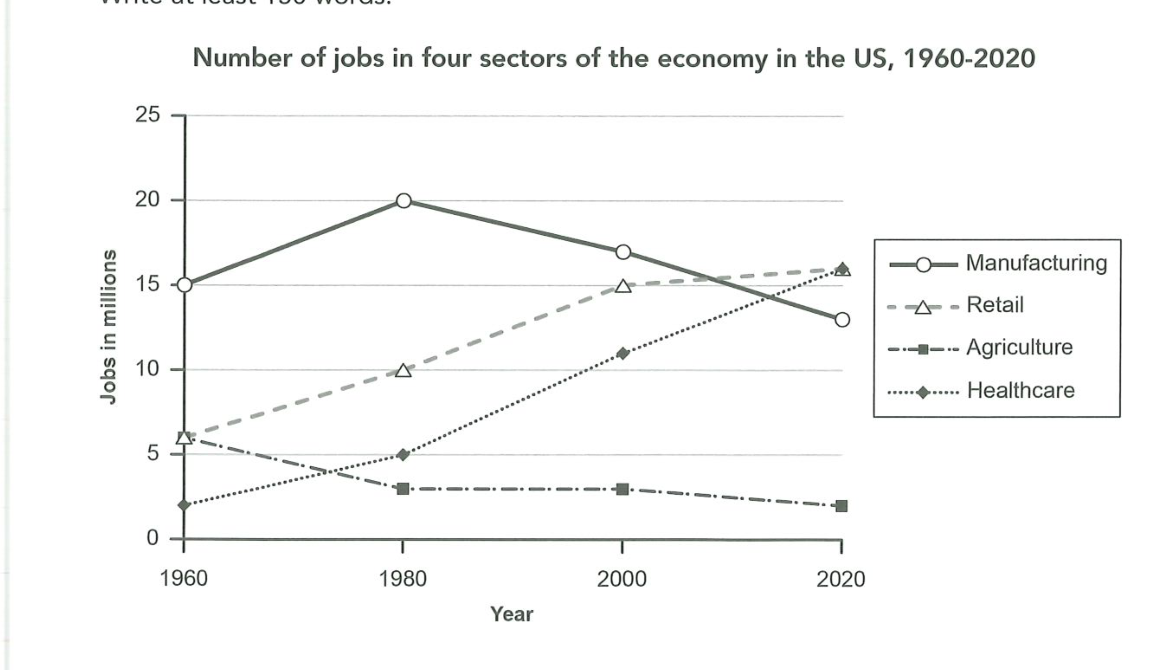
The graph below gives information about the number of jobs in four sectors of the economy in the US between 1960 and 2020.
Summarise the information by selecting and reporting the main features, and make comparisons where relevant.
Number of jobs in four sectors of the economy in the US, 1960-2020
Student answer (Band 6.0)
The given line graph represents the job opportunities present in four sectors of the economy in the US namely manufacturing, retail, agriculture and healthcare in the period of [redacted phone].
Beggining from the manufacturing sector, 15 million jobs were there in year 1960. A positive growth in the job opportunities occured till the year 1980. But afterwards, a countinous downfall was witnessed from [redacted phone]. The number of jobs went about 16 million and then about 9 million from 20 million in the following years 2000 and 2020. In contrast, the number of job opportunities in the field of retail continously inreased from 1960 till the year 2020. From 6 million jobs in 1960 the sector shines by providing16 million jobs in 2020.
Same as that of retail, healthcare sector also provided a wide number of jobs as from about 2 million in 1960 it grows in a constant manner such as 5 million in 1980 then about 11 million in 2000 and lastly 16 million in 2020. In contrast, the agriculture remained declining as starting from 6 million the number reaches about only 2 million job opportunities left in the sector.
AI examiner evaluation
| Criterion | Band |
|---|---|
| Task Achievement / Task Response | 5.5 |
| Coherence and Cohesion | 6.5 |
| Lexical Resource | 5.5 |
| Grammatical Range and Accuracy | 5.5 |
| Overall | 6.0 |
Task Achievement / Task Response: Band 5.5
You identify all four sectors and report several key figures, including manufacturing’s peak of 20 million in 1980 and healthcare’s rise from 2 million to 16 million. However, the response does not give a clear overall summary of the main comparisons—for example, that manufacturing peaked and then declined, while retail and healthcare rose, and agriculture fell. Some figures are inaccurate: manufacturing is about 17 million in 2000 and 13 million in 2020, not 16 and 9 million. The retail trend is described, but its 1980 and 2000 values are omitted. The agriculture account gives the endpoints but not its fall to 3 million by 1980 and subsequent level. These gaps and misreadings leave important features only partly reported.
Coherence and Cohesion: Band 6.5
The response has a coherent overall arrangement: it introduces the graph, then groups manufacturing and retail before discussing healthcare and agriculture. The sequence within each sector is generally chronological, and linking phrases such as “In contrast” help signal comparisons. This clear organisation is a strength. However, the contrast markers are sometimes imprecise: “In contrast” introduces retail after manufacturing, although the comparison is not clearly explained, and it is used again for agriculture without a developed comparison. The response would progress more effectively with a concise overview paragraph followed by grouped details, such as the rising sectors versus the declining ones. Some links between sentences feel mechanical, and the final paragraph combines two trends without a concluding synthesis.
Lexical Resource: Band 5.5
You use enough topic vocabulary to communicate the subject, including “manufacturing,” “agriculture,” “job opportunities,” “growth,” and “declining.” There are also attempts at less common phrasing, such as “a positive growth” and “the sector shines,” but these are not natural or precise in an academic data report. Several spelling errors—“Beggining,” “countinous,” and “inreased”—are noticeable, while “provided a wide number of jobs” is an awkward collocation. Repetition of “number of jobs” and “job opportunities” also limits flexibility. Choose neutral reporting verbs and accurate trend vocabulary, such as “rose,” “peaked,” “fell,” and “remained stable,” and check spelling carefully.
Grammatical Range and Accuracy: Band 5.5
You attempt a mixture of simple and more complex sentences, including clauses beginning with “as” and “such as,” and the main trends are usually understandable. However, errors in verb forms, articles, and sentence construction are frequent enough to affect clarity. For example, “it grows” should be “it grew,” and “the agriculture remained declining” has an incorrect structure; use “agricultural employment continued to decline.” The opening phrase “Beggining from the manufacturing sector” is also an awkward sentence construction, while “from 6 million jobs in 1960 the sector shines by providing16 million jobs” lacks natural grammatical framing and punctuation. Aim for controlled past-tense sentences, with clear subjects and correctly punctuated clauses, before adding more complex structures.
See this exact question answered at other band scores. The same prompt compared across bands.
Browse more IELTS Writing model answers or get your own writing scored by the same AI examiner.